
Big 4 Sports Teams Quiz
How the Scales are Structured
Who Usually Takes This Test?
See How You Compare
Below is a preview of how scores are typically distributed across each scale.
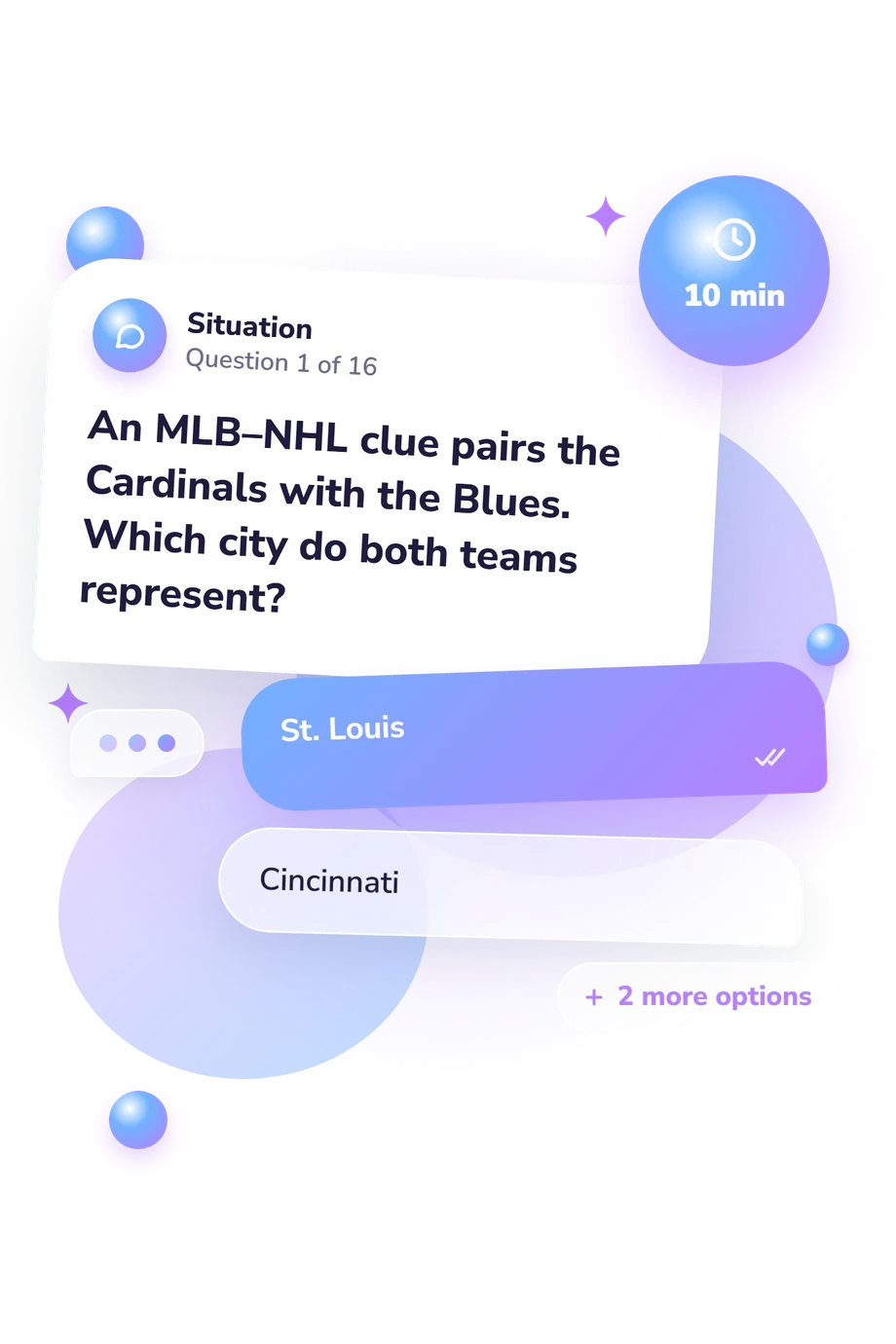
Example Questions From the Test
- St. Louis
- Cincinnati
- Nashville
- Kansas City
- San Jose Sharks
- Los Angeles Kings
- Vegas Golden Knights
- Anaheim Ducks
- Detroit Pistons
- Cleveland Cavaliers
- Indiana Pacers
- Milwaukee Bucks
Big 4 Sports Teams Quiz - Description and methodology of the test
Fans comparing franchises across leagues can use this assessment to test how well they connect teams with shared city and metropolitan identities. This big 4 sports quiz offers a focused check across the four leagues for casual and committed fans alike. It separates team-geography recall from opinions about performance or loyalty. The Big 4 Sports Teams Quiz shows which cross-league relationships feel secure and where regional knowledge needs attention.
What This Assessment Explores
Questions connect MLB, NFL, NBA, and NHL franchises through shared city, metropolitan, or regional identities. Some prompts ask for a missing team in a lineup; others test whether you can distinguish an exact city match from a wider market. The result reflects sports-market geography, not team quality.
Three themes in this big four sports teams quiz shape the result:
- City matching shows whether you connect franchises with the same city identity.
- Market completion measures whether you identify the missing franchise in a four-league grouping.
- Regional grouping tests whether you recognize a broader metropolitan relationship when city labels differ.
The Big 4 Sports Teams Knowledge scale (0-16) uses Starting Lineup (0-6), Developing Knowledge (7-12), and All-Star Knowledge (13-16). The scale reflects recognized Big Four team and market connections rather than general sports intelligence.
Methodology and Scientific Basis
Each item presents a sports-market clue with four answer choices. Clues ask you to select the team, city label, or grouping completing the sports-market clue. The result summarizes the connections recognized in this set.
Methodologically, this is a fixed-response knowledge assessment, not a personality or clinical measure. Performance depends partly on the franchises included and on how respondents understand market boundaries; it checks recall rather than depth of league involvement.
The evidence frame is the Einolf (2012) franchise-placement study, which examines franchise distribution across American markets. Danielson (1997) adds a metropolitan perspective on sports and city identity, while Macdonald and Pulleyblank (2014) discuss realignment and changing franchise geography. The quiz is conceptually consistent with these works, not an adaptation of any one of them.
No standardization is stated for this online questionnaire; scoring reflects recall of presented teams, city labels, and market groupings. This 4 major sports teams quiz tests recall across four leagues, shaped by regional familiarity, memory, and market uncertainty. Use it to spot gaps and explore further. This big 4 teams quiz supports self-reflection, not broad expertise.
- Einolf, Karl W. (2012). Location, Location, Location? Sports Franchise Placement in the Four Major U.S. Sports Leagues. In The Oxford Handbook of Sports Economics: Economics Through Sports Volume 2, edited by Leo H. Kahane and Stephen Shmanske, 263-282. Oxford University Press. 10.1093/oxfordhb/9780195387780.013.0015
- Danielson, Michael N. (1997). Home Team: Professional Sports and the American Metropolis. Princeton University Press.
- Macdonald, Brian, and William Pulleyblank. (2014). Realignment in the NHL, MLB, the NFL, and the NBA. Journal of Quantitative Analysis in Sports, 10(2), 1-16. 10.1515/jqas-2013-0070
Updated: