
The Crucible Act 1 Quiz
How the Scales are Structured
Who Usually Takes This Test?
See How You Compare
Below is a preview of how scores are typically distributed across each scale.
Example Questions From the Test
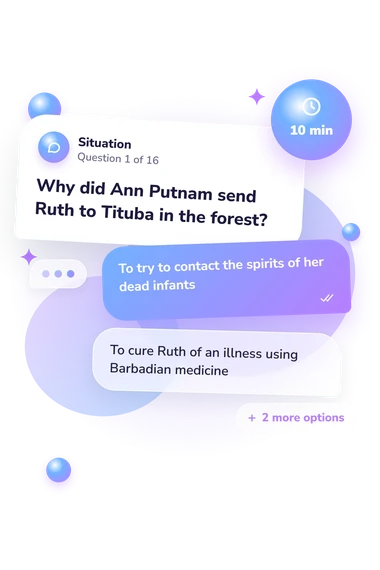
- To try to contact the spirits of her dead infants
- To cure Ruth of an illness using Barbadian medicine
- To discover who had been taking food from the Putnam home
- To learn whether Parris planned to dismiss Tituba
- A disagreement over whether Hale should examine Betty
- A long-running struggle over land ownership and boundaries
- A dispute over whether servants may attend church
- A conflict about who should replace Parris as minister
- Rebecca Nurse is leading prayers for Ruth and Betty.
- Hale is questioning Abigail while the Putnams watch.
- Parris is praying beside Betty, who lies unresponsive on the bed.
- Proctor is confronting Parris about rumors of witchcraft.
The Crucible Act 1 Quiz - Description and methodology of the test
Readers who want to check their grasp of Act 1 without rereading every scene can use The Crucible Act 1 Quiz as a focused knowledge check. It is suited to students, teachers preparing discussion, and anyone revisiting Arthur Miller’s drama. The Crucible Act One Quiz links plot recall with motives, relationships, conflicts, dramatic irony, and the way fear turns uncertainty into accusation.
What This Assessment Explores
Act 1 is treated as a connected dramatic argument rather than a string of plot facts. Questions in The Crucible Act I Quiz ask why characters act, how private grievances become public accusations, and what the audience sees that Salem’s adults miss. The result therefore reflects both recall and interpretation.
The displayed result is The Crucible Act 1 Knowledge (0-16). Foundation to revisit (0-6) indicates that sequence, relationships, or conflicts need review; Developing knowledge (7-12) reflects understanding of the main action and several themes with some uncertain details; Strong knowledge (13-16) indicates clear command of events, motives, conflicts, and dramatic meaning.
The main dimensions are:
- Event and relationship knowledge shows how accurately you place revelations, alliances, and tensions within the action.
- Motive and accusation reasoning shows whether you connect private grievances with public claims and fear-shaped interpretations.
- Dramatic meaning shows how well you recognize irony, concealment, suspense, and divided knowledge.
Methodology and Evidence Base
Each item presents a short question with four answer choices. You select the interpretation that best fits the scene, so performance depends on remembering details and attending to implication. The response pattern is checked against the answer key and summarized on the displayed knowledge scale.
Questions remain anchored to Miller (1953), whose dialogue, revelations, relationships, and dramatic construction supply the primary textual basis. Johnson and Johnson (1998) supports contextual reading, while Boyer and Nissenbaum (1974) clarifies the social tensions transformed into accusations. Popkin (1964) supports attention to irony, motive, and structure. Together, these sources make the questionnaire conceptually consistent with established readings of Miller’s play, not an adaptation of a published standardized instrument.
Multiple-choice answers in this Act 1 Crucible quiz are designed to distinguish close reading from surface recall, so a strong result suggests secure understanding of this act rather than broad literary expertise. Because this online questionnaire has no stated academic norms or clinical interpretation, its band reflects performance on selected Act 1 material and may vary with familiarity, memory, and judgments about ambiguous scenes.
- Miller, Arthur. The Crucible: A Play in Four Acts. New York: Viking Press, 1953.
- Johnson, Claudia Durst, and Vernon E. Johnson. Understanding The Crucible: A Student Casebook to Issues, Sources, and Historical Documents. Westport, CT: Greenwood Press, 1998. ISBN 0313301212.
- Boyer, Paul S., and Stephen Nissenbaum. Salem Possessed: The Social Origins of Witchcraft. Cambridge, MA: Harvard University Press, 1974. ISBN 9780674785267.
- Popkin, Henry. “Arthur Miller’s The Crucible.” College English, vol. 26, no. 2, 1964, pp. 139-146. 10.2307/373665.