
Animal Quiz for Kids
How the Scales are Structured
Who Usually Takes This Test?
See How You Compare
Below is a preview of how scores are typically distributed across each scale.
Example Questions From the Test
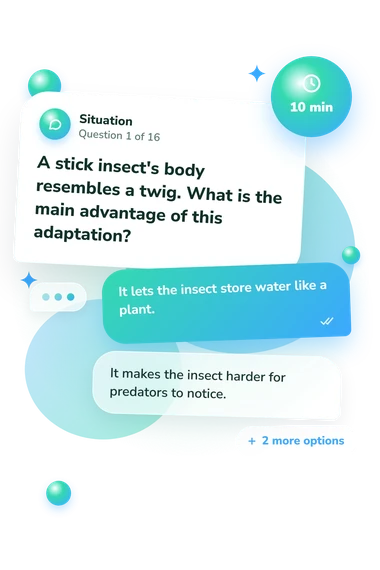
- It lets the insect store water like a plant.
- It makes the insect harder for predators to notice.
- It helps the insect make food from sunlight.
- It allows the insect to grow roots in the ground.
- On Arctic sea ice and nearby coasts
- On the sea ice around Antarctica
- In tropical forests near the equator
- In hot deserts with little rainfall
- Amphibians
- Reptiles
- Mammals
- Fish
Animal Quiz for Kids - Description and methodology of the test
Children who enjoy asking why animals look and behave differently can use this animal quiz for kids to organize what they know and notice where understanding is strongest. It is designed for shared use by a child, parent, teacher, or tutor, with the result serving as a starting point for conversation. As a free animal quiz, it supports playful review without making the score more important than curiosity.
What This Assessment Explores
The questions ask children to connect clues with classification, adaptations, habitats, diets, life cycles, and conservation. A feather, footprint, food choice, or developmental change is treated as evidence for reasoning, making the format useful for a childrens animal quiz that values explanation as well as recall.
The question themes are:
- Adaptations show how features help animals survive.
- Classification shows how traits place animals in biological groups.
- Habitats and diets show how animals relate to environments and food chains.
- Life cycles and conservation show how development and habitat protection support animal survival.
Together, these themes are summarized by the Animal Knowledge score of 0-16. The displayed bands are Curious Starter (0-6), Growing Explorer (7-12), and Animal Expert (13-16). They describe demonstrated knowledge on this set of questions, not a fixed limit on what the child can learn.
Methodology and Evidence Base
Each item presents a short animal situation or clue with four answer choices. The child selects the best fit, so the questionnaire samples recognition, comparison, classification, and application of biological ideas. The displayed result is a single total, but the format does not capture open-ended reasoning or the child's wider knowledge.
Conceptually, the content is consistent with Huxham et al. (2006) on children's wildlife knowledge, Braund (1991) on animal classification, and Trowbridge and Mintzes (1988) on alternative classification concepts. These studies support the relevance of the topics; they do not make this online questionnaire an adaptation or validation of those instruments.
The accessible wording can suit an animal quiz for 6 year olds when an adult explains unfamiliar terms. Short discussions help reveal whether a missed answer reflects vocabulary, a new concept, or inattention. With guided discussion, it can also work as an animal quiz for kindergarten. This online version is a structured learning snapshot rather than a standardized diagnostic measure, and results can shift with prior lessons, attention, reading ability, and the child's willingness to guess honestly.
- Huxham, Mark, Angela Welsh, Alice Berry, and Stuart Templeton. “Factors influencing primary school children's knowledge of wildlife.” Journal of Biological Education 41, no. 1 (2006): 9-12. 10.1080/00219266.2006.9656050
- Braund, Martin. “Children's ideas in classifying animals.” Journal of Biological Education 25, no. 2 (1991): 103-110. 10.1080/00219266.1991.9655186
- Trowbridge, John E., and Joel J. Mintzes. “Alternative conceptions in animal classification: A cross-age study.” Journal of Research in Science Teaching 25, no. 7 (1988): 547-571. 10.1002/tea.3660250704