
What Planet Are You Quiz
How the Scales are Structured
Who Usually Takes This Test?
See How You Compare
Below is a preview of how scores are typically distributed across each scale.
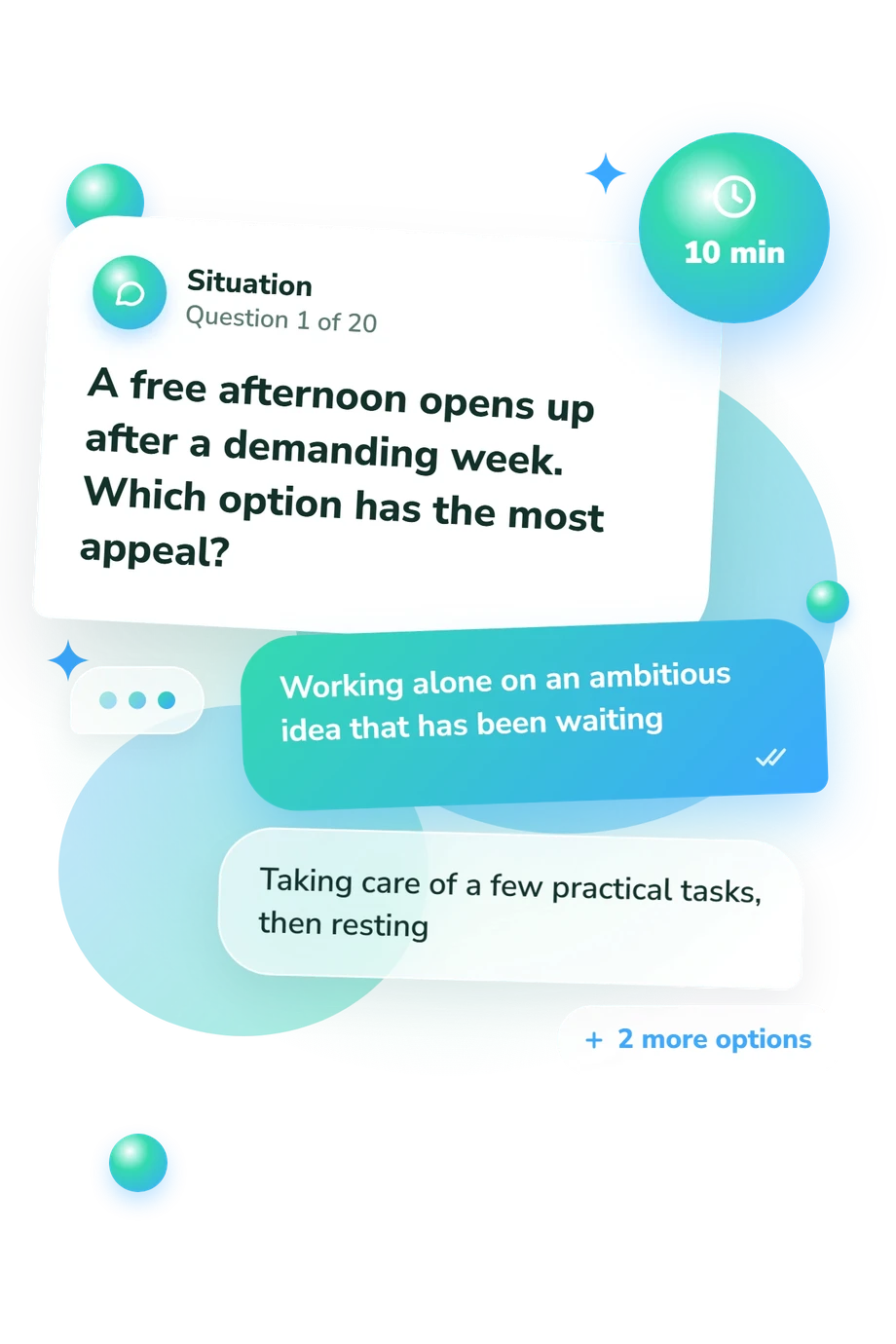
Example Questions From the Test
- Working alone on an ambitious idea that has been waiting
- Taking care of a few practical tasks, then resting
- Sharing a relaxed meal or walk with someone close
- Spending time somewhere comfortable, beautiful, or green
- I prefer to identify the most evidence-based interpretation
- I enjoy exploring several symbolic or dreamlike meanings
- I appreciate some mystery if the central storyline still resolves
- I would rather the story provide a definite conclusion
- Pointing out the constraints that any proposal must satisfy
- Developing a workable variation on the strongest existing idea
- Connecting distant concepts to suggest an unusual direction
- Offering an original possibility, then testing how it might work
What Planet Are You Quiz - Description and methodology of the test
People drawn to symbolic self-reflection can use the What Planet Are You Quiz to consider which motivational patterns feel most familiar. It is suited to readers curious about ambition, initiative, ideas, originality, connection, and comfort, and it returns a leading planetary profile or a blended result. Readers taking the what planet am i quiz receive a memorable frame for discussing these preferences.
What This Assessment Explores
Five symbolic dimensions organize everyday choices. Readers who enjoy a which planet are you quiz can consider a leading affinity rather than a fixed label; situations touch goals, action, ideas, originality, relationships, and comfort.
The result profiles are:
- Jupiter-Saturn Architect (0-12) measures ambition, structure, endurance, and responsibility: Open-Ended Explorer (0-4), Practical Planner (5-8), Jupiter-Saturn Architect (9-12).
- Mars Trailblazer (0-12) reflects initiative, independence, and direct action: Measured Navigator (0-4), Selective Initiator (5-8), Mars Trailblazer (9-12).
- Mercury Quickmind (0-12) captures curiosity, agility, communication, and variety: Deliberate Observer (0-4), Flexible Communicator (5-8), Mercury Quickmind (9-12).
- Uranus-Neptune Visionary (0-12) reflects originality, imagination, intuition, and possibility: Concrete Realist (0-4), Imaginative Adapter (5-8), Uranus-Neptune Visionary (9-12).
- Venus-Earth Harmonizer (0-12) reflects warmth, connection, comfort, and care: Independent Minimalist (0-4), Grounded Companion (5-8), Venus-Earth Harmonizer (9-12).
The highest score shows strongest affinity; profiles within one point blend.
Methodology and Scientific Basis
Each item presents an everyday situation with four response choices. Selecting the option that best matches your reaction makes the format a structured self-report rather than a performance task. An answer key assigns responses to five totals, then compares them for a leading affinity or close blend.
Hume and Goldstein (1977) is the closest study to this questionnaire’s astrology-and-personality theme, but it does not validate this format. Bruno and Louise Huber provide a symbolic framework in which planets represent psychological capacities; this questionnaire is conceptually consistent with that work, not an adaptation of their book.
As a which planet am i quiz, it makes abstract preferences easier to discuss. Carlson’s study tests astrological matching under controlled conditions, while Forer’s research shows why broad descriptions can feel exact; together, they make careful interpretation important.
For this planet personality quiz, results may shift with mood, current circumstances, self-awareness, or the wish to choose a flattering answer. No normative sample, reliability estimate, or validated clinical cutoff is stated for this online questionnaire, so the result works best as a descriptive prompt for reflection.
- Hume, Nicholas, and Gerald Goldstein. “Is There an Association Between Astrological Data and Personality?” Journal of Clinical Psychology, vol. 33, no. 3, 1977, pp. 711-713. 10.1002/1097-4679(197707)33:3<711::AID-JCLP2270330321>3.0.CO;2-H
- Huber, Bruno, and Louise Huber. The Planets and Their Psychological Meaning: Capabilities and Tools of the Personality: Detailed Descriptions of the Ten Horoscope Planets. HopeWell, 2006. ISBN 978-0-9547680-2-7
- Carlson, Shawn. “A Double-Blind Test of Astrology.” Nature, vol. 318, 1985, pp. 419-425. 10.1038/318419a0
- Forer, Bertram R. “The Fallacy of Personal Validation: A Classroom Demonstration of Gullibility.” The Journal of Abnormal and Social Psychology, vol. 44, no. 1, 1949, pp. 118-123. 10.1037/h0059240
Updated: