
Wine Quiz
How the Scales are Structured
Who Usually Takes This Test?
See How You Compare
Below is a preview of how scores are typically distributed across each scale.
Example Questions From the Test
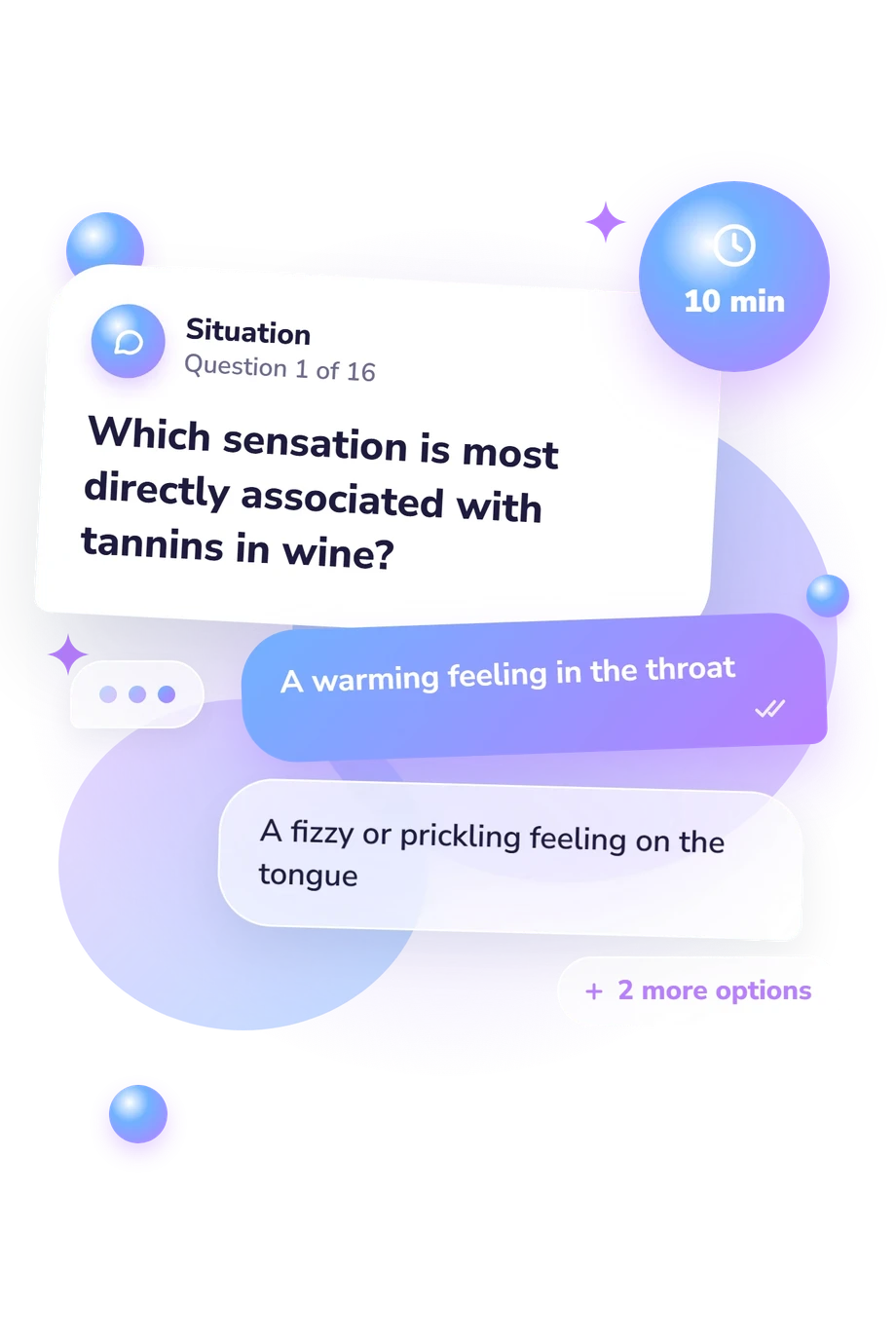
- A warming feeling in the throat
- A fizzy or prickling feeling on the tongue
- A sweet coating on the lips
- A drying, gripping feeling in the mouth
- A cool, dark place with a stable temperature
- A car trunk with regular temperature changes
- A bright shelf above a kitchen stove
- A sunny windowsill in an air-conditioned room
- Excessive carbonation
- Tartrate crystallization
- Cork taint
- Normal bottle sediment
Wine Quiz - Description and methodology of the test
People who want to understand wine more confidently can use this wine quiz to check practical knowledge rather than personal taste preferences. Curious drinkers, students, and anyone seeking more informed choices at the table can use this wine knowledge quiz to connect practical concepts with everyday decisions. The result shows how securely you recognize core concepts and where further study may be useful.
What This Assessment Explores
The questions examine practical wine literacy rather than preference. They cover grapes and styles, production, tasting sensations, faults, storage, service, temperature, decanting, sequencing, and food pairing. This online wine assessment helps readers understand why a wine behaves a certain way or why a serving decision changes perception. That breadth gives the assessment practical value: its score summarizes performance across the listed wine topics rather than showing how strengths are distributed.
The displayed scale is Wine Knowledge, scored from 0-16. Its result bands are:
- Foundation (0-6) indicates recognition of some basics, with room to build core tasting, production, and service knowledge.
- Developing (7-12) indicates useful knowledge that supports many practical distinctions while leaving topics to explore.
- Well Established (13-16) indicates a strong grasp of wine styles, production, tasting, storage, service, and pairing.
Methodology and Scientific Basis
Each item presents a wine concept or everyday scenario followed by four answer choices. As a wine knowledge assessment, its format checks recognition and application: you may identify a grape, explain fermentation, match a fault to its aroma, or choose a suitable serving or pairing decision. Answers produce a total score interpreted through the displayed bands; the result is an overall knowledge indicator, not a separate rating of every skill.
The content is conceptually consistent with WSET's 2026 Level 2 framework, covering grape varieties, styles, production, tasting, storage, service, and pairing. The score can help organize general study priorities without reproducing the qualification or its standardized administration.
Fermentation, oxidation, tannin, acidity, and aroma topics also align with principles discussed by Waterhouse, Sacks, and Jeffery (2016). That source explains relevant wine chemistry. This questionnaire has no published norms; its bands describe demonstrated knowledge levels, not comparison with a reference population.
Because responses depend on honesty, memory, current attention, and tasting experience, results may shift with context. A high score does not establish sensory acuity or professional competence, while a lower score may reflect unfamiliar terminology rather than limited appreciation of wine.
- Wine & Spirit Education Trust. WSET Level 2 Award in Wines Specification. Issue 2.1, 2026. London: Wine & Spirit Education Trust.
- Waterhouse, Andrew L., Gavin L. Sacks, and David W. Jeffery. Understanding Wine Chemistry. Chichester: John Wiley & Sons, 2016. 10.1002/9781118730720
Updated: