
Which Robin Are You Quiz
How the Scales are Structured
Who Usually Takes This Test?
See How You Compare
Below is a preview of how scores are typically distributed across each scale.
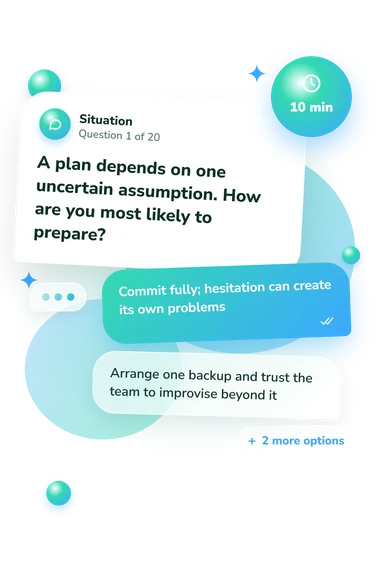
Example Questions From the Test
- The chance to make a visible difference quickly
- The unanswered question that keeps suggesting a hidden pattern
- The opportunity to test my skills against another person
- The possibility that careful preparation could change the outcome
- Preserve the relationship by staying close to their original path
- Make a clean break and avoid revisiting the disagreement
- Adapt the lessons I value while gradually changing direction
- Create a distinct identity while keeping room for mutual respect
- It makes me more determined to prove myself through action
- I treat it as useful cover while I prepare
- I try to change the relationship through conversation
- It sharpens my competitive edge, though I choose my moment
Which Robin Are You Quiz - Description and methodology of the test
Readers who enjoy comparing themselves with fictional heroes can use this assessment as a what robin are you quiz to explore loyalty, authority, teamwork, risk, and self-definition. It helps fans decide which Robin they most resemble, offering a character affinity and playful reflection. The Which Robin Are You Quiz turns those preferences into a comparative result and gives language for discussing familiar traits.
What This Assessment Explores
Items cover pressure, belonging, achievement, authority, conflict, and setbacks. For readers asking which Robin am I in this quiz, five affinities reveal a leading match or blend.
Dimensions follow:
- Damian Wayne (0-12) reflects discipline, legacy awareness, mastery, and earned trust: Collaborative Path (0-4), Ambitious Heir (5-8), Formidable Successor (9-12).
- Dick Grayson (0-12) reflects charisma, adaptability, connection, and self-directed identity: Independent Style (0-4), Shared Spark (5-8), Natural Ringleader (9-12).
- Jason Todd (0-12) reflects fierce independence, direct action, intensity, and outsider identification: Different Code (0-4), Rebel Streak (5-8), Defiant Protector (9-12).
- Stephanie Brown (0-12) reflects persistence, improvisation, pressure humor, and resilience when underestimated: Measured Route (0-4), Resilient Improviser (5-8), Unstoppable Spoiler (9-12).
- Tim Drake (0-12) reflects detective preparation, curiosity, and useful insight: Instinct-Led Approach (0-4), Strategic Mind (5-8), Master Detective (9-12).
Methodology and Scientific Basis
Each item presents a scenario about planning, personal codes, legacy, conflict, teamwork, setbacks, or pressure. Four response options ask for the instinct closest to the respondent’s own, so the task compares preferences rather than factual knowledge.
The answers contribute to five character-specific affinity scores. The highest score is the strongest match; any outcome within one point of it creates a blended result. The result addresses the question Which Robin character are you? A leading affinity shows the closest pattern in the answers, while a blend shows comparable character patterns. Displayed ranges and bands are descriptive output categories for this questionnaire; they do not establish a universal point value for each answer.
Doyle, Kay, and Arrow (2025) provide the closest conceptual support for perceived similarity to fictional characters. Cohen (2001) explains identification with media characters, and Tal-Or and Cohen (2010) distinguish identification from transportation in audience involvement. This Robin personality quiz is conceptually consistent with those ideas, not an adaptation of their measures.
As a self-report comparison, the profile can shift with mood, self-awareness, and a wish to identify with a character, so it is a context-dependent snapshot.
- Doyle, E. K., Kay, C. S., & Arrow, H. (2025). Rating heroes, antiheroes, and villains: Machiavellianism, grandiose narcissism, psychopathy, and sadism predict admiration for and perceived similarity to morally questionable characters. Psychology of Popular Media, 14(3), 495-501. 10.1037/ppm0000571
- Tal-Or, N., & Cohen, J. (2010). Understanding audience involvement: Conceptualizing and manipulating identification and transportation. Poetics, 38(4), 402-418. 10.1016/j.poetic.2010.05.004
- Cohen, J. (2001). Defining identification: A theoretical look at the identification of audiences with media characters. Mass Communication & Society, 4(3), 245-264. 10.1207/S15327825MCS0403_01
Updated: