
Mary Sue Quiz
How the Scales are Structured
Who Usually Takes This Test?
See How You Compare
Below is a preview of how scores are typically distributed across each scale.
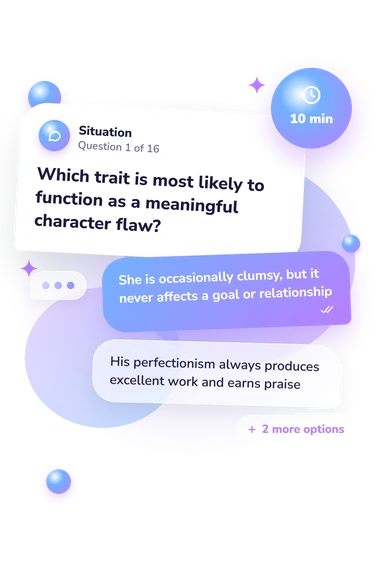
Example Questions From the Test
- She is occasionally clumsy, but it never affects a goal or relationship
- His perfectionism always produces excellent work and earns praise
- His loyalty makes him dismiss evidence and protect an ally, worsening the conflict
- Her modesty mainly prompts other characters to compliment her
- They ensure the character loses at least half of all conflicts
- They create tradeoffs and force choices that ability alone cannot erase
- They prevent readers from identifying with the character too strongly
- They make exceptional abilities unnecessary to the story
- A label used in early role-playing manuals for overpowered player characters
- A term coined by screenwriters to describe protagonists without backstories
- A nickname for flawless heroines in nineteenth-century serialized novels
- A character in Paula Smith’s parody of idealized Star Trek fan fiction
Mary Sue Quiz - Description and methodology of the test
Designed for writers, readers, and fans, this assessment works as a quiz asking whether my character is a Mary Sue while distinguishing narrative favoritism from genuine competence, earned growth, and ordinary heroism. The Mary Sue Quiz gives a useful frame for evaluating character construction rather than delivering a verdict on one fictional person. Writers can use it during drafting, revision, or discussion.
What This Assessment Explores
Questions focus on exceptional ability, meaningful flaws, resistance, consequences, and supporting-character agency. Talent, beauty, identity, or author resemblance do not establish the trope alone. The key issue is whether the narrative grounds ability, permits difficulty, lets others matter, and makes success carry consequences.
As a quiz asking whether my OC is a Mary Sue, it separates self-insertion from favoritism. It also addresses earned expertise, balanced ensembles, independent motivations, and uneven standards.
The main dimensions are:
- Trope history and meaning: this quiz tests whether you recognize when your character is a Mary Sue in the debated sense, not simply an unusually capable protagonist.
- Character grounding and consequences: this reflects whether limits, costs, and flaws shape success.
- Ensemble agency: this shows whether supporting characters retain goals and consequential choices.
Together, these themes make the result a profile of interpretive knowledge, not a ruling on one character.
Methodology and Evidence Base
Each item is multiple choice, combining definition checks with story situations and revision decisions. Options contrast meaningful flaws with cosmetic weaknesses, grounded victories with unexplained ones, and functioning ensembles with casts reduced to praise. This tests interpretive knowledge rather than judgment from a character’s name or premise.
Scoring uses one scale, Mary Sue Knowledge (0-16). Its bands are Foundations to build (0-6), Developing insight (7-12), and Strong understanding (13-16). It measures knowledge of the trope’s history, nuances, and craft signals, not an objective ruling. Someone using a quiz to ask whether your OC is a Mary Sue can identify priorities rather than outsource judgment to a number.
The questionnaire is conceptually consistent with Smith (1973), which established the parody origin of the name, but the online version is not an adaptation of it. Beck and Herrling (2009) address fan interpretation; Sapuridis and Alberto (2022), self-insert writing; and Barner (2011), popular criticism and uneven standards. These sources do not standardize the score.
As self-report, the outcome depends on attention, prior knowledge, and honest interpretation. Read it alongside the character’s choices, relationships, setbacks, and consequences.
- Smith, Paula. "A Trekkie's Tale." In Menagerie 2. New York: Boojums Press, 1973.
- Beck, Julia, and Frauke Herrling. "Playing Sue." Transformative Works and Cultures, vol. 2, 2009. 10.3983/twc.2009.093.
- Sapuridis, Effie, and Maria K. Alberto. "Self-Insert Fanfiction as Digital Technology of the Self." Humanities, vol. 11, no. 3, article 68, 2022. 10.3390/h11030068.
- Barner, Ashley. "Pamela, Twilight, and the \"Mary-Sue\" in Literature: Patterns of Popular Criticism." Reconstruction: Studies in Contemporary Culture, vol. 11, no. 3, 2011, pp. 1-14.
Updated: