
Dream House Quiz
How the Scales are Structured
Who Usually Takes This Test?
See How You Compare
Below is a preview of how scores are typically distributed across each scale.
Example Questions From the Test
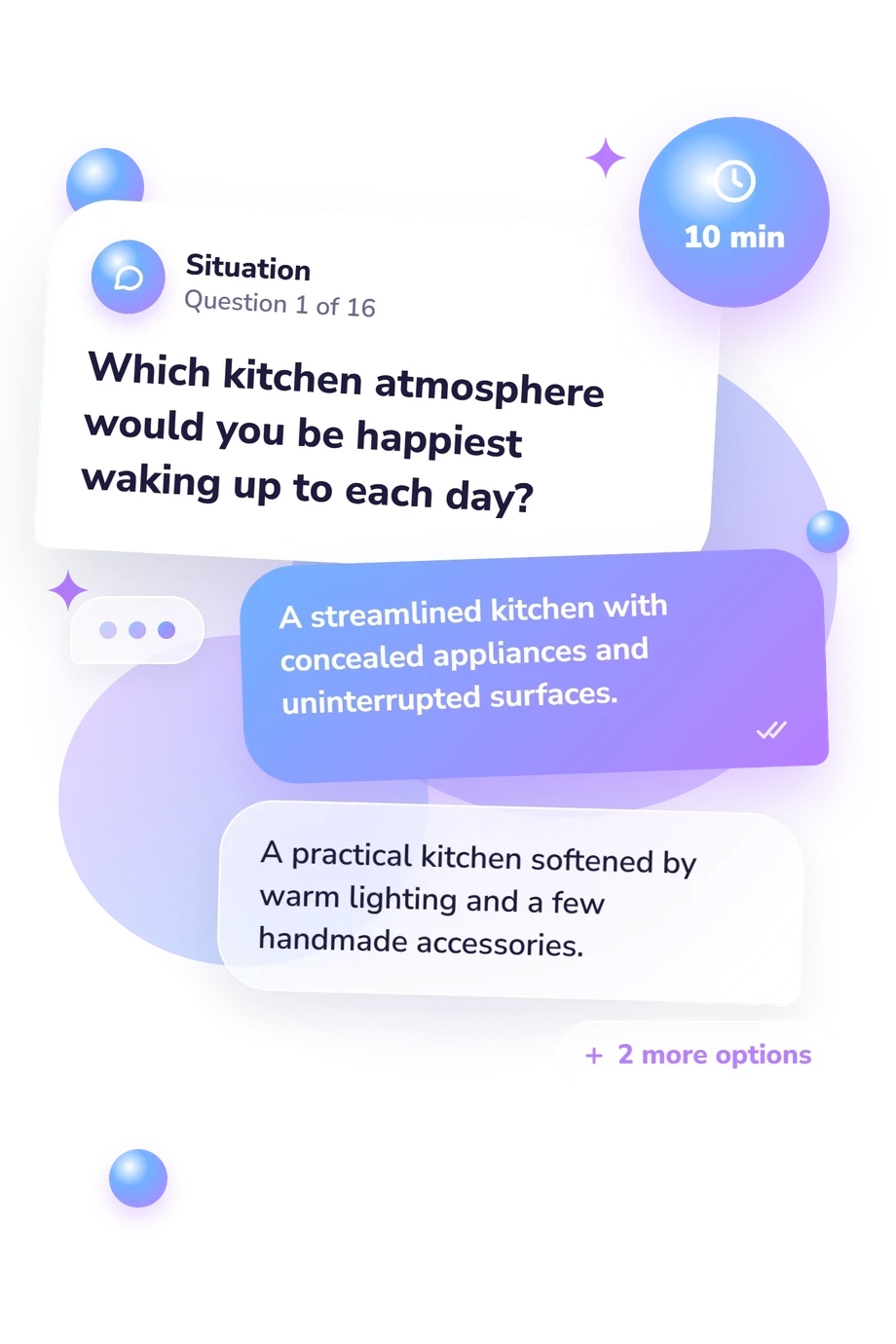
- A streamlined kitchen with concealed appliances and uninterrupted surfaces.
- A practical kitchen softened by warm lighting and a few handmade accessories.
- Painted cabinetry, open shelves, and a sturdy table for everyday meals.
- A mostly contemporary kitchen with one traditional feature, such as a farmhouse sink.
- Rooms filled with art, books, souvenirs, and objects that invite attention.
- Comfortable rooms with belongings visible but loosely organized.
- Mostly clear rooms, with a few curated objects left on display.
- Quiet, precisely arranged spaces where every visible item feels intentional.
- A peaceful setting where outside activity is rarely noticeable.
- A residential area with occasional access to lively streets.
- A walkable district where cafés, studios, and evening activity are close by.
- A visibly urban setting where the movement and character of the city feel energizing.
Dream House Quiz - Description and methodology of the test
People who are shaping a home, comparing design instincts, or trying to understand why certain rooms feel right can use the Dream House Quiz as a structured reflection on residential preferences. It connects choices about materials, layout, neighborhood, and atmosphere with a personal result, while this dream home quiz can help name the balance of comfort, simplicity, nature, and urban energy that feels most like home.
What This Assessment Explores
Rather than testing design expertise, the questionnaire maps preferred atmosphere and setting across comfort, order, personal history, landscape, city energy, industrial character, indoor-outdoor connection, and social flexibility. As a home style quiz, it organizes four directions in the result.
The profile has four scales:
- Cozy Cottage (0-12) measures intimate rooms, nostalgic detail, soft layers, and lived-in warmth: 0-4 Different Direction; 5-8 Touch of Cottage; 9-12 Cottage at Heart.
- Modern Minimalist (0-12) measures clean geometry, visual calm, purposeful objects, and controlled space: 0-4 Expressive Alternative; 5-8 Selective Simplicity; 9-12 Minimalist Focus.
- Nature Retreat (0-12) measures landscape views, outdoor transitions, natural rhythms, and refuge from built-up surroundings: 0-4 More Connected Elsewhere; 5-8 Nature in Reach; 9-12 Landscape Led.
- Urban Loft (0-12) measures converted spaces, industrial materials, city energy, and flexible rooms: 0-4 Quieter Vision; 5-8 Loft Accents; 9-12 Loft Living.
Methodology and Scientific Basis
Each item offers four alternative descriptions of a domestic situation, covering kitchens, bedrooms, storage, color, materials, neighborhood, weather, outdoor access, building sites, and entertaining. The respondent selects the option that feels most appealing, so the format captures imagined everyday preferences rather than factual knowledge or architectural skill.
Scoring combines responses into four dimensions; each receives a band showing how strongly that direction appears. The profile helps users think through and plan an ideal home; this build-your-dream-home quiz turns that exercise into a preference profile, not a constructed design. The questionnaire does not document how individual responses are weighted or provide norms, so the displayed bands should be read as a personal preference profile.
Its themes are conceptually consistent with environmental-preference research on residential scenes, urban and rural settings, and natural versus built environments, but this online questionnaire is not an adaptation or validated version of a published instrument.
Honest self-report, current mood, familiarity with settings, and the imagined context of the choices can shape the outcome. The result can guide reflection on priorities, but it cannot diagnose or establish a clinical trait.
- Richmond, Virginia P., and James C. McCroskey. (1995). Nonverbal Behavior in Interpersonal Relations (3rd ed.). Boston, MA: Allyn & Bacon.
- Nasar, Jack L. (1983). Adult Viewers' Preferences in Residential Scenes: A Study of the Relationship of Environmental Attributes to Preference. Environment and Behavior, 15(5), 589-614. 10.1177/0013916583155003
- Jansen, Sylvia J. T. (2020). Urban, suburban or rural? Understanding preferences for the residential environment. Journal of Urbanism: International Research on Placemaking and Urban Sustainability, 13(2), 213-235. 10.1080/17549175.2020.1726797
- McMahan, Ethan A., and Patrick Josh. (2017). Measuring Preference for Natural versus Built Environments: Initial Validation of the Preference for Nature Questionnaire. Ecopsychology, 9(3), 161-171. 10.1089/eco.2017.0009
Updated: