
Social and Emotional Loneliness Scale for Adults, Short Form (SELSA-S) Test
How the Scales are Structured
Who Usually Takes This Test?
See How You Compare
Below is a preview of how scores are typically distributed across each scale.
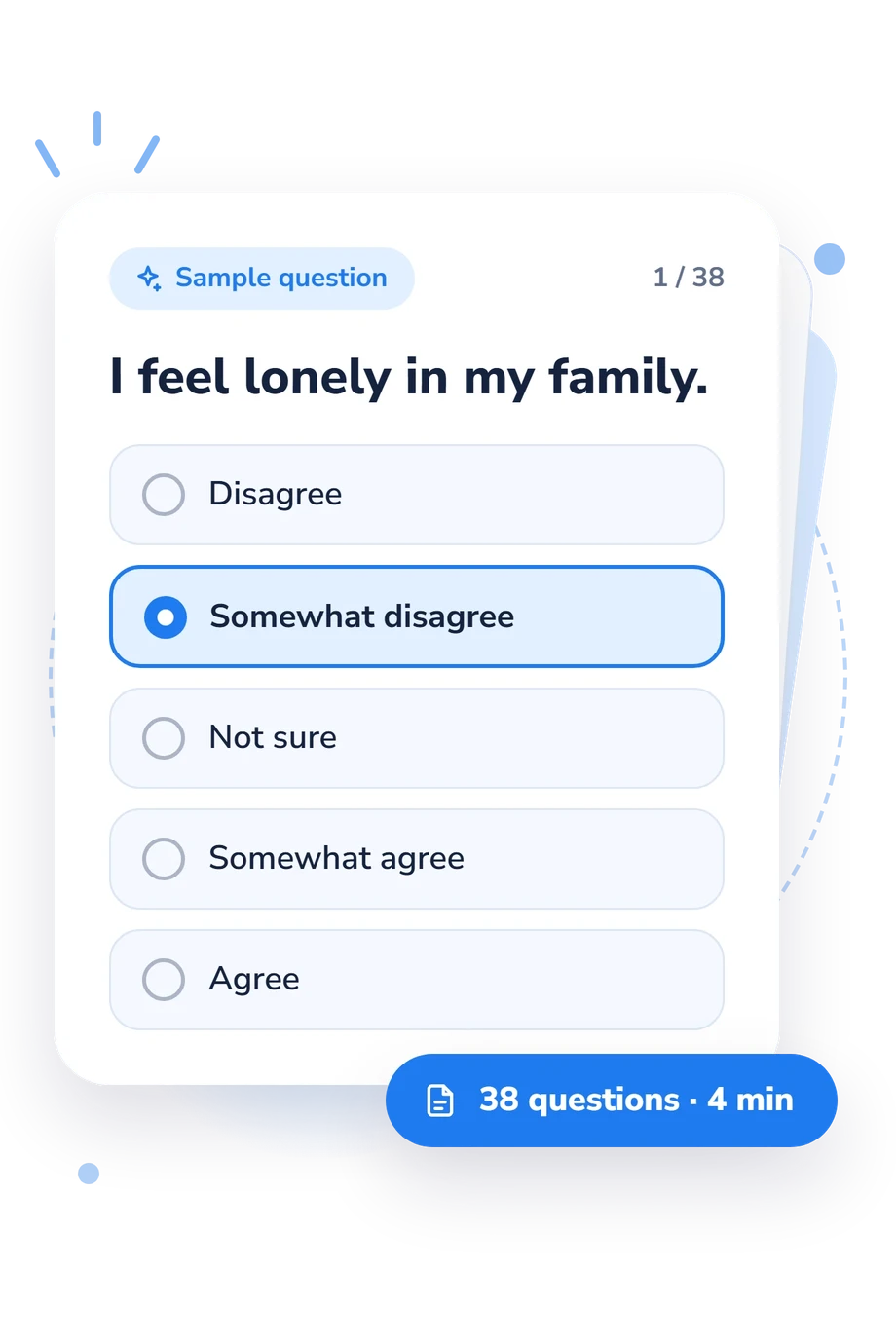
Example Questions From the Test
- Disagree
- Somewhat disagree
- Not sure
- Somewhat agree
- Agree
- Disagree
- Somewhat disagree
- Not sure
- Somewhat agree
- Agree
- Disagree
- Somewhat disagree
- Not sure
- Somewhat agree
- Agree
Social and Emotional Loneliness Scale for Adults, Short Form (SELSA-S) Test - Description and methodology of the test
People who want to understand whether loneliness is concentrated in one relationship area or spread across their social world may find this assessment useful. The Social and Emotional Loneliness Scale for Adults, Short Form (SELSA-S) Test offers a structured snapshot of perceived connection, support, and unmet intimacy needs. The resulting loneliness profile clarifies whether disconnection is mainly romantic, familial, social, or broadly experienced.
What This Assessment Explores
These results distinguish loneliness by relationship context. The SELSA-S questionnaire is intended for adults seeking a differentiated profile of perceived closeness, emotional support, and unmet connection needs. It shows where isolation feels most prominent rather than treating loneliness as one undivided experience.
The displayed scales describe five parts of the profile:
- Romantic Emotional Loneliness (1-5) shows unmet emotional needs within an existing romantic bond; Low 1-3.2, High 3.3-5.
- Romantic Relationships (1-5) reflects loneliness or limited closeness in romance; Low loneliness 1-3.9, High loneliness 4-5.
- Non-Family Emotional Loneliness (1-5) reflects emotional distance or insufficient support from friends; Low 1-2.9, High 3-5.
- Family Emotional (1-5) reflects emotional isolation among close relatives; Low 1-2.5, Moderate 2.6-3.7, High 3.8-5.
- Loneliness (1-5) reflects overall perceived social and emotional isolation; Low 1-1.3, Moderate 1.4-2.8, High 2.9-5.
Methodology and Scientific Basis
Items cover family belonging and isolation, friendship understanding and practical support, and the presence or absence of a close romantic relationship. Responses follow a five-point agreement scale running from disagreement through uncertainty to agreement; some items use labels such as Rather disagree, Rather agree, or Unsure.
Viewed as a social and emotional loneliness assessment, this self-report questionnaire reports context scores and an overall score. Higher results generally indicate more loneliness or unmet relational need in the relevant domain; interpretation follows the displayed bands, not an invented conversion rule. The pattern is more informative than an isolated number.
The closest published evidence is the 2004 SELSA-S study by DiTommaso and colleagues, while the original SELSA instrument, developed by DiTommaso and Spinner in 1993, provides the earlier framework for separating social and emotional loneliness across relationship contexts. This online version is conceptually consistent with those instruments, but should not be treated as having the same standardization, norms, or validation evidence as research use.
Current mood, relationship changes, memory, and willingness to disclose can affect self-report. The profile therefore describes a context-sensitive experience rather than a fixed personal trait.
- DiTommaso, E., Brannen, C., & Best, L. A. (2004). Measurement and validity characteristics of the short version of the Social and Emotional Loneliness Scale for Adults. Educational and Psychological Measurement, 64(1), 99-119. 10.1177/0013164403258450
- DiTommaso, E., & Spinner, B. (1993). The development and initial validation of the Social and Emotional Loneliness Scale for Adults (SELSA). Personality and Individual Differences, 14(1), 127-134. 10.1016/0191-8869(93)90182-3
Updated: