
Young Mania Rating Scale (YMRS) Test
How the Scales are Structured
Who Usually Takes This Test?
See How You Compare
Below is a preview of how scores are typically distributed across each scale.
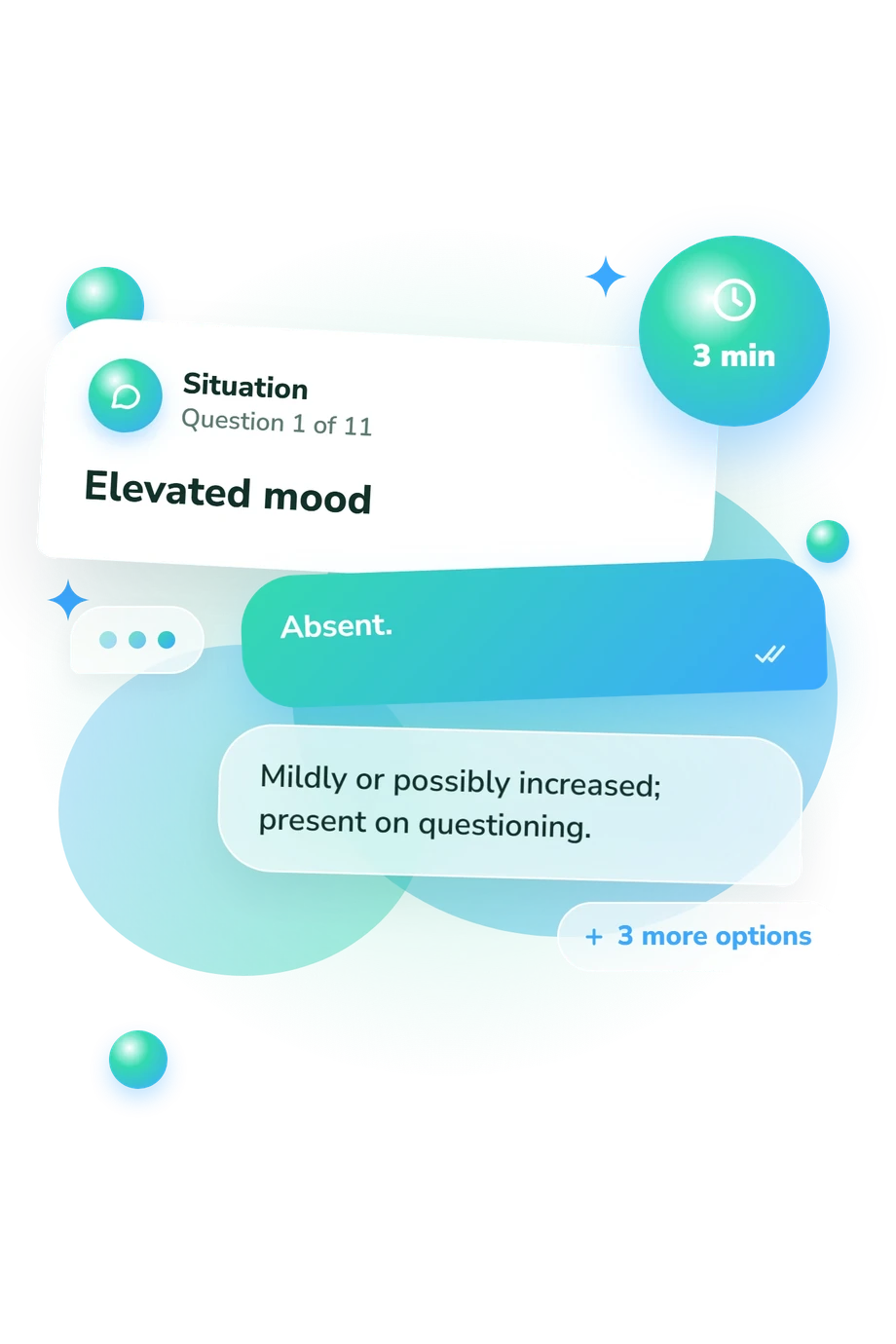
Example Questions From the Test
- Absent.
- Mildly or possibly increased; present on questioning.
- Subjectively elevated; optimistic, self-confident, cheerful; appropriate to situation.
- Elevated mood inappropriate to situation; joking or facetious.
- Euphoric; inappropriately laughing; singing.
- Absent.
- Subjective increase.
- Increased animation; more gesturing.
- Excessively energetic; hyperactive at times; restless (can be calmed).
- Motor agitation; continuous hyperactivity (cannot be calmed).
- Appropriately dressed and well groomed.
- Slightly unkempt.
- Unkempt; careless dress; inappropriately overdressed.
- Disheveled; partially dressed; garish makeup.
- Extremely sloppy dress; bizarre; strange adornments.
Young Mania Rating Scale (YMRS) Test - Description and methodology of the test
For someone noticing unusual activation, irritability, or reduced sleep, the Young Mania Rating Scale (YMRS) Test offers a structured way to organize observations. As a mania symptom questionnaire, the assessment helps a respondent arrange recent changes before discussing them with a clinician. The result summarizes apparent severity across several symptom areas and highlights which recent changes shaped the total.
What This Assessment Explores
The YMRS questionnaire assesses the severity of manic symptoms in manic or hypomanic states. Its domains cover elevated mood, irritability, energy, sleep, speech, thought content, sexual interest, aggression, appearance, and insight. These observations help a respondent reflect on recent changes or prepare for discussion.
The displayed scale spans 0-60: Minimal/none 0-12, Mild to moderate 13-21, and Marked to severe 22-60. Higher totals reflect greater symptom intensity and may indicate a marked manic state. The assessment captures:
- Mood and energy indicate elevation, optimism, restlessness, or activation.
- Sleep duration or need for sleep and sexual interest or behavior indicate manic changes in these domains.
- Speech and thought content indicate acceleration, distractibility, unusual beliefs, or impaired communication.
- Irritability and disruptive behavior indicate hostility, threats, or reduced behavioral control.
- Appearance and insight indicate visible change and recognition of possible illness.
Methodology and Evidence Base
Items use ordered descriptions from absent or typical functioning to pronounced change. Domain responses run from 0 to 4 or 0 to 8, and selected ratings are summed into a total. This produces an estimate of symptom intensity rather than a conclusion about each symptom.
The Young Mania Rating Scale (YMRS), developed by Young and colleagues in 1978, is clinician-rated. This online mania rating scale presents descriptions drawn from it in a self-administered format. Some anchors concern interview or ward behavior, so the original rating depends on clinician observation.
Lukasiewicz and colleagues (2013) examined severity thresholds and meaningful change; Prisciandaro and Tolliver (2016) studied item functioning in bipolar-disorder treatment data. These studies support the source framework but do not establish norms or validation for this online format.
Memory, current context, self-awareness, sleep loss, stress, substances, medical conditions, or another mood state can affect responses; this presentation is not established as equivalent to the original clinician rating and its total is not diagnostic and cannot identify the cause of a score. The original scale supports clinical monitoring of symptom severity and change.
- Young, R. C., Biggs, J. T., Ziegler, V. E., & Meyer, D. A. (1978). A rating scale for mania: Reliability, validity and sensitivity. The British Journal of Psychiatry, 133(5), 429-435. 10.1192/bjp.133.5.429
- Lukasiewicz, M., Gerard, S., Besnard, A., Falissard, B., Perrin, E., Sapin, H., Tohen, M., Reed, C., Azorin, J.-M., & Emblem Study Group. (2013). Young Mania Rating Scale: How to interpret the numbers? Determination of a severity threshold and of the minimal clinically significant difference in the EMBLEM cohort. International Journal of Methods in Psychiatric Research, 22(1), 46-58. 10.1002/mpr.1379
- Prisciandaro, J. J., & Tolliver, B. K. (2016). An item response theory evaluation of the Young Mania Rating Scale and the Montgomery-Asberg Depression Rating Scale in the Systematic Treatment Enhancement Program for Bipolar Disorder (STEP-BD). Journal of Affective Disorders, 205, 73-80. 10.1016/j.jad.2016.06.062
Updated: