
Reactivity Rating Scale Test
How the Scales are Structured
Who Usually Takes This Test?
See How You Compare
Below is a preview of how scores are typically distributed across each scale.
Example Questions From the Test
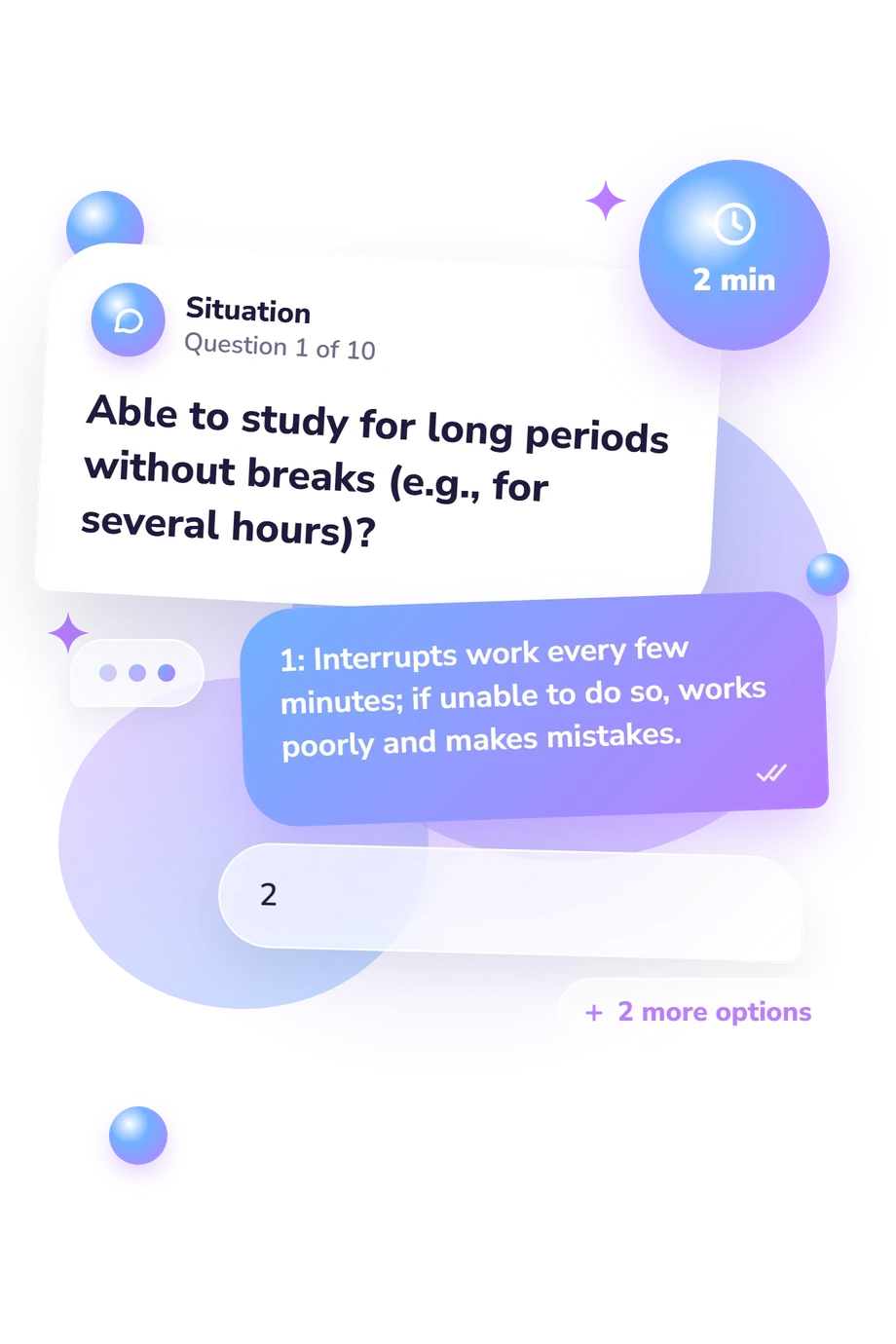
- 1: Interrupts work every few minutes; if unable to do so, works poorly and makes mistakes.
- 2
- 3
- 4: Despite prolonged work, shows no fatigue.
- 1: Unable to concentrate on the task being performed. External stimuli distract from ongoing actions.
- 2
- 3
- 4: Completely absorbed in the activity. Notices nothing except the task.
- 1: After setbacks, stops learning; cries; becomes upset; criticism is demobilizing.
- 2
- 3
- 4: Becomes even more mobilized after setbacks; does not become discouraged and does not show nervousness.
Reactivity Rating Scale Test - Description and methodology of the test
People who want to understand how they respond to sustained demands, interruption, pressure, and emotional disruption may find the Reactivity Rating Scale Test useful as a structured self-reflection exercise. The exercise focuses on everyday performance and coping, helping readers consider whether their pattern is more sensitive and easily unsettled or more steady, persistent, and self-directed. It offers a concise assessment of nervous system reactivity for that comparison.
What This Assessment Explores
The questionnaire examines reactions to sustained effort, distraction, obstacles, unfamiliar supervision, important tasks, and emotional events. It also reflects concentration, persistence, initiative, tolerance of demanding conditions, and recovery. The result describes a broad reactivity profile rather than one isolated behavior.
The following four item themes organize these observations for interpretation:
- Concentration and endurance show how consistently effort and attention are maintained.
- Environmental sensitivity indicates how strongly noise, people, or unfamiliar settings interfere with functioning.
- Persistence and initiative reflect responses to obstacles, responsibility, and demanding work.
- Emotional steadiness describes composure before important events and recovery after distress.
The single displayed scale is Reactivity, scored from 10-40: High reactivity 10-19, Moderate reactivity 20-29, and Low reactivity 30-40. Lower scores indicate higher reactivity, associated here with sensitivity, anxiety, and introversion; higher scores indicate lower reactivity, associated with resilience, self-sufficiency, and extraversion.
Methodology and Scientific Basis
Each item presents a situation in contrasting terms, such as losing focus under distraction versus remaining absorbed in a task. Four response positions let the respondent place their experience between those anchors. The questionnaire reports one result; the reactivity assessment summarizes overall response style.
The questionnaire is conceptually consistent with the published Reactivity Rating Scale discussed by Friedensberg and Strelau in 1982, but the online form is not presented as that instrument or as a direct adaptation. Strelau’s regulative theory of temperament supplies the relevant framework, linking nervous-system properties with activation and endurance. Bogdanova and colleagues discuss the scale in experimental-psychology practice.
Interpret the result as a descriptive response profile. Lower scores correspond to stronger reactivity while higher scores suggest greater steadiness and self-sufficiency. For this online questionnaire, reliability and validity findings for the published instrument cannot automatically be transferred: no norms or independent reliability estimates are reported for this form, and self-report can reflect current stress, self-awareness, and the wish to present oneself favorably; read the result alongside the situations that prompted the answers.
- Grodner, M. (1973). Impact of the strength of the nervous system and anxiety level on the results of a motor test in a competitive situation among boys aged 12-15. Unpublished master's thesis, University of Warsaw, Poland.
- Friedensberg, E., & Strelau, J. (1982). The Reactivity Rating Scale (RRS): Reliability and validity. Polish Psychological Bulletin, 13(3), 223-237.
- Bogdanova, T. V., Gippenreiter, Y. B., Grigorenko, E. L., et al. (2002). Experimental Psychology: Practicum: Textbook for Higher Education Institutions. Edited by S. D. Smirnov and T. V. Kornilova. Moscow: Aspect Press.
- Strelau, J. (1983). A Regulative Theory of Temperament. Australian Journal of Psychology, 35(3), 305-317. 10.1080/00049538308258746
Updated: