
Affective States Proneness Scale Test
How the Scales are Structured
Who Usually Takes This Test?
See How You Compare
Below is a preview of how scores are typically distributed across each scale.
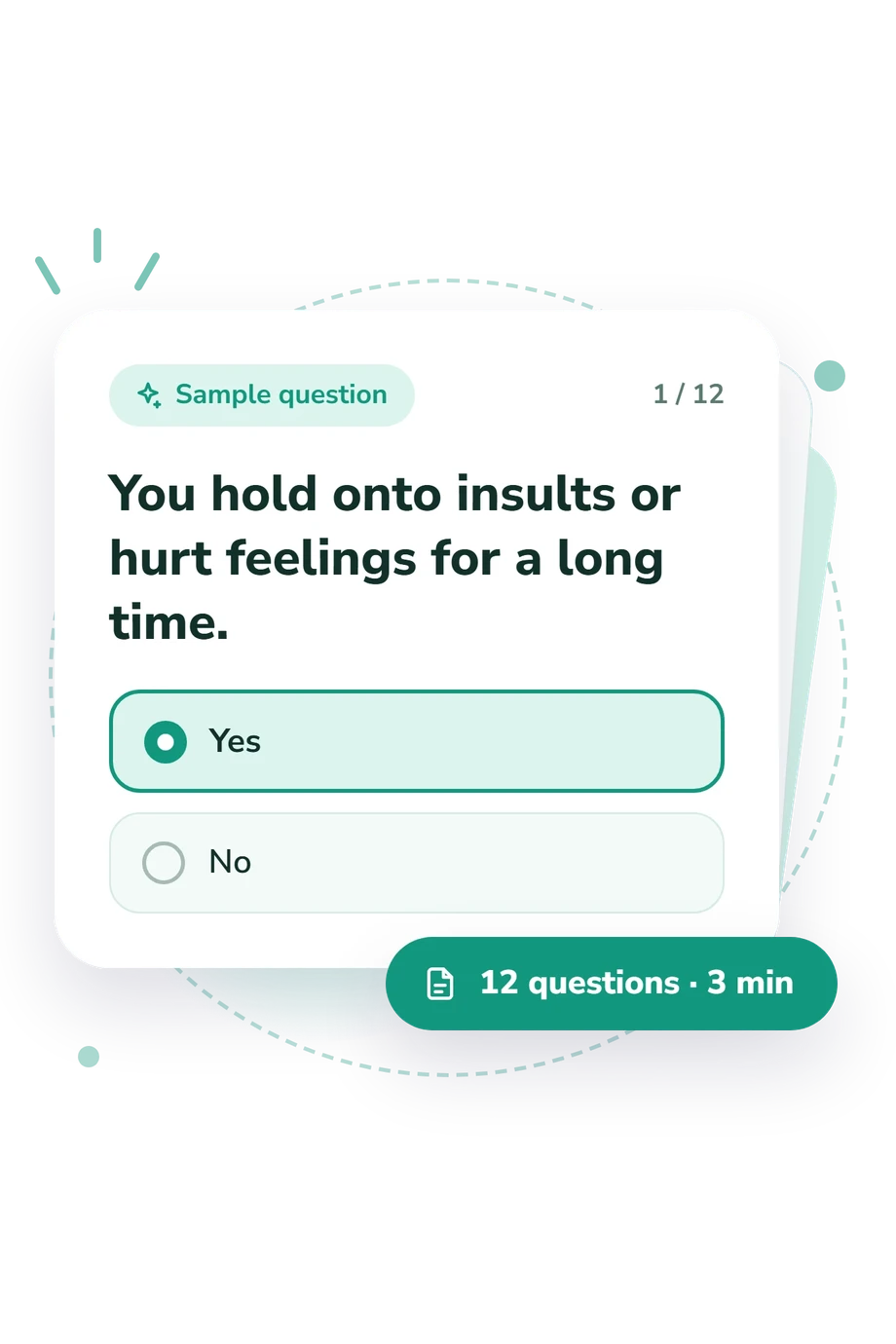
Example Questions From the Test
- Yes
- No
- Yes
- No
- Yes
- No
Affective States Proneness Scale Test - Description and methodology of the test
For readers who notice recurring resentment, conflict, or difficulty settling after upsetting events, this assessment offers a structured way to examine emotional persistence in everyday life. The Affective States Proneness Scale Test connects these experiences with a broader pattern of affective regulation. This affective states questionnaire organizes self-observations about relationships, sleep, and mental preoccupation. Its result describes a tendency, not a fixed identity.
What This Assessment Explores
These questions examine what follows an upsetting event: lingering resentment, replayed unfairness, imagined arguments, withdrawal after disagreement, and difficulty returning to routine. They also address sleep disruption and trouble shifting attention from unresolved problems. Together, the themes concern emotional persistence and regulation rather than one mood.
For the reader, the affective states scale describes a tendency toward frequent, prolonged episodes of intense, poorly regulated emotion that may become disorganizing, affecting physical and mental well-being and relationships. The displayed result is Affective States Proneness, 0–12, with Low (0–4), Moderate (5–9), and High (10–12) bands. Moderate scores are typical when affects remain brief.
The themes fall into three areas:
- Lingering hurt tracks insults, mistakes, or unfairness that remain active.
- Conflict spillover covers reconciliation difficulty, repeated disputes, and withdrawal.
- Mental preoccupation captures rumination, sleep disruption, and trouble redirecting attention.
Methodology and Scientific Basis
Each item uses a yes-or-no response to describe a familiar emotional or interpersonal situation. The questionnaire presents a combined displayed total without specifying how each yes-or-no answer is weighted, so interpretation should follow the reported band rather than a deduced point-by-point rule.
Conceptually, the affective proneness assessment is consistent with the Schmieschek Questionnaire and Karl Leonhard’s account of accentuated personalities. It is a separate online self-report format rather than the published instrument itself. Its items sample lingering interpersonal reactions, rumination, and difficulty shifting attention, so the total reflects a pattern across situations rather than one isolated reaction. The displayed bands are catalogue categories, not population norms or validated diagnostic cutoffs; no reliability estimates are stated for the online format.
Self-report is affected by current stress, recent conflict, sleep, self-awareness, and willingness to acknowledge difficult reactions. Its result is therefore best read alongside current circumstances and, when needed, broader psychological assessment.
- Schmieschek, H. (1970). Questionnaire for the determination of accentuated personalities. Psychiatrie, Neurologie und medizinische Psychologie, 22(10), 378–381.
- Littmann, E., & Schmieschek, H. G. (1982). Analysis and revision of the long form of a questionnaire for determination of accentuated personality traits according to Leonhard. Psychiatrie, Neurologie und medizinische Psychologie, 34(1), 32–45.
- Leonhard, K. (1968). Accentuated Personalities. Berlin: Verlag Volk und Gesundheit.
- Rada, C., & Ispas, A. T. (2016). Alcohol consumption and accentuated personality traits among young adults in Romania: A cross-sectional study. Substance Abuse Treatment, Prevention, and Policy, 11, 36. 10.1186/s13011-016-0080-3
Updated: