
Freudly+971 508685814hello@freudly.ai
Freudly
self-determination

Brief Strivings Index (AI) Test
Take the online Brief Strivings Index (AI) Test - AI psychologist FreudlyYou can take Brief Strivings Index (AI) Testhere. Online version of a simple and accurate psychological test with interpretation.en
In 4 minutes, uncover which life goals matter most to you and how close you feel to reaching them. Get a clear, research-based snapshot to guide coaching, counseling, or personal growth.
Start Online Test
Questions: 184 minutes
08:30
October 2, 2025
October 2, 2025
Material has been updated
October 2, 2025
Material has been published
16,305 views
1,629 completions
1,368 likes
Verified by Daniel Hall
Psychologist with 25 years of experience
Share
Scale Explorer

How the Scales are Structured

example score
10/21
Self-Expression (SE)
Measures the importance a person places on realizing their abilities, interests, and personal potential through self-expression and growth.
Lower emphasis
Moderate emphasis
High emphasis
39: Lower emphasis | 1015: Moderate emphasis | 1621: High emphasis
A score of 10 suggests a moderate emphasis on self-expression, indicating personal growth is valued but may not be a dominant priority right now.
example score
8/21
Relationships (R)
Assesses how important close, warm, and supportive relationships are in the person’s current life goals.
Lower priority
Moderate priority
High priority
39: Lower priority | 1015: Moderate priority | 1621: High priority
A score of 8 falls in the Lower priority range, suggesting close relationships are a less central aspiration compared with other life goals at this time.
example score
11/21
Community (C)
Measures the importance placed on contributing to community life, social engagement, and helping others.
Lower
Moderate
Higher
39: Lower | 1015: Moderate | 1621: Higher
A score of 11 falls in the Moderate range, suggesting community involvement and helping others are somewhat important but not a dominant life priority right now.
example score
20/21
Appearance (A)
Assesses how strongly a person prioritizes having an attractive appearance and meeting socially valued beauty standards.
Low focus
Moderate focus
High focus
39: Low focus | 1015: Moderate focus | 1621: High focus
A score of 20 falls in the High focus range, suggesting appearance and social approval related to attractiveness are highly important goals right now.
example score
15/21
Fame (F)
Measures how strongly a person values fame, public recognition, and being seen as popular or influential.
Low
Moderate
High
38: Low | 915: Moderate | 1621: High
A score of 15 falls in the Moderate range, suggesting public recognition matters somewhat, but it is not the dominant life priority.
example score
12/21
Influence (I)
Measures the extent to which a person values power, influence, and control over others as a life goal.
Low
Moderate
High
39: Low | 1015: Moderate | 1621: High
A score of 12 falls in the Moderate range, suggesting a balanced interest in influence and leadership without a strong emphasis on dominating social situations.
Start Online Test
just completed the test
DATA-BASED USER COHORTS

Who Usually Takes This Test?

Coaching and therapy clients
41%OF USERS
People starting or continuing personal work who want to clarify what they truly value, what feels achievable, and where their motivation is stuck.
Career and life changers
34%OF USERS
Adults at a crossroads (new job, burnout, relocation, breakup) who want to prioritize goals and regain direction and confidence.
Psychology students and researchers
25%OF USERS
Learners and researchers who need a quick, theory-based way to compare goal types with wellbeing, satisfaction, or motivation outcomes.
BASED ON AGGREGATED, ANONYMIZED DATA FROM TENS OF THOUSANDS OF FREUDLY USERS.
Benchmarking

See How You Compare

Once you complete the test, your results are compared with real-world data from people in your country.
Below is a preview of how scores are typically distributed across each scale.
Self-expression (S)
Self-expression (S)
Average
8.9
Normal range
6.511.3
min.
3
max.
21
This curve shows how scores are typically distributed.
Once you complete the test, your result will appear on the scale so you can see how you compare.
Relationships (R)
Relationships (R)
Average
9.6
Normal range
7.112
min.
3
max.
21
This curve shows how scores are typically distributed.
Once you complete the test, your result will appear on the scale so you can see how you compare.
Community (C)
Community (C)
Average
12.5
Normal range
1015
min.
3
max.
21
This curve shows how scores are typically distributed.
Once you complete the test, your result will appear on the scale so you can see how you compare.
Appearance (A)
Appearance (A)
Average
9.1
Normal range
6.711.5
min.
3
max.
21
This curve shows how scores are typically distributed.
Once you complete the test, your result will appear on the scale so you can see how you compare.
Fame (F)
Fame (F)
Average
10.8
Normal range
8.113.4
min.
3
max.
21
This curve shows how scores are typically distributed.
Once you complete the test, your result will appear on the scale so you can see how you compare.
Influence (I)
Influence (I)
Average
15.2
Normal range
12.917.5
min.
3
max.
21
This curve shows how scores are typically distributed.
Once you complete the test, your result will appear on the scale so you can see how you compare.
Featured On
SAMPLE QUESTIONS

Example Questions From the Test

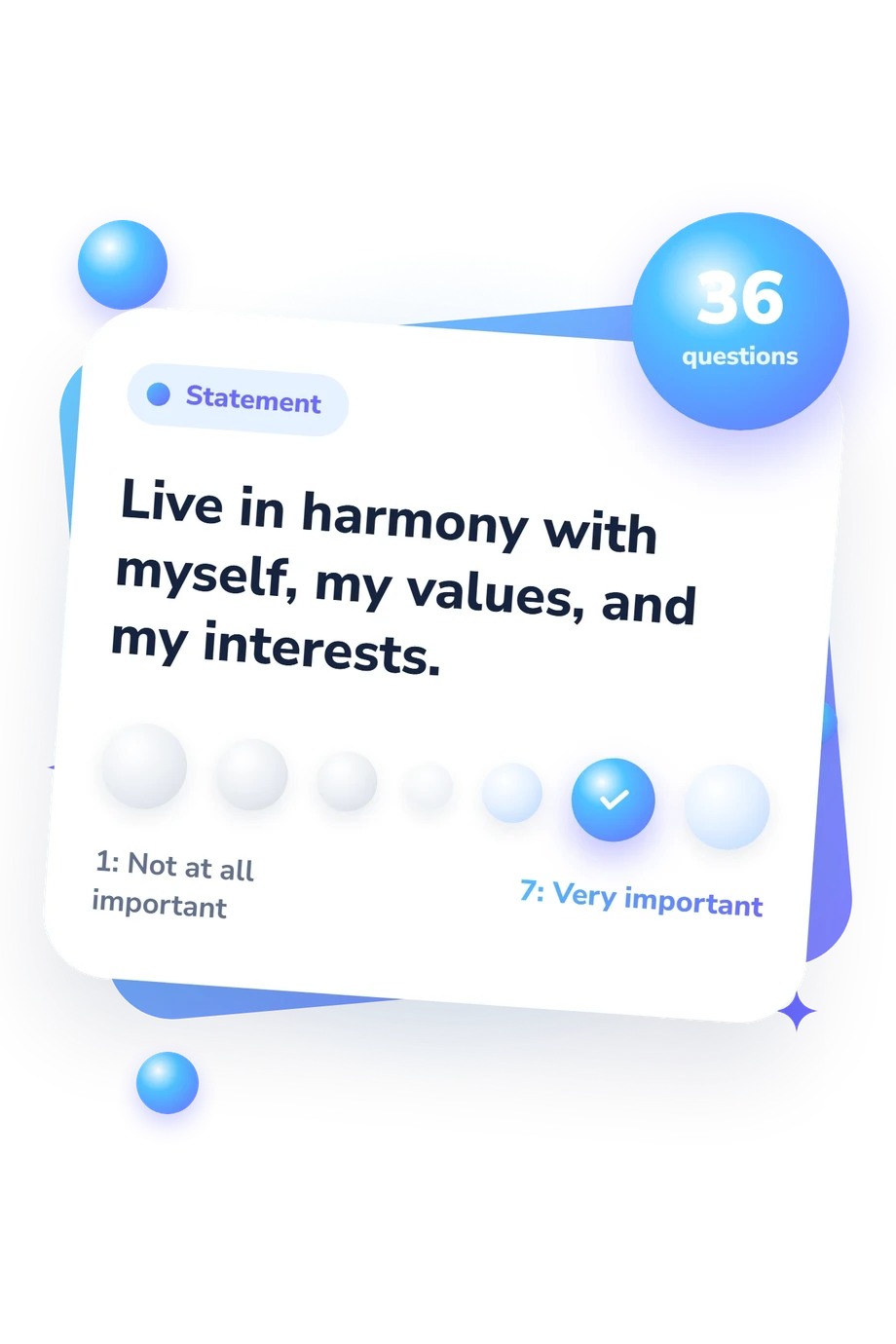
Everyone has long-term aspirations or goals that they hope to achieve over the course of their life. Below is a list of life goals. For each goal, please answer the following question: How important is this goal to you? Depending on the purpose of the study, you may also be asked to answer additional questions, such as: “How likely is it that you will achieve this goal in the future?” and “To what extent have you already achieved this goal?”
    • 1: Not at all important
    • 2
    • 3
    • 4: Moderately important
    • 5
    • 6
    • 7: Very important
    • 1: Not at all important
    • 2
    • 3
    • 4: Moderately important
    • 5
    • 6
    • 7: Very important
    • 1: Not at all important
    • 2
    • 3
    • 4: Moderately important
    • 5
    • 6
    • 7: Very important
WHAT THE TEST MEASURES
About This Assessment
Brief Index of Aspirations, AI Test

Brief Strivings Index (AI) Test - Symptoms and Signs

self-determination

Life goals can help clarify what currently motivates an individual. The Brief Strivings Index (AI) is a brief self-report measure designed to survey the relative salience of common goal domains and the respondent’s appraisal of those goals.

The instrument asks respondents to rate goal-related attributes (e.g., importance and perceived attainability and/or current realization) across broad areas of striving, supporting rapid clinical or research screening of motivational priorities. It contains 18 items and typically requires about 4 minutes to complete.

Results from the Brief Strivings Index (AI) may be used to guide discussion in counseling or coaching, to inform hypothesis generation about approach/avoidance patterns and values alignment, and to support group or research comparisons. Interpretation is best integrated with clinical context and other sources of information.

Author: E. L. Deci, R. M. Ryan
Literature: Deci, E. L., & Ryan, R. M. The “what” and “why” of goal pursuits: Human needs and the self-determination of behavior. Psychological Inquiry. 2000.; Sheldon, K. M., Ryan, R. M., Deci, E. L., & Kasser, T. The independent effects of goal contents and motives on well-being: It’s both what you pursue and why you pursue it. Personality and Social Psychology Bulletin. 2004.; Kasser, T., & Ryan, R. M. A dark side of the American dream: Correlates of financial success as a central life aspiration. Journal of Personality and Social Psychology. 1993.
Popular tests
Comments
Leave a Comment