
Self-Talk Scale Test
How the Scales are Structured
Who Usually Takes This Test?
See How You Compare
Below is a preview of how scores are typically distributed across each scale.
Example Questions From the Test
- Never
- Rarely
- Sometimes
- Often
- Very often
- Never
- Rarely
- Sometimes
- Often
- Very often
- Never
- Rarely
- Sometimes
- Often
- Very often
Self-Talk Scale Test - Description and methodology of the test
People who want to understand how they plan, review, encourage, or monitor themselves can use the Self-Talk Scale Test to examine recurring functions of inner speech. It is intended for readers reflecting on everyday self-regulation, reactions to mistakes and successes, and concern about others’ responses. As a self-talk questionnaire, it produces a four-part profile for focused personal reflection rather than a single overall judgment.
What This Assessment Explores
The items focus on inner dialogue during planning, reviewing mistakes, anticipating responses, and reactions to success or failure. They examine distinct functions rather than assuming self-talk is always helpful or harmful.
The result presents four dimensions:
- Self-Management (4-20) shows how inner dialogue organizes, plans, and monitors actions: Low 4-9, Moderate 10-14, High 15-20.
- Self-Criticism (4-20) shows internal criticism and analysis of mistakes: Low 4-9, Moderate 10-15, High 16-20.
- Self-Reinforcement (4-20) shows how self-talk supports and encourages you: Low self-reinforcement 4-9, Moderate self-reinforcement 10-15, High self-reinforcement 16-20.
- Social Evaluation (4-20) shows attention to others’ opinions when considering thoughts and actions: Low 4-9, Moderate 10-14, High 15-20.
Together, the profile shows which functions are more prominent for you. The resulting self-talk assessment can focus reflection on organization, criticism, support, and social expectations.
Methodology and Scientific Basis
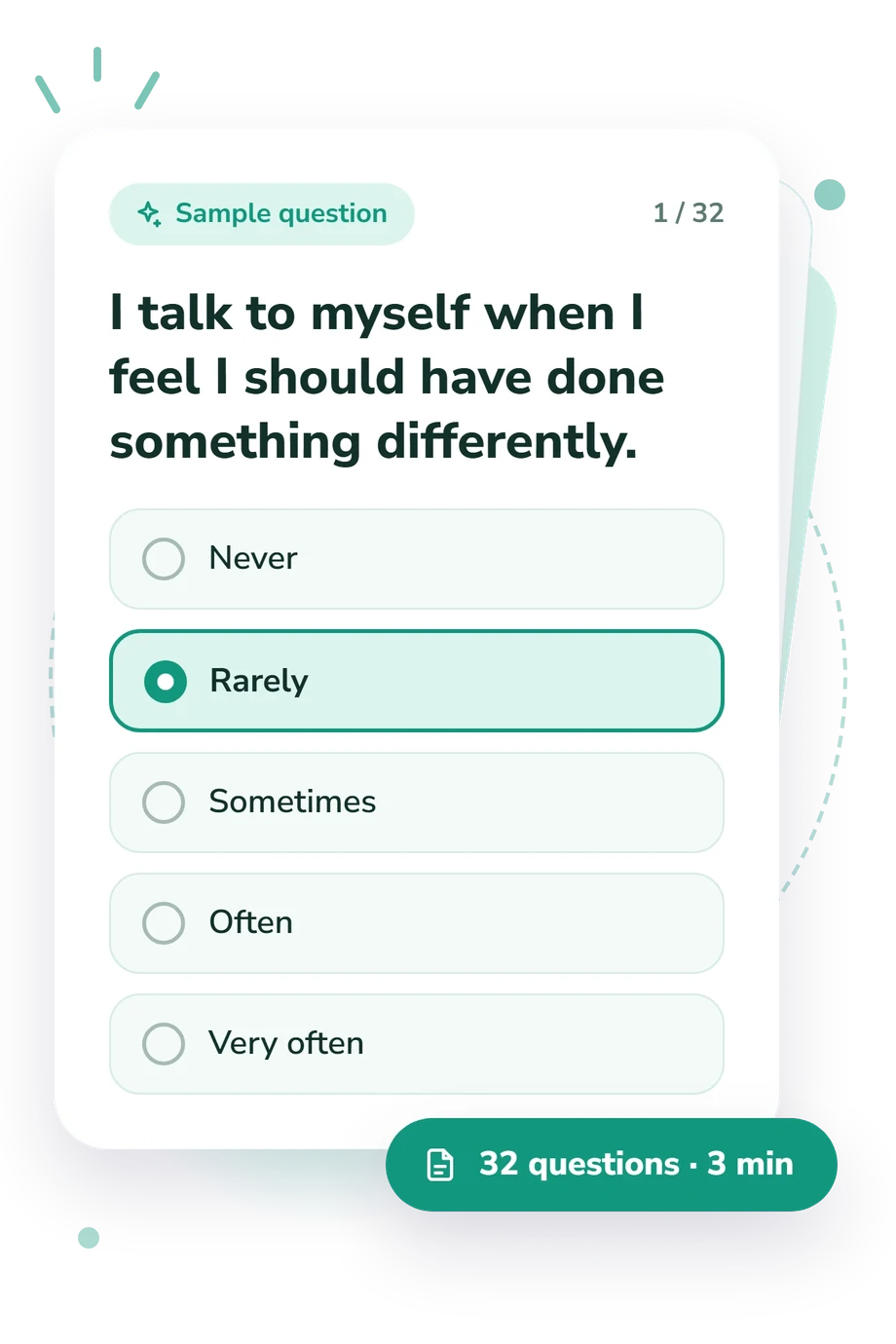
The prompts cover situations, thoughts, feelings, and self-directed speech. You rate how often each occurs using five frequency options: Never, Rarely, Sometimes, Often, or Very often. Responses are grouped by function into four separate scores rather than one total. Higher scores represent more of the tendency named by the relevant dimension; they do not all mean better functioning.
The structure is conceptually consistent with Self-Talk Scale (Brinthaupt et al., 2009), a published instrument that organizes self-talk into four related functions. Brinthaupt and Kang’s (2014) many-faceted Rasch analysis examined item and response-pattern calibration, while Oles et al. (2023) reported further validation of a Polish adaptation. These studies provide a relevant evidence base, but this online inner dialogue test should not be presented as a standardized version of those instruments.
Interpret the bands as descriptions of reported tendencies, not fixed qualities or clinical categories. Current mood, recent events, self-awareness, and willingness to acknowledge uncomfortable thoughts can influence answers. This online form has no stated population norms, so its scores are best used to identify themes for reflection; they do not establish a diagnosis or explain why a pattern occurs.
- Brinthaupt, Thomas M., Michael B. Hein, and Tracey E. Kramer. “The Self-Talk Scale: Development, Factor Analysis, and Validation.” Journal of Personality Assessment 91, no. 1 (2009): 82-92. 10.1080/00223890802484498
- Brinthaupt, Thomas M., and Minsoo Kang. “Many-Faceted Rasch Calibration: An Example Using the Self-Talk Scale.” Assessment 21, no. 2 (2014): 241-249. 10.1177/1073191112446653
- Oles, Piotr K., Katarzyna Pasternak, Aneta Kozioł, and Jan Kutnik. “Self-Talk Scale: Further Validation and Polish Adaptation.” Polish Psychological Bulletin 54, no. 2 (2023): 79-90. 10.24425/ppb.2023.146402
Updated: