
Humor Styles Questionnaire (HSQ) Test
How the Scales are Structured
Who Usually Takes This Test?
See How You Compare
Below is a preview of how scores are typically distributed across each scale.
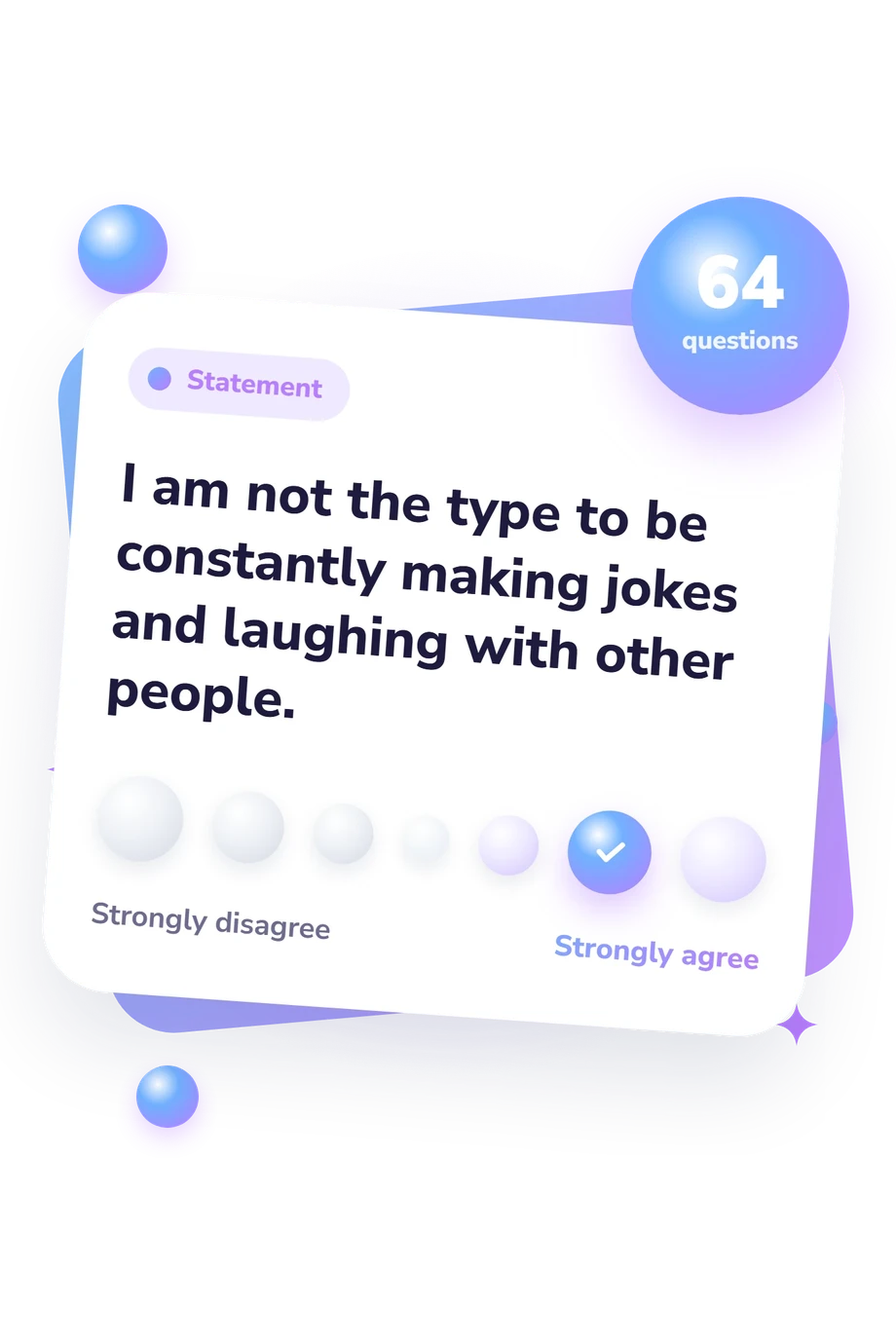
Example Questions From the Test
- Strongly disagree
- Disagree
- Slightly disagree
- Neither agree nor disagree
- Slightly agree
- Agree
- Strongly agree
- Strongly disagree
- Disagree
- Somewhat disagree
- Neither agree nor disagree
- Somewhat agree
- Agree
- Strongly agree
- Strongly disagree
- Disagree
- Somewhat disagree
- Neither agree nor disagree
- Somewhat agree
- Agree
- Strongly agree
Humor Styles Questionnaire (HSQ) Test - Description and methodology of the test
People who want to understand how humor operates in relationships, self-talk, and difficult moments can use this self-report profile for focused reflection. The Humor Styles Questionnaire (HSQ) Test describes recurring tendencies rather than fixed personality judgments. As a humor style assessment, it helps readers consider whether their humor supports connection, eases stress, involves seeking approval through self-directed humor, or creates interpersonal strain.
What This Assessment Explores
Across social situations and difficult moods, the items examine humor as interpersonal behavior and as a response to discomfort. They cover joking, self-directed criticism, teasing, sensitivity to offense, and finding amusement while upset. This humor style questionnaire offers a structured profile of everyday tendencies rather than a complete personality description.
The four displayed dimensions are:
- Self-Defeating Humor (8-56) measures self-directed joking for approval; Low 8-18, Moderate 19-39, High 40-56.
- Aggressive Humor (8-56) measures sarcasm, ridicule, or teasing that may strain relationships; Low 8-23, Moderate 24-42, High 43-56.
- Self-Enhancing Humor (8-56) measures optimism and humor-based coping with stress; Low 8-25, Moderate 26-44, High 45-56.
- Affiliative Humor (8-56) measures warm, tolerant joking that supports connection; Low 8-28, Moderate 29-46, High 47-56.
Different levels reflect tendencies toward approval-seeking self-directed humor, potentially hurtful humor, stress-coping humor, and relationship-enhancing humor.
Methodology and Evidence Base
A seven-point agreement format runs from strongly disagree to strongly agree, with a neutral midpoint. Items address social joking, self-criticism used for amusement, concern about offending others, and finding humor during low or stressful moods. Together, they examine humor’s function rather than simply perceived funniness.
Displayed scoring combines responses into four dimension scores. The displayed bands are descriptive categories for the scores reported here. Together, the four scores summarize how strongly the respondent endorses the corresponding humor tendencies.
The relevant published framework is the Humor Styles Questionnaire (Martin et al., 2003), and this questionnaire is conceptually consistent with it rather than a direct adaptation. Ruch and Heintz (2016) examined a German version, and their 2017 experimental study reported limited construct and criterion validity. Those studies concern the published HSQ and a German version, not this online humor questionnaire.
Current mood, memory, self-awareness, and the wish to appear considerate can shift self-reports. Read the result as a structured snapshot of reported tendencies, alongside the situations and relationships behind particular answers.
- Martin, Rod A., Patricia Puhlik-Doris, Gwen Larsen, Jeanette Gray, and Kelly Weir. (2003). Individual differences in uses of humor and their relation to psychological well-being: Development of the Humor Styles Questionnaire. Journal of Research in Personality, 37(1), 48-75. 10.1016/S0092-6566(02)00534-2
- Ruch, Willibald, and Sonja Heintz. (2016). The German Version of the Humor Styles Questionnaire: Psychometric Properties and Overlap With Other Styles of Humor. Europe's Journal of Psychology, 12(3), 434-455. 10.5964/ejop.v12i3.1116
- Ruch, Willibald, and Sonja Heintz. (2017). Experimentally Manipulating Items Informs on the (Limited) Construct and Criterion Validity of the Humor Styles Questionnaire. Frontiers in Psychology, 8, 616. 10.3389/fpsyg.2017.00616
Updated: