
Identity Style Inventory (ISI-5) Test
How the Scales are Structured
Who Usually Takes This Test?
See How You Compare
Below is a preview of how scores are typically distributed across each scale.
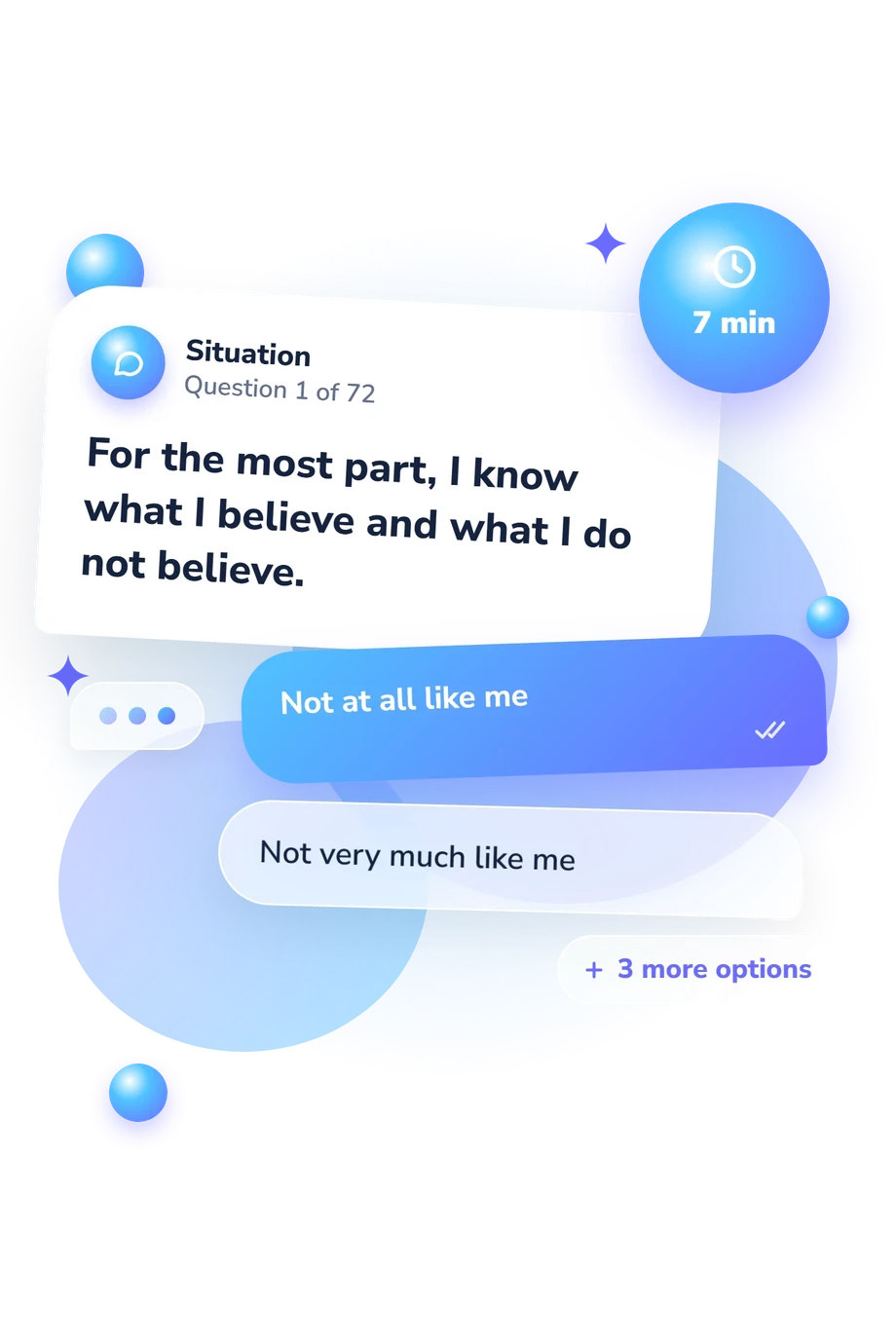
Example Questions From the Test
- Not at all like me
- Mostly not like me
- Somewhere in between
- Mostly like me
- Describes me very well
- Not at all like me
- Somewhat unlike me
- Neither like nor unlike me
- Somewhat like me
- Describes me very accurately
- Not at all like me
- Mostly not like me
- Somewhere in between
- Mostly like me
- Describes me very accurately
Identity Style Inventory (ISI-5) Test - Description and methodology of the test
For people reflecting on how they define themselves, make important choices, or respond to inherited expectations, the Identity Style Inventory (ISI-5) Test offers a structured snapshot of identity processing. It is useful when you want language for patterns in values, goals, self-reflection, and decision-making. This identity processing style test can show how strongly separate patterns appear in your profile rather than assigning one overall identity type.
What This Assessment Explores
It examines identity processing. It links values, goals, expectations, and decisions to self-definition. The identity style questionnaire covers four dimensions:
- Commitment (1-5) shows clarity and stability of values, beliefs, and attitudes; Low commitment 1-1.52, Moderate commitment 1.53-2.84, High commitment 2.85-5.
- Diffuse-Avoidant Style (1-5) assesses decision-making avoidance and situation-led behavior, alongside an external locus of control, limited self-control, and identity instability; Low 1-1.52, Moderate 1.53-2.84, High 2.85-5.
- Normative Style (1-5) assesses adopting significant others’ standards, conscientiousness, discipline, and limited tolerance for uncertainty; Low normative 1-2.13, Moderate normative 2.14-3.39, High normative 3.4-5.
- Informational Style (1-5) assesses self-reflection, feedback, open-mindedness, and personal efficacy; Low 1-3.06, Moderate 3.07-4.24, High 4.25-5.
Methodology and Scientific Basis
The representative items in this identity processing questionnaire are first-person statements about beliefs, future direction, problems, values, or decisions. Choose one of five ordered responses, from not at all like me to describes me very well, based on how well the statement fits you.
Responses produce separate dimensional scores, not one total identity score. Higher scores indicate more of the tendency named by a scale. Displayed bands organize results into low, moderate, or high levels, but the questionnaire does not state an item-by-item scoring formula; points should not be inferred from ranges.
Conceptually, the questionnaire is consistent with the ISI-5, associated with Berzonsky and colleagues, and Berzonsky’s social-cognitive account of identity processing. The 2013 study reported factor, reliability, and validity evidence for the instrument, while Bosch and Card’s meta-analysis examined relationships among styles and commitment. This evidence does not establish standardization or validation for the online implementation.
Self-report results can reflect current circumstances, self-awareness, and impression management. Read the profile as a reflection prompt, not a diagnosis or stand-alone clinical conclusion, alongside context.
- Berzonsky, Michael D., Bart Soenens, Koen Luyckx, Ilse Smits, Dennis R. Papini, and Luc Goossens. "Development and validation of the revised Identity Style Inventory (ISI-5): Factor structure, reliability, and validity." Psychological Assessment 25, no. 3 (2013): 893-904. 10.1037/a0032642
- Berzonsky, Michael D. "Identity Style: Conceptualization and Measurement." Journal of Adolescent Research 4, no. 3 (1989): 267-281. 10.1177/074355488943002
- Bosch, Leslie A., and Noel A. Card. "A meta-analytic review of Berzonsky's Identity Style Inventory (ISI)." Journal of Adolescence 35, no. 2 (2012): 333-343. 10.1016/j.adolescence.2011.08.007
Updated: