
Conflict Resolution Styles Inventory (CRSI) Test
How the Scales are Structured
Who Usually Takes This Test?
See How You Compare
Below is a preview of how scores are typically distributed across each scale.
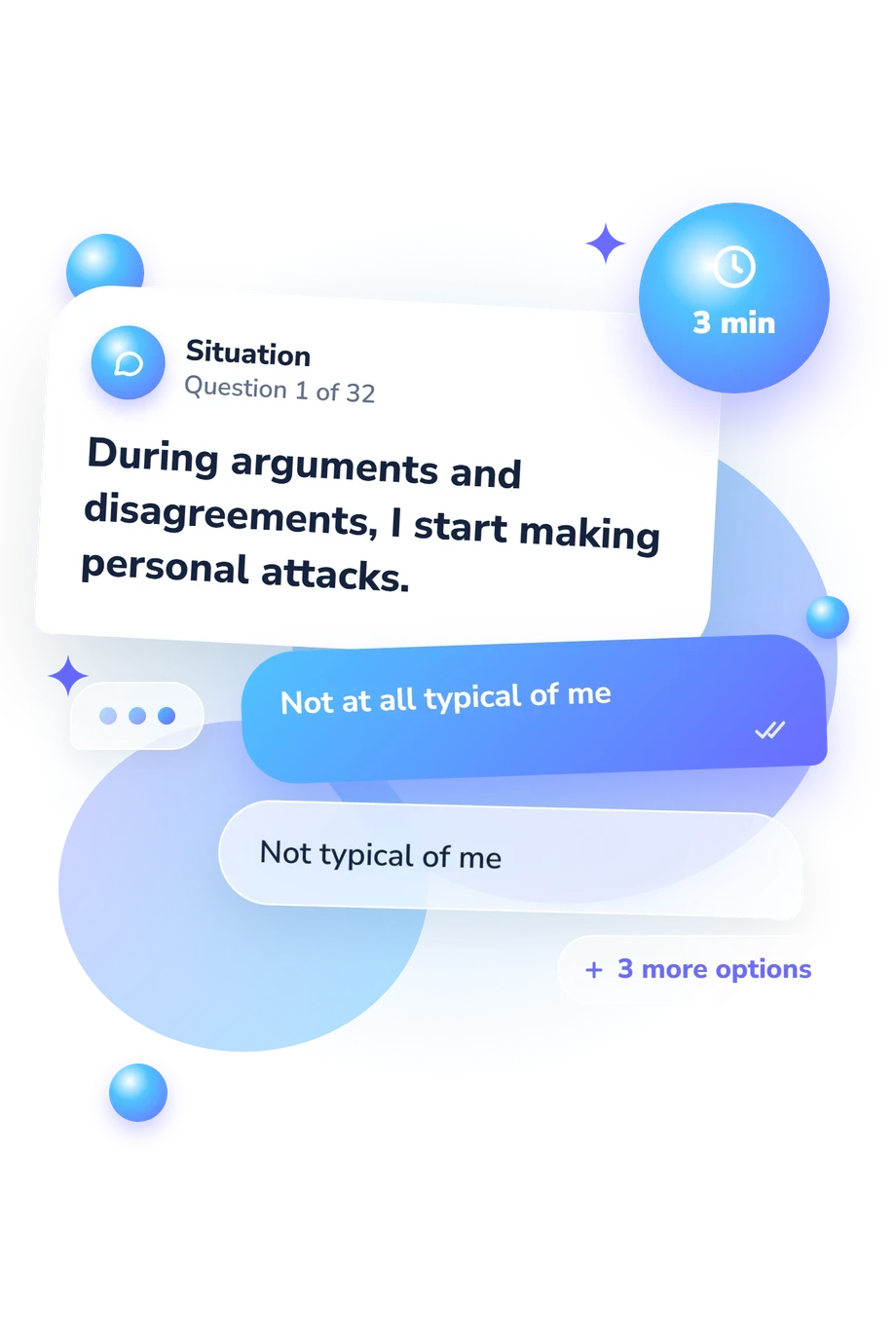
Example Questions From the Test
- Not at all true
- Not true
- Sometimes true, sometimes not true
- True
- Very true
- Not at all characteristic of me
- Not characteristic of me
- Sometimes characteristic, sometimes not
- Characteristic of me
- Very characteristic of me
- Not at all characteristic of me
- Not characteristic of me
- Sometimes characteristic, sometimes not
- Characteristic of me
- Very characteristic of me
Conflict Resolution Styles Inventory (CRSI) Test - Description and methodology of the test
For readers who want a clearer picture of their behavior during relationship disagreements, this Conflict Resolution Styles Inventory (CRSI) Test organizes recurring ways of responding into an interpretable profile. It can help someone reflect on whether they tend to accommodate, distance themselves, react intensely, or work toward cooperation, while placing those conflict resolution styles in the context of everyday communication rather than treating one response as a fixed identity.
What This Assessment Explores
This conflict resolution style test examines four response patterns in close-relationship disagreements. It suits readers reflecting on communication habits and wanting to recognize both difficult reactions and constructive resources. The profile describes tendencies in the situations represented by the items, not a fixed identity or a judgment of the whole relationship.
The result presents each dimension with the following score bands:
- Accommodating Style (1-5) reflects agreement or approval used to avoid conflict; Low (1-1.5), Moderate (1.6-3.3), and High (3.4-5).
- Withdrawal Style (1-5) reflects disengaging from conflict discussion; Low distancing (1-1.5), Moderate distancing (1.6-3.5), and High distancing (3.6-5).
- Engagement Style (1-5) reflects anger, hostility, criticism, and personal attacks; Low (1-1.4), Moderate (1.5-3.4), and High (3.5-5).
- Positive Style (1-5) reflects responsibility, compromise, and open discussion; Low (1-2.9), Moderate (3-3.9), and High (4-5).
Methodology and Scientific Basis
Each item asks how characteristic a conflict behavior is on five ordered choices from 1 to 5. Wording varies among the terms true, characteristic, and typical, but the response scale runs from not describing the respondent to describing them very strongly. Four thematic styles receive separate displayed scores on a 1-5 scale.
Lower, intermediate, and higher bands describe expression within this questionnaire. No standardized norms or clinical interpretation are specified for this online questionnaire, so the displayed bands are within-questionnaire levels.
The patterns are conceptually consistent with Kurdek’s published Conflict Resolution Styles Inventory, or CRSI, but this separate online self-report measure does not claim to be that instrument or inherit its validation. A 2024 study by Trifan, Meeus, and Branje examined the CRSI’s dimensionality across ages and relationship contexts, supporting a multidimensional reading.
As a relationship conflict questionnaire, it captures the respondent’s perspective, not an external behavioral record.
Responses may shift with current stress, the relationship in mind, self-awareness, and willingness to report behavior honestly, so interpret the profile in context before drawing conclusions about communication or relationship quality.
- Kurdek, Lawrence A. (1994). Conflict Resolution Styles in Gay, Lesbian, Heterosexual Nonparent, and Heterosexual Parent Couples. Journal of Marriage and the Family, 56(3), 705-722. 10.2307/352880
- Trifan, Tatiana Alina, Wim Meeus, and Susan Branje. (2024). The dimensionality of the Conflict Resolution Styles Inventory across age and relationships. Frontiers in Psychology, 15, 1233279. 10.3389/fpsyg.2024.1233279
Updated: