
Freudly+971 508685814hello@freudly.ai
Freudly
loneliness

Loneliness Experience Questionnaire Test
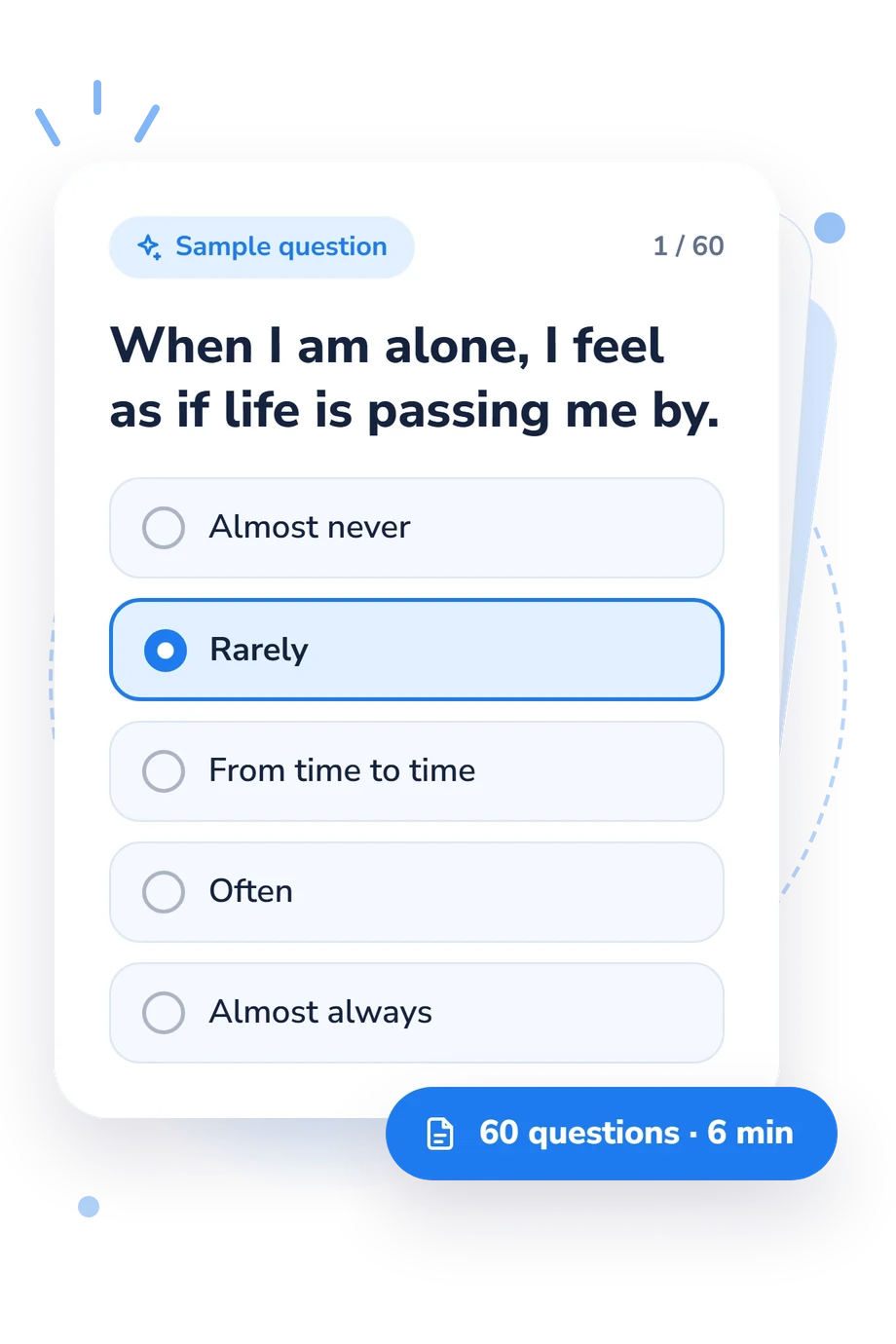
Take the online Loneliness Experience Questionnaire Test - AI psychologist FreudlyYou can take Loneliness Experience Questionnaire Testhere. Online version of a simple and accurate psychological test with interpretation.en
Understand the specific emotional patterns behind loneliness in about 6 minutes. With 30 targeted items, it delivers clear, nuanced insights to guide care and research.
Start Online Test
Questions: 306 minutes
08:30
October 2, 2025
October 2, 2025
Material has been updated
October 2, 2025
Material has been published
19,421 view
1,696 completions
1,398 likes
Verified by Daniel Hall
Psychologist with 25 years of experience
Share
Scale Explorer

How the Scales are Structured

example score
20/25
Fear of Responsibility (FoR)
Measures how strongly a person’s loneliness is associated with avoiding responsibility for others, which may contribute to social withdrawal.
Low
Moderate
High
511: Low | 1218: Moderate | 1925: High
A score of 20 falls in the High range, suggesting loneliness may be closely tied to reluctance to take responsibility for others and a tendency to keep interpersonal distance.
example score
12/25
Temporary Phenomenon (TP)
This scale measures the extent to which a person experiences loneliness as a temporary, involuntary state linked to current circumstances.
Low
Moderate
High
511: Low | 1218: Moderate | 1925: High
A score of 12 suggests a moderate tendency to view loneliness as a temporary, situational experience rather than a stable personal condition.
example score
18/25
Denial (D)
Measures the tendency to minimize or deny feelings of loneliness as a psychological defense and reluctance to acknowledge the issue.
Low denial
Moderate denial
High denial
511: Low denial | 1218: Moderate denial | 1925: High denial
A score of 18 indicates a moderate tendency to downplay or distance from feelings of loneliness, which may make the experience harder to recognize and articulate.
example score
20/25
Negative Affect (NA)
Measures how strongly loneliness is experienced as an unpleasant state marked by emotional discomfort and dissatisfaction with interpersonal relationships.
Low
Moderate
High
511: Low | 1218: Moderate | 1925: High
A score of 20 falls in the High range, suggesting loneliness is often accompanied by noticeable emotional discomfort and a sense of dissatisfaction with current relationships.
example score
59/150
Overall Loneliness (OL)
This scale measures the overall intensity of loneliness experienced across multiple facets of a person’s life.
Low
Moderate
High
3069: Low | 70109: Moderate | 110150: High
A score of 59 falls in the Low range, suggesting a generally lower cumulative level of loneliness across assessed aspects.
example score
16/25
Spiritual (S)
Measures the degree of spiritual loneliness linked to feeling a lack of support, understanding, and kindred spirits.
Low
Moderate
High
511: Low | 1218: Moderate | 1925: High
A score of 16 indicates a moderate level of spiritual loneliness, suggesting occasional or situational feelings of not being understood or supported by like-minded people.
example score
15/25
Physical (P)
Measures feelings of physical loneliness linked to perceived unattractiveness and insufficient social contact.
Low
Moderate
High
511: Low | 1218: Moderate | 1925: High
A score of 15 falls in the Moderate range, suggesting occasional or situational feelings of physical loneliness tied to self-perception and social contact.
Start Online Test
just completed the test
DATA-BASED USER COHORTS

Who Usually Takes This Test?

People feeling disconnected
41%OF USERS
They sense a persistent distance from others and want to understand the specific emotions and patterns behind it.
Clients in therapy
34%OF USERS
They are already reflecting on their emotional life and use the results to name subtle aspects of loneliness and discuss them in sessions.
Psychology students and researchers
25%OF USERS
They take it for coursework or studies to explore the multidimensional nature of loneliness and compare profiles across groups.
BASED ON AGGREGATED, ANONYMIZED DATA FROM TENS OF THOUSANDS OF FREUDLY USERS.
Benchmarking

See How You Compare

Once you complete the test, your results are compared with real-world data from people in your country.
Below is a preview of how scores are typically distributed across each scale.
Fear of Responsibility (FoR)
Average
19.7
Normal range
16.123.4
min.
5
max.
25
This curve shows how scores are typically distributed.
Once you complete the test, your result will appear on the scale so you can see how you compare.
Temporary phenomenon (Tp)
Average
17.4
Normal range
14.420.5
min.
5
max.
25
This curve shows how scores are typically distributed.
Once you complete the test, your result will appear on the scale so you can see how you compare.
Denial (D)
Denial (D)
Average
16.8
Normal range
14.319.2
min.
5
max.
25
This curve shows how scores are typically distributed.
Once you complete the test, your result will appear on the scale so you can see how you compare.
Negative feeling (Nf)
Average
15.5
Normal range
12.718.2
min.
5
max.
25
This curve shows how scores are typically distributed.
Once you complete the test, your result will appear on the scale so you can see how you compare.
Overall Loneliness Score (OLS)
Average
117.6
Normal range
102.7132.6
min.
30
max.
150
This curve shows how scores are typically distributed.
Once you complete the test, your result will appear on the scale so you can see how you compare.
Spiritual (S)
Spiritual (S)
Average
10.4
Normal range
7.912.8
min.
5
max.
25
This curve shows how scores are typically distributed.
Once you complete the test, your result will appear on the scale so you can see how you compare.
Physical (P)
Physical (P)
Average
14.3
Normal range
11.117.4
min.
5
max.
25
This curve shows how scores are typically distributed.
Once you complete the test, your result will appear on the scale so you can see how you compare.
Featured On
SAMPLE QUESTIONS

Example Questions From the Test

    • Almost never
    • Rarely
    • From time to time
    • Often
    • Almost always
    • Almost never
    • Rarely
    • From time to time
    • Often
    • Almost always
    • Almost never
    • Rarely
    • From time to time
    • Often
    • Almost always
WHAT THE TEST MEASURES
About This Assessment
Loneliness Experience Questionnaire Test

Loneliness Experience Questionnaire Test - Symptoms and Signs

loneliness
social alienation

This instrument is designed to assess subjective experiences related to perceived loneliness. The Loneliness Experience Questionnaire is a brief self-report measure intended for use in clinical screening or research contexts.

The measure includes 30 items and typically takes about 6 minutes to complete. Item content focuses on the respondent’s perceived social and emotional experience, supporting characterization of loneliness-related distress and its potential clinical correlates. When interpreted in context, results may help inform case conceptualization, treatment planning, or monitoring over time.

The Loneliness Experience Questionnaire was developed by Daniel Perlman and Letitia Anne Peplau. Scores should be interpreted alongside clinical interview data and relevant collateral information rather than used as a standalone diagnostic indicator.

Author: Daniel Perlman, Letitia Anne Peplau
Literature: Russell, D. W. UCLA loneliness scale (version 3): Reliability, validity, and factor structure. Journal of Personality Assessment. 1996.
Popular tests
Comments
Leave a Comment