
Positive Parental Feelings Scale Test
How the Scales are Structured
Who Usually Takes This Test?
See How You Compare
Below is a preview of how scores are typically distributed across each scale.
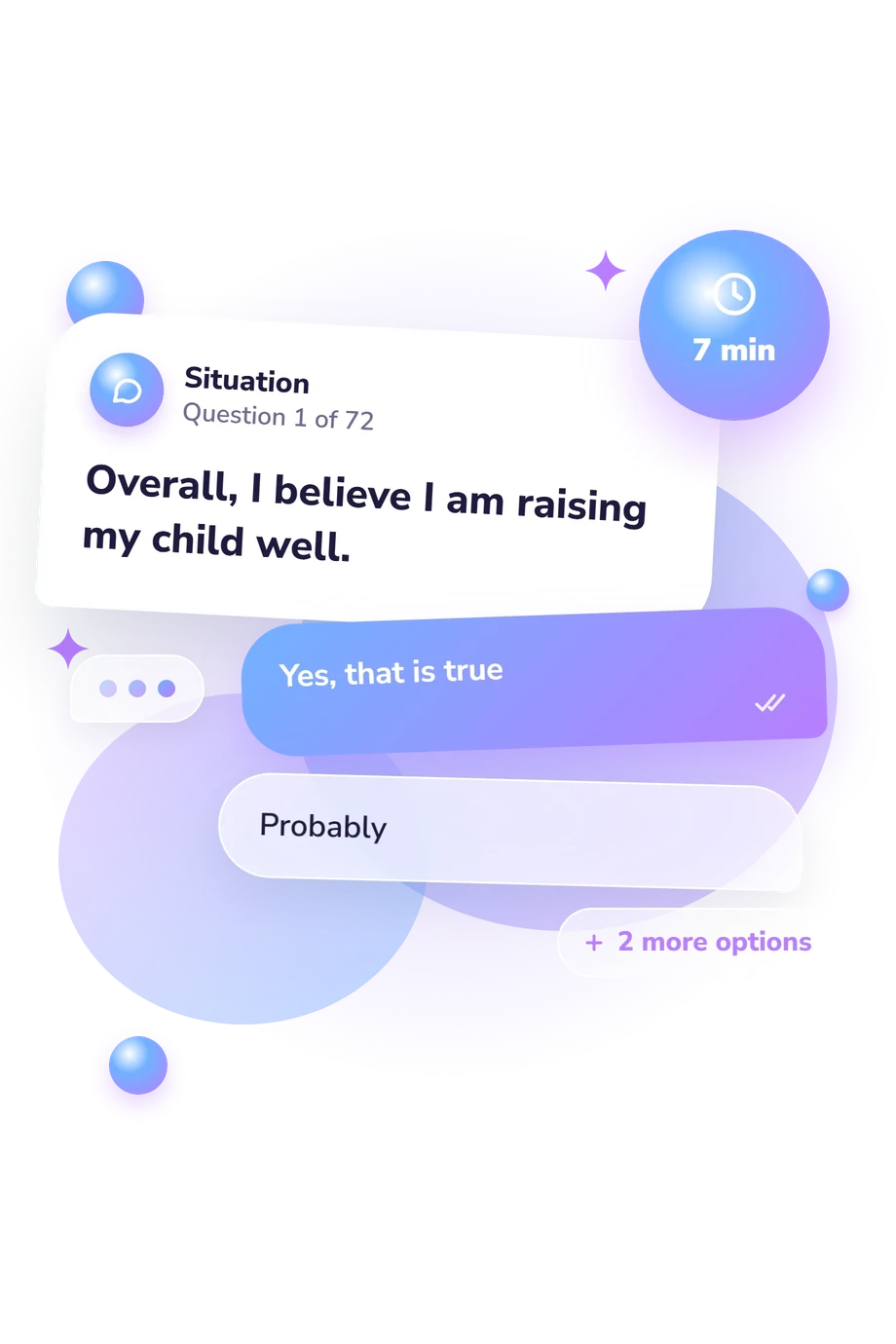
Example Questions From the Test
- Yes, that is true
- Probably
- Unlikely
- No, not at all
- Yes, this is true
- This is probably true
- This is probably not true
- No, this is not true at all
- Yes, this is true
- This is probably true
- This is probably not true
- No, this is not true at all
Positive Parental Feelings Scale Test - Description and methodology of the test
Parents who want a clearer picture of their emotional experience may use the Positive Parental Feelings Scale Test to examine affection, acceptance, confidence, and family security. This parental feelings assessment is suited to personal reflection when you are considering how you relate to your child, your role, the other parent, and the everyday meaning of family life. It describes tendencies rather than explaining a single event.
What This Assessment Explores
This positive parenting questionnaire presents:
- Toward the Child (18-72) measures positivity: Low positivity (18-48); Moderate positivity (49-60); High positivity (61-72).
- Unconditional Acceptance (0-0) measures bond, worth: Acceptance present (0-0); Acceptance present (0-0). Strengths and Achievements (0-0) shows pride: Fixed score (0-0); Only possible level (0-0).
- Parental Love (6-24) measures trust: Lower (6-12); Moderate (13-20); High (21-24). Toward Spouse as a Parent (6-24) shows security: Lower (6-12); Moderate (13-20); High (21-24).
- Toward Parenthood Overall (0-0) measures enjoyment: Lower positive feelings (0-0); Higher positive feelings (0-0). Toward Oneself as a Parent (0-0) shows confidence: Score unavailable (0-0); No variability (0-0).
- Overall Positive Parental Feelings (36-144) measures family attitudes: Low (36-72); Moderate (73-96); High (97-144).
Methodology and Evidence Base
Items group around child-directed feelings, unconditional acceptance, pride in strengths, the parenting role, the other parent, and overall family experience. Each statement offers four ordered responses, from agreement or truth to rejection. The format captures degree of endorsement rather than a yes-or-no choice.
Scores are reported by dimension and as an overall index. Higher values on variable scales indicate more positive feelings, but no universal point value for every answer is stated. Fixed 0-0 outputs indicate no variability in those displayed dimensions, not absence of the underlying experience.
Conceptually, the questionnaire is consistent with the Positive Parental Feelings Questionnaire (Padurina, 2008), Padurina’s 2014 account, and Basimov and Padurina’s 2019 analysis of linear and nonlinear structure. It is not a direct adaptation of those publications. This parenting self-reflection test has no documented normative sample or standardized clinical thresholds, so its bands are descriptive. Self-report means current stress, family circumstances, and impression management can shape the profile; read it as a structured snapshot rather than a diagnosis.
- Padurina, Elena A. (2008). Development of Positive Parental Feelings as a Factor in Correcting Preschoolers' Self-Esteem: Dissertation for the Degree of Candidate of Psychological Sciences. Yekaterinburg: Ural State University named after A. M. Gorky, 231 pp.
- Padurina, Elena A. (2014). Positive Parental Feelings: Linear and Nonlinear Psychology. Kurgan: Kurgan State University Press, 147 pp. ISBN 978-5-4217-0292-4.
- Basimov, Mikhail, and Padurina, Elena. (2019). The Non-Linear Nature of Positive Parental Feelings. The European Proceedings of Social & Behavioural Sciences, 3755-3763. 10.15405/epsbs.2019.12.04.503
Updated: