
Individualism–Collectivism Scale Test
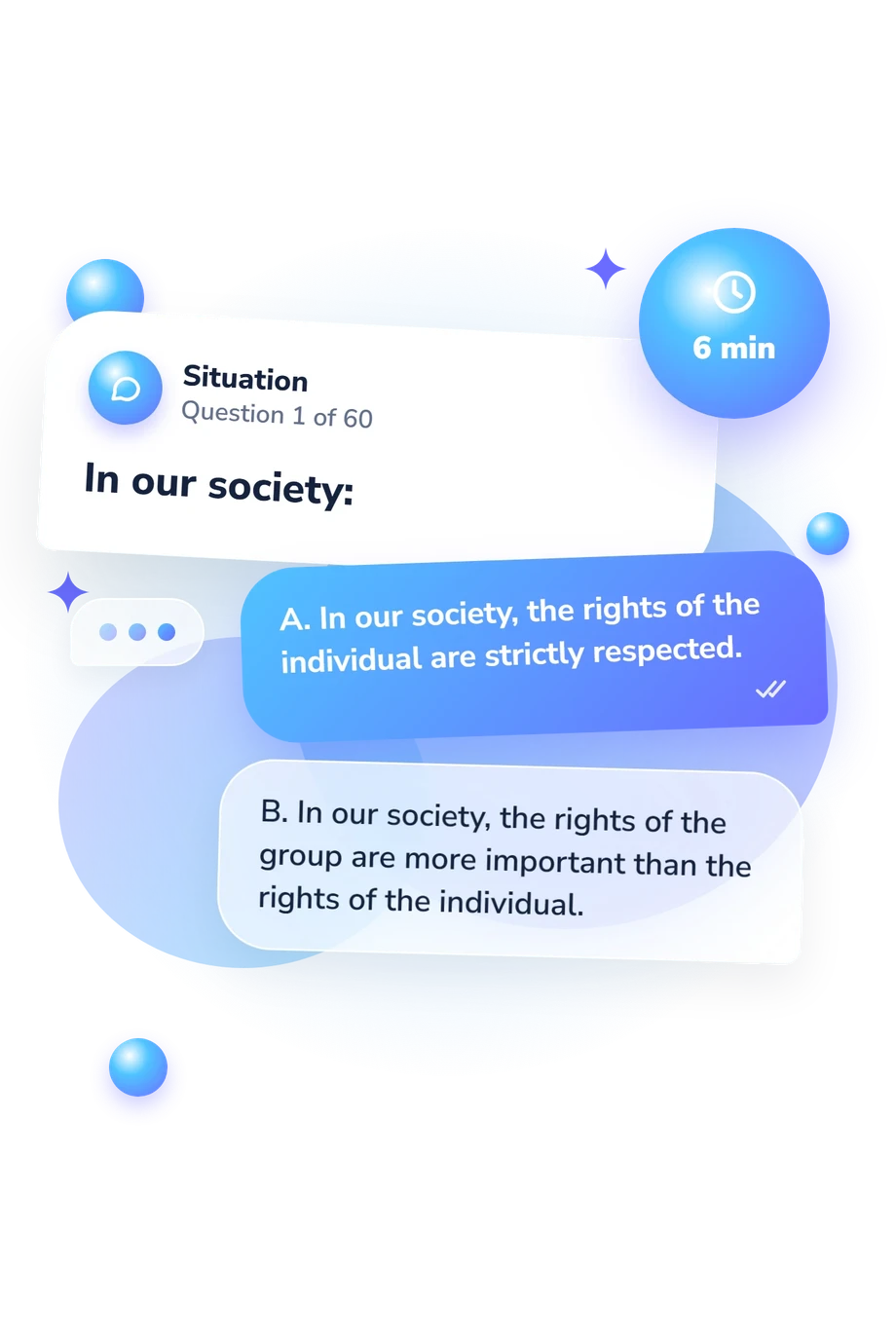
How the Scales are Structured
Who Usually Takes This Test?
See How You Compare
Below is a preview of how scores are typically distributed across each scale.
Example Questions From the Test
- At work (or in school), I need to be sure that I can do what I consider necessary to get the job done.
- At work (or in school), I need to be sure that I am making a significant contribution to the group’s work.
- I believe women should focus on their own roles and not seek work traditionally done by men.
- I believe women should do the same kinds of work as men.
- I always consult family or friends.
- I try to think it through on my own, without consulting anyone.
Individualism–Collectivism Scale Test - Description and methodology of the test
People who want to understand how they balance autonomy, loyalty, and shared responsibility can use this Individualism-Collectivism Scale Test as a structured self-report exercise. It is suitable for readers reflecting on values in friendships, family, study, or work. The format also works as an individualism and collectivism assessment, describing relative preferences for independent action or group connection rather than assigning a fixed identity.
What This Assessment Explores
The questions examine how a person approaches independence, mutual obligation, status, authority, family influence, and cooperation. They also touch on reactions to success, failure, conflict, approval, reciprocity, and the balance between personal rights and group interests. The paired statements make this an individualism vs collectivism test for reflecting on everyday social preferences, not just abstract opinions.
The result is organized into two complementary dimensions:
- Individualism (0-30) measures orientation toward personal interests, autonomy, and independence. Its bands are Collectivist-leaning 0-10, Balanced 11-20, and Individualist-leaning 21-30.
- Collectivism (0-30) measures orientation toward group interaction and prioritizing collective interests over personal interests. Its bands are More individualist 0-10, Balanced 11-20, and More collectivist 21-30.
Together, they show which orientation is more prominent in the responses, while allowing mixed patterns across work, family, and friendship contexts.
Methodology and Scientific Basis
Each prompt presents two contrasting statements, and the respondent selects the option that more closely matches their usual view or behavior. The choices cover decisions, relationships, work, study, family expectations, social approval, reciprocity, and conflict. The selected options are then summarized as two dimension scores; higher values indicate stronger endorsement of the orientation defined by the corresponding dimension. The result should be read through its bands, with a balanced range indicating neither pole clearly dominates.
In practice, this individualism and collectivism questionnaire is conceptually consistent with Triandis et al. (1985), which examined allocentric and idiocentric tendencies, and with the self-ingroup model discussed by Triandis et al. (1988). Triandis’s 1995 book supplies the broader framework. These sources support the construct explored; the questionnaire applies it to choices involving initiative, cooperation, obligations, and social harmony.
The displayed bands organize the two scores descriptively; they do not establish a diagnosis or explain every context in which preferences appear. Self-report results may shift with current circumstances, self-awareness, or the wish to appear socially acceptable; read the profile as a context-sensitive snapshot of stated preferences.
- Triandis, H. C., Leung, K., Villareal, M. J., & Clack, F. I. (1985). Allocentric versus idiocentric tendencies: Convergent and discriminant validation. Journal of Research in Personality, 19(4), 395-415. 10.1016/0092-6566(85)90008-X
- Triandis, H. C., Bontempo, R., Villareal, M. J., Asai, M., & Lucca, N. (1988). Individualism and collectivism: Cross-cultural perspectives on self-ingroup relationships. Journal of Personality and Social Psychology, 54(2), 323-338. 10.1037/0022-3514.54.2.323
- Triandis, H. C. (1995). Individualism and collectivism. Boulder, CO: Westview Press.
Updated: