
Freudly+971 508685814hello@freudly.ai
Freudly
self-acceptance

Self-Confidence Assessment Test
Take the online Self-Confidence Assessment Test - AI psychologist FreudlyYou can take Self-Confidence Assessment Testhere. Online version of a simple and accurate psychological test with interpretation.en
Understand how strongly you trust yourself across key areas of life in about 14 minutes. Get a clear overall score plus domain insights to build confidence and target growth.
Start Online Test
Questions: 7314 minutes
08:30
October 2, 2025
October 2, 2025
Material has been updated
October 2, 2025
Material has been published
22,094 views
2,663 completions
2,103 likes
Verified by Daniel Hall
Psychologist with 25 years of experience
Share
Scale Explorer

How the Scales are Structured

example score
2/4
Leisure (L)
This scale measures how much you trust yourself to plan, organize, and enjoy your free time in a satisfying way.
Low self-trust
Moderate self-trust
High self-trust
01: Low self-trust | 23: Moderate self-trust | 4: High self-trust
A score of 2 suggests a moderate level of self-trust in leisure, with some confidence in organizing free time but room to feel more consistently satisfied and self-directed.
example score
2/5
Opposite Sex (OS)
This scale measures confidence in your attractiveness and ability to communicate effectively with members of the opposite sex.
Low confidence
Moderate confidence
High confidence
01: Low confidence | 23: Moderate confidence | 45: High confidence
A score of 2 suggests a moderate level of self-trust in appealing to members of the opposite sex, with some confidence present but not consistently steady.
example score
2/4
With Parents (WP)
This scale measures how confidently you rely on your own feelings and judgment when building relationships with your parents.
Low self-trust
Moderate self-trust
High self-trust
01: Low self-trust | 23: Moderate self-trust | 4: High self-trust
A score of 2 indicates a moderate level of self-trust with parents, suggesting some confidence in your ability to relate authentically while still experiencing uncertainty in certain situations.
example score
3/6
With Children (WC)
This scale measures how confident and self-reliant you feel in your ability to parent and connect with children.
Low self-trust
Moderate self-trust
High self-trust
02: Low self-trust | 34: Moderate self-trust | 56: High self-trust
A score of 3 suggests a moderate level of self-trust with children, with some situations feeling manageable and others prompting uncertainty.
example score
5/7
In the Family (ItF)
This scale measures how confidently a person trusts their ability to build and maintain harmonious relationships within their family.
Low
Moderate
High
02: Low | 35: Moderate | 67: High
A score of 5 indicates a moderate level of self-trust in the family domain, suggesting you generally feel capable of navigating family interactions while still experiencing some uncertainty in certain situations.
example score
2/6
With Supervisors (WS)
This scale measures how confidently you trust your own judgment and communicate effectively when interacting with superiors or authority figures.
Low self-trust
Moderate self-trust
High self-trust
02: Low self-trust | 34: Moderate self-trust | 56: High self-trust
A score of 2 suggests relatively low self-trust with superiors, with greater hesitation or reliance on external approval in interactions with management or authority figures.
example score
3/6
With Subordinates (WS)
This scale measures how confidently you trust your judgment and leadership effectiveness when working with subordinates.
Low self-trust
Moderate self-trust
High self-trust
02: Low self-trust | 34: Moderate self-trust | 56: High self-trust
A score of 3 indicates a moderate level of self-trust with subordinates, suggesting you can lead and communicate effectively at times but may hesitate in more challenging team situations.
example score
2/8
With Close People (WCP)
This scale measures how confidently you rely on your own judgment and feelings when building and maintaining relationships with close people.
Low
Moderate
High
02: Low | 35: Moderate | 68: High
A score of 2 indicates low self-trust with close ones, suggesting you may often doubt your own perceptions or decisions in close relationships.
example score
2/7
In Solving Everyday Problems (ISEP)
This scale measures how much you trust your ability to handle everyday tasks and routine challenges independently.
Low
Moderate
High
02: Low | 35: Moderate | 67: High
A score of 2 indicates low self-trust in solving everyday problems, suggesting you may often feel uncertain about managing routine tasks without extra support.
example score
4/10
Intellectual Domain (ID)
This scale measures confidence in your intellectual abilities and problem-solving skills.
Lower self-trust
Moderate self-trust
Higher self-trust
03: Lower self-trust | 47: Moderate self-trust | 810: Higher self-trust
A score of 4 indicates moderate self-trust in the intellectual domain, suggesting you sometimes rely on your thinking skills but may still second-guess your abilities in more challenging situations.
example score
3/10
In Professional Activity (IPA)
This scale measures how confidently you rely on your professional skills, judgment, and autonomy in work-related tasks and decisions.
Low self-trust
Moderate self-trust
High self-trust
03: Low self-trust | 47: Moderate self-trust | 810: High self-trust
A score of 3 indicates low self-trust in professional activities, suggesting you may often doubt your competence or second-guess work decisions and rely more on external guidance.
example score
41/73
Overall Self-Confidence (OSC)
Measures overall self-trust and confidence in one’s abilities and potential across key life areas.
Low
Moderate
High
024: Low | 2548: Moderate | 4973: High
A score of 41 falls in the Moderate range, suggesting a generally present but uneven sense of self-trust that may vary by situation.
Start Online Test
just completed the test
DATA-BASED USER COHORTS

Who Usually Takes This Test?

At a life crossroads
41%OF USERS
People facing a big decision or transition use it to see where they rely on themselves and where doubt is holding them back.
Growth-minded professionals
34%OF USERS
Career-focused learners take it to understand how self-trust affects their work, leadership, and goal-setting across key life areas.
Coaches and educators
25%OF USERS
Practitioners use it in workshops or one-on-one work to map strengths and target specific domains for building inner support.
BASED ON AGGREGATED, ANONYMIZED DATA FROM TENS OF THOUSANDS OF FREUDLY USERS.
Benchmarking

See How You Compare

Once you complete the test, your results are compared with real-world data from people in your country.
Below is a preview of how scores are typically distributed across each scale.
leisure (l)
leisure (l)
Average
2.1
Normal range
1.42.7
min.
0
max.
4
This curve shows how scores are typically distributed.
Once you complete the test, your result will appear on the scale so you can see how you compare.
opposite sex (os)
opposite sex (os)
Average
1.7
Normal range
12.4
min.
0
max.
5
This curve shows how scores are typically distributed.
Once you complete the test, your result will appear on the scale so you can see how you compare.
with parents (wp)
with parents (wp)
Average
1.3
Normal range
0.62.1
min.
0
max.
4
This curve shows how scores are typically distributed.
Once you complete the test, your result will appear on the scale so you can see how you compare.
with children (wc)
with children (wc)
Average
2.3
Normal range
1.33.3
min.
0
max.
6
This curve shows how scores are typically distributed.
Once you complete the test, your result will appear on the scale so you can see how you compare.
in the family (itf)
in the family (itf)
Average
3.3
Normal range
2.34.3
min.
0
max.
7
This curve shows how scores are typically distributed.
Once you complete the test, your result will appear on the scale so you can see how you compare.
with superiors (ws)
with superiors (ws)
Average
2.3
Normal range
1.63.1
min.
0
max.
6
This curve shows how scores are typically distributed.
Once you complete the test, your result will appear on the scale so you can see how you compare.
with subordinates (ws)
Average
3.8
Normal range
2.84.7
min.
0
max.
6
This curve shows how scores are typically distributed.
Once you complete the test, your result will appear on the scale so you can see how you compare.
with close ones (wco)
Average
3.8
Normal range
2.45.3
min.
0
max.
8
This curve shows how scores are typically distributed.
Once you complete the test, your result will appear on the scale so you can see how you compare.
in solving everyday problems (isep)
Average
1.9
Normal range
0.92.9
min.
0
max.
7
This curve shows how scores are typically distributed.
Once you complete the test, your result will appear on the scale so you can see how you compare.
in the intellectual domain (itid)
Average
4.3
Normal range
2.46.2
min.
0
max.
10
This curve shows how scores are typically distributed.
Once you complete the test, your result will appear on the scale so you can see how you compare.
in professional activities (ipa)
Average
2.9
Normal range
1.64.2
min.
0
max.
10
This curve shows how scores are typically distributed.
Once you complete the test, your result will appear on the scale so you can see how you compare.
Overall self-confidence rating (Osr)
Average
20.5
Normal range
7.133.9
min.
0
max.
73
This curve shows how scores are typically distributed.
Once you complete the test, your result will appear on the scale so you can see how you compare.
Featured On
SAMPLE QUESTIONS

Example Questions From the Test

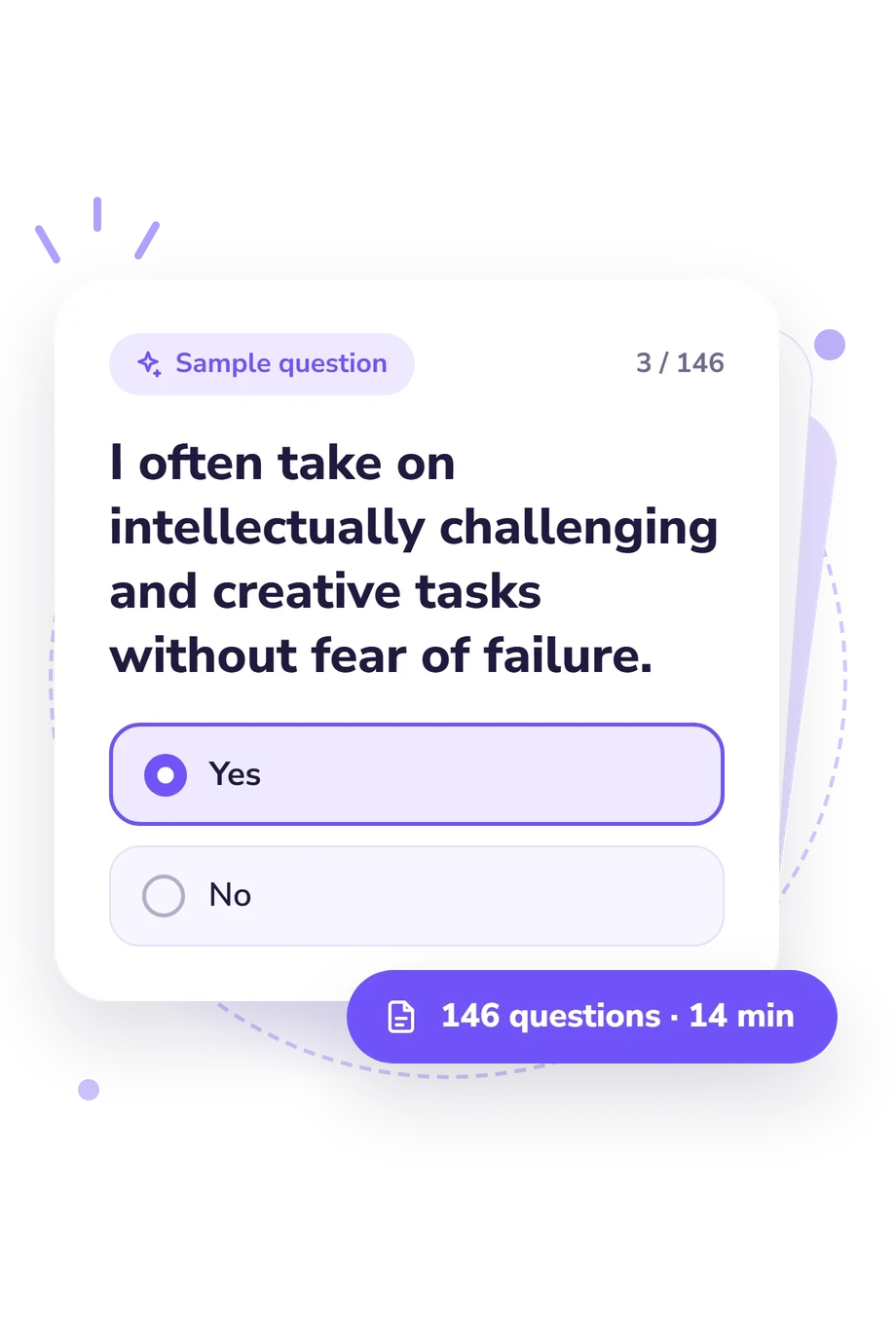
You will be presented with a series of statements addressing various aspects of life. You may agree or disagree with each one. Please read each statement carefully. If you agree with the statement, respond “Yes”; if you do not agree, respond “No.”
    • Yes
    • No
    • Yes
    • No
    • Yes
    • No
WHAT THE TEST MEASURES
About This Assessment
Self-Trust Assessment Test

Self-Confidence Assessment Test - Symptoms and Signs

self-acceptance

This measure evaluates perceived self-reliance and confidence across everyday domains, using the Self-Confidence Assessment to support a structured self-report profile. It is intended to help clarify how consistently an individual trusts their own judgment, abilities, and internal cues when navigating common life situations.

Developed by M. Rosenberg, it includes 73 items and typically takes about 14 minutes to complete. Results can be summarized as an overall index with domain-level scores to highlight relative strengths and potential areas for further clinical inquiry.

The Self-Confidence Assessment may be used in individual or group settings as part of screening, treatment planning, or skills-focused interventions. Interpretation should consider response style, situational context, and relevant psychosocial factors rather than relying on scores in isolation.

Author: M. Rosenberg
Literature: Rotter, J. B. A new scale for the measurement of interpersonal trust. Journal of Personality. 1967.
Popular tests
Comments
Leave a Comment