
Activity Threshold Test
How the Scales are Structured
Who Usually Takes This Test?
See How You Compare
Below is a preview of how scores are typically distributed across each scale.
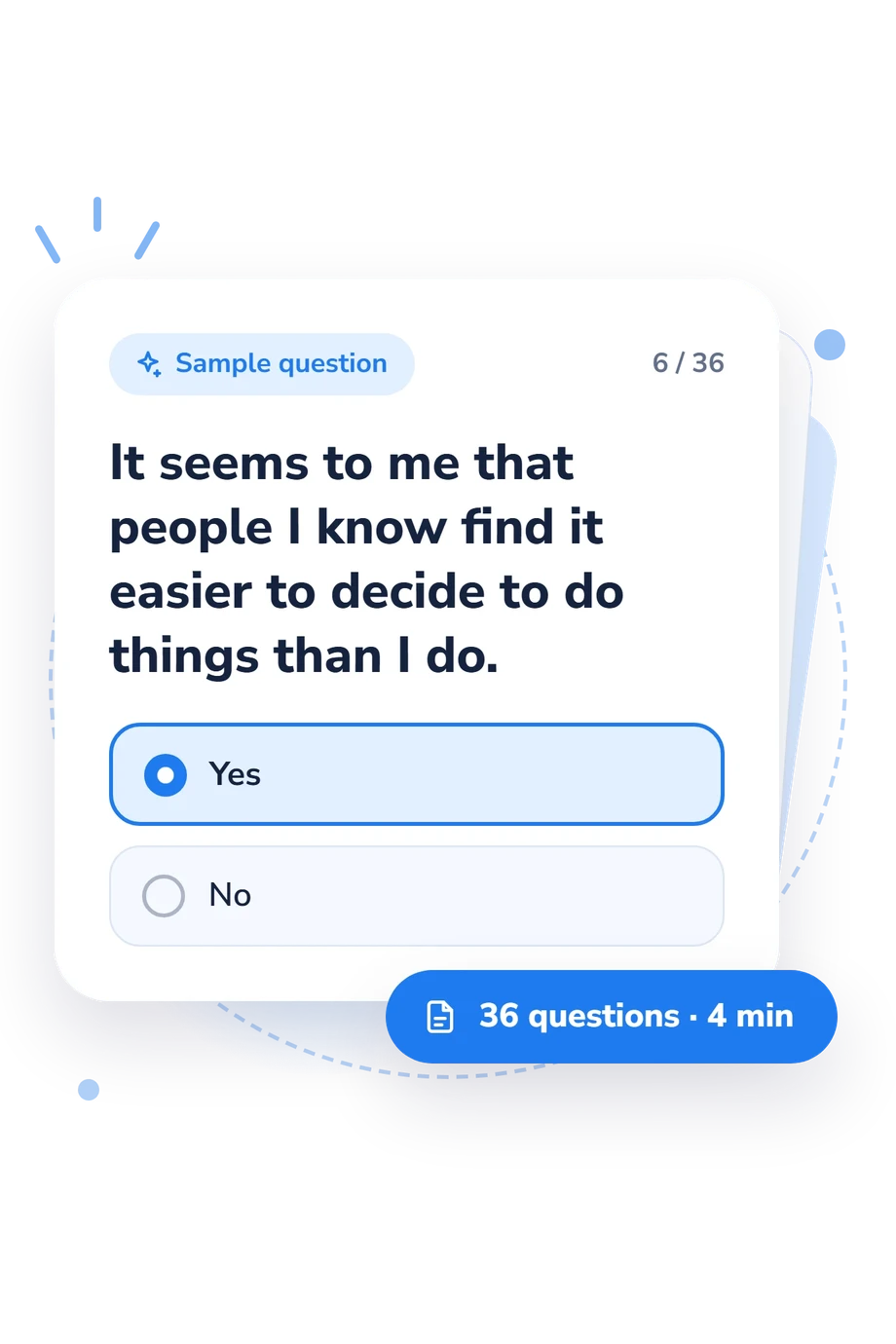
Example Questions From the Test
- Yes
- No
- Yes
- No
- Yes
- No
Activity Threshold Test - Description and methodology of the test
People who want to understand why starting, deciding, persisting, or withdrawing feels easier in some situations can use this self-report profile to examine their balance between action and reflection. This activity threshold questionnaire groups everyday situations around action, reflection, energy, and social recovery. The Activity Threshold Test helps readers consider whether action, preparation, inward focus, or recovery tends to dominate.
What This Assessment Explores
Questions in this profile place action beside hesitation: preparing for tasks, persisting with problems, tolerating mistakes, handling hassles, maintaining energy, and recovering after social contact. They contrast solitary thinking and passive leisure with active engagement.
The questionnaire reports one scale score, interpreted through these item themes:
- Activity Threshold: 0-18. Lower activation (0-5), Balanced activation (6-10), and Higher activation (11-18) mark positions on the activity-reflection balance; the catalogue defines the middle as harmonious and either extreme as a possible predominance of external activity or introspection.
- Initiative and follow-through are item themes showing how readily intentions become completed actions.
- Reflective preference appears in items about preparation, thinking, and solitary pursuits.
- Activation and recovery are themes showing how energy and social stamina shape the need for time alone.
Together, this activity threshold score describes a tendency, not a fixed identity; context can change how someone responds.
Methodology and Scientific Basis
Every item is answered yes or no, so the questionnaire asks for a directional self-description rather than a graded frequency rating. The statements contrast acting with delaying, thinking with doing, social involvement with solitude, and felt energy with low activation. Responses are combined into one displayed result, not separate subscale scores.
The questionnaire is conceptually consistent with Romanova’s 1990 measure, but this online version is not presented as a standardized reproduction. Levintsova (2014) links activity threshold with risk readiness and personal traits; Kirsanov (2020) discusses related individual differences in a psychophysiological context.
Interpret the result by considering how this activity level test groups the situations described in your answers. The catalogue defines an average position as a harmonious combination, while either higher or lower level may indicate a predominance of external activity or introspection.
No normative sample, reliability estimate, or clinical cutoff is documented for this online questionnaire. Current energy, circumstances, self-awareness, and response bias can influence self-report, so the score is best used for focused reflection on one tendency.
- Romanova, T. L. "Activity Threshold." In Practicum in Psychodiagnostics: Psychodiagnostics of Motivation and Self-Regulation, pp. 139-143. Moscow: Moscow State University Press, 1990. ISBN 5-211-01232-1.
- Levintsova, N. S. "Some Structural Peculiarities of Risk Readiness Connected with Threshold of Activity and Personal Traits of Policemen." Bulletin of Buryat State University, no. 5, 2014, pp. 48-50.
- Kirsanov, V. M. "Psychophysiological and Individual Typological Features of Full-Time University Students of the Ural Region." Psychology. Psychophysiology, vol. 13, no. 2, 2020, pp. 86-95. 10.14529/jpps200208
Updated: