
Psychological Capital Questionnaire (PCQ) Test
How the Scales are Structured
Who Usually Takes This Test?
See How You Compare
Below is a preview of how scores are typically distributed across each scale.
Example Questions From the Test
- Strongly agree
- Agree
- Agree more than disagree
- Disagree more than agree
- Disagree
- Strongly disagree
- Strongly agree
- Agree
- Agree more than disagree
- Disagree more than agree
- Disagree
- Strongly disagree
- Strongly agree
- Agree
- Agree more than disagree
- Disagree more than agree
- Disagree
- Strongly disagree
Psychological Capital Questionnaire (PCQ) Test - Description and methodology of the test
Students and other learners who want to understand their inner resources during demanding academic work can use this assessment as a structured self-reflection tool. The Psychological Capital Questionnaire (PCQ) Test connects everyday experiences of confidence, goal pursuit, positive expectations, and recovery from setbacks with a readable profile. As a psychological capital assessment, it helps clarify which resources appear more or less available in academic situations.
What This Assessment Explores
Academic examples make the construct concrete: the items address confidence in difficult tasks, finding alternative ways forward, persistence after poor results, future expectations, and staying composed under pressure. Because its items focus on study situations, it suits learners reflecting on psychological capital in academic settings, particularly their motivation, coping, and goal pursuit. The result presents four resources and their combined profile:
- Resilience (0-30) describes recovery and resource maintenance; bands: Low 0-13, Moderate 14-24, High 25-30.
- Optimism (0-30) describes favorable expectations; bands: Low 0-15, Moderate 16-25, High 26-30.
- Hope (0-30) describes goals, pathways, and strategy adjustment; bands: Low hope 0-13, Moderate hope 14-21, High hope 22-30.
- Confidence (0-30) describes self-efficacy on challenging tasks; bands: Low 0-13, Moderate 14-22, High 23-30.
- Psychological Capital (0-120) combines the four resources; bands: Low 0-59, Moderate 60-92, High 93-120.
Methodology and Scientific Basis
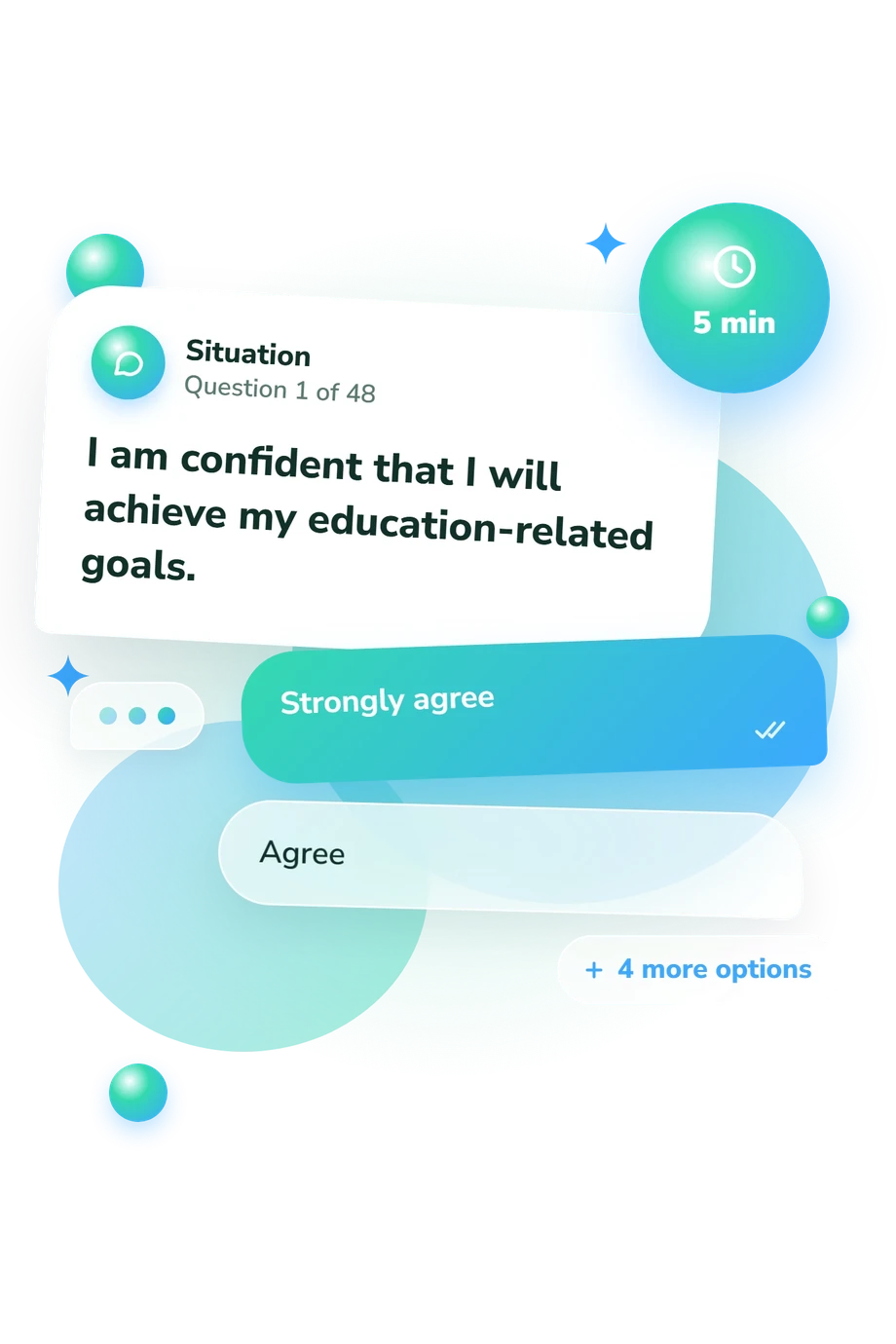
Each item uses six response choices from Strongly agree to Strongly disagree, including intermediate agreement options. Statements address academic demands and mix encouraging with difficulty-focused situations, so respondents compare the wording with their experience rather than select a personality label. The questionnaire reports four component scores and an overall Psychological Capital score, each interpreted through the displayed ranges and bands, showing both distinct resources and their broader pattern.
Maralov et al. (2022) offer the closest published comparison: their higher-education questionnaire uses a four-component psychological-capital model that is conceptually consistent with the dimensions shown here. Luthans et al. (2007) describe the broader PsyCap framework, and Luthans et al. (2012) examine its relationship with students’ academic performance. These sources provide context, not evidence that the online questionnaire has identical items, administration, standardization, or measurement properties.
Results are best read as a snapshot of perceived resources in the situations addressed by the items. Current workload, mood, self-awareness, and response style can influence answers; use the profile to notice patterns, not as a diagnosis or complete evaluation of functioning.
- Maralov, V. G., Kudaka, M. A., & Smirnova, O. V. (2022). Development and testing of the Russian-language version of the questionnaire “Psychological Capital” for use in higher education. Pedagogical Review, 6, 168-180. 10.23951/2307-6127-2022-6-168-180
- Luthans, B. C., Luthans, K. W., & Jensen, S. M. (2012). The impact of business school students’ psychological capital on academic performance. Journal of Education for Business, 87(5), 253-259. 10.1080/08832323.2011.609844
- Luthans, F., Avolio, B. J., Avey, J. B., & Norman, S. M. (2007). Positive psychological capital: Measurement and relationship with performance and satisfaction. Personnel Psychology, 60(3), 541-572. 10.1111/j.1744-6570.2007.00083.x
Updated: