
Company Business Culture Assessment Test
How the Scales are Structured
Who Usually Takes This Test?
See How You Compare
Below is a preview of how scores are typically distributed across each scale.
Example Questions From the Test
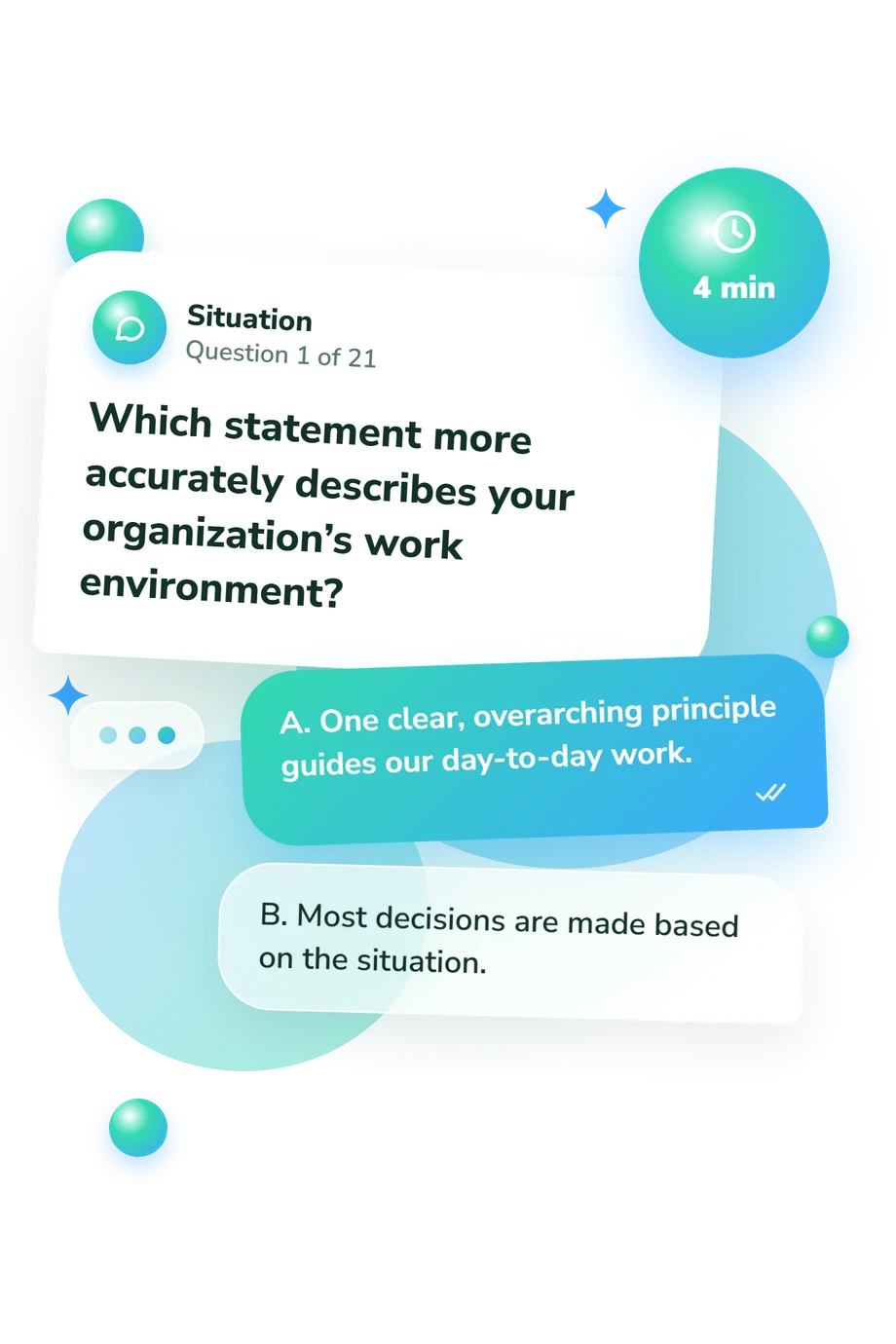
- A. One clear, overarching principle guides our day-to-day work.
- B. Most decisions are made based on the situation.
- A. Our projects often cross the boundaries of individual departments’ responsibilities.
- B. We place a high value on departments’ autonomy.
- A. How well they help others.
- B. How well they do their job.
Company Business Culture Assessment Test - Description and methodology of the test
Leaders, managers, and employees who want a structured view of how work is organized can use this assessment to examine shared priorities, decision habits, and everyday expectations. The Company Business Culture Assessment Test turns paired workplace statements into a profile of cultural strengths and development needs. As a company culture assessment, it is most useful when completed by people familiar with the organization’s actual practices.
What This Assessment Explores
The paired items make this an organizational culture assessment of how culture appears in everyday management and work. They contrast formal systems with situational decisions, quality with output, employee with customer priority, central approval with frontline discretion, departmental autonomy with cross-functional work, and internal development with external hiring. The test suits respondents familiar with actual practices.
The Total Score spans 1-21 and measures development of business culture across key characteristics. Scores of 1-3 indicate operational excellence, scores of 4-6 indicate a positive work climate, and higher scores reflect stronger team building, change management, customer service, work engagement, leadership, and alignment with successful-company principles.
These are the displayed result bands:
- Operational focus (1-6) marks the displayed band for cultures emphasizing operational priorities.
- Developing culture (7-12) marks an intermediate profile across the measured characteristics.
- High-performing culture (13-21) marks stronger overall cultural development.
Methodology and Evidence Base
Each prompt offers two statements, and the respondent selects the one that more accurately describes the organization. The choices address policies, leadership communication, hiring, customer contact, innovation, social responsibility, and employee expectations. The result reports a total score and displayed bands; individual response weighting is not stated. The items cover customer trends, complaints, technology, and cross-department cooperation.
The framework aligns with Gallagher’s characteristics of successful corporate cultures (2003), which connect values with recurring organizational practices. In practice, it functions as a business culture test, while Schein’s model explains culture through shared assumptions, values, and visible behavior. Van der Post, De Coning, and Smit’s organizational-culture instrument offers a relevant precedent; this online questionnaire is conceptually consistent with it, not an adaptation or validated version.
Interpretation is strongest when respondents know how decisions, customer interactions, leadership, hiring, and teamwork occur in practice. Scores can vary by role, department, recent events, and self-perception, so one online result cannot establish how consistently the wider organization behaves. Comparing informed responses with concrete examples adds context; the assessment is a structured self-report tool, not a diagnosis.
- Gallagher, Richard S. (2003). The Soul of an Organization: Understanding the Values That Drive Successful Corporate Cultures. Dearborn Trade Publishing. ISBN 0-7931-5780-3.
- Schein, Edgar H. (2004). Organizational Culture and Leadership (3rd ed.). Jossey-Bass.
- Van Der Post, W. Z., De Coning, T. J., & Smit, E. V. D. M. (1997). An instrument to measure organizational culture. South African Journal of Business Management, 28(4), a800. 10.4102/sajbm.v28i4.800
Updated: