
Personal Rehabilitation Potential Test
How the Scales are Structured
Who Usually Takes This Test?
See How You Compare
Below is a preview of how scores are typically distributed across each scale.
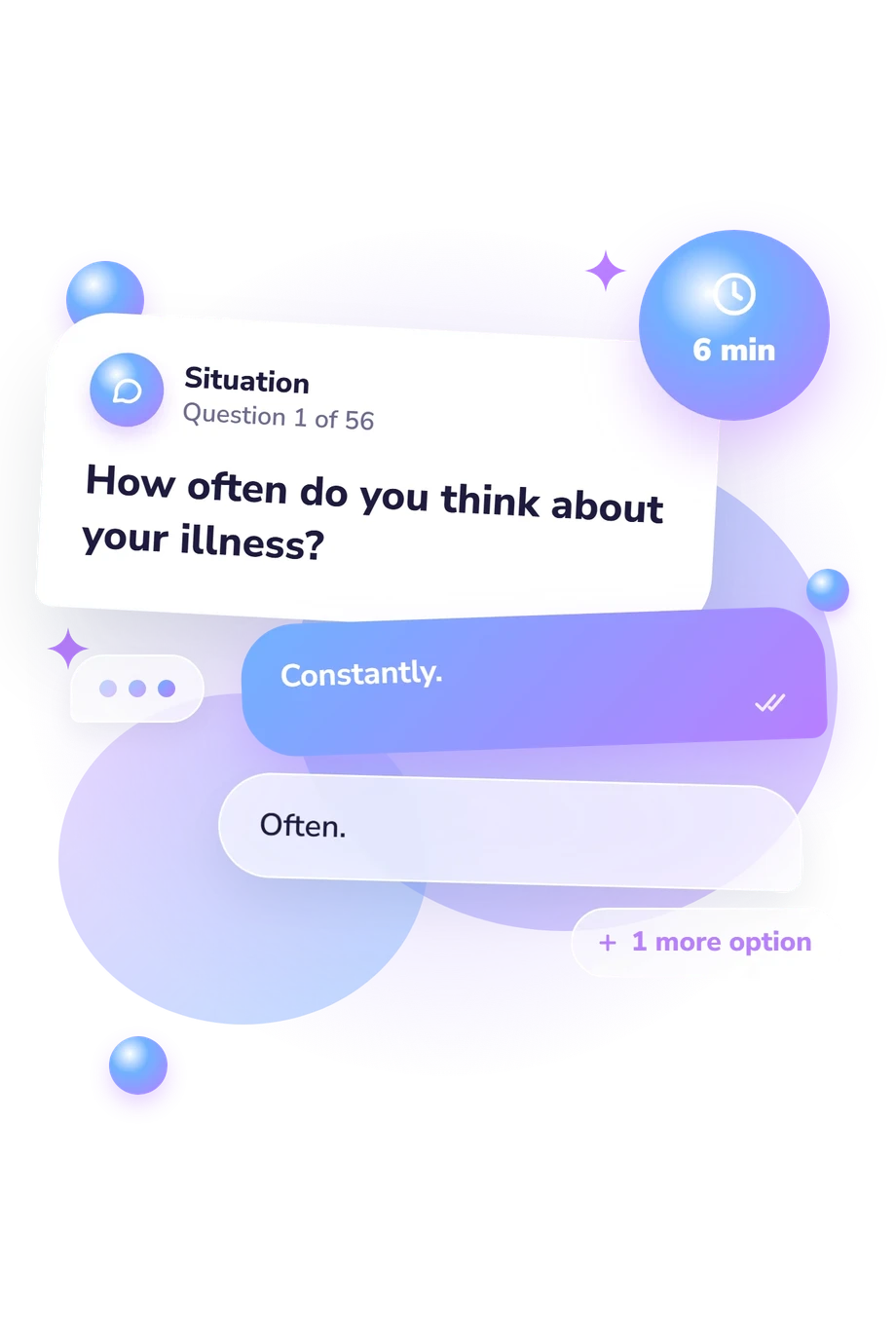
Example Questions From the Test
- Constantly.
- Often.
- Rarely.
- Yes.
- No.
- Hard to say.
- Sometimes I get involved in solving them.
- I try to distance myself from them.
- They are still interesting to me.
Personal Rehabilitation Potential Test - Description and methodology of the test
People living with illness, supporting recovery, or reflecting on adjustment may use this questionnaire when deciding what support or conversation would be most useful. The Personal Rehabilitation Potential Test gives that decision a structured context by showing how current experience may relate to adaptation. An illness recovery profile can help identify whether to focus on practical coping, communication with close people, treatment discussions, or broader support.
What This Assessment Measures
Comparing communication, self-attitude, emotional regulation, motivation, and illness perceptions in a personal rehabilitation profile shows stronger or challenging areas.
Results show these dimensions:
- Communicative Component (0-8) describes social ties: Limited communication (0-2); Developing communication (3-5); Strong communication (6-8).
- Self-Esteem Component (0-8) describes self-attitude: Low (0-2); Moderate (3-5); High (6-8).
- Emotional Component (0-8) describes tone and regulation: Low (0-2); Moderate (3-5); High (6-8).
- Motivational Component (0-12) describes breadth of interests and activity toward life and health goals; higher scores show stronger recovery motivation: Low motivation (0-4); Moderate motivation (5-8); High motivation (9-12).
- Internal Representation of Illness (0-20) describes illness attitude; optimism may facilitate rehabilitation and pessimism may hinder recovery: Pessimistic view (0-9); Balanced view (10-15); Optimistic view (16-20).
- Overall Level of Rehabilitation Potential (0-56) describes recovery and adaptation capacity: Low (0-18); Moderate (19-37); High (38-56).
Methodology and Evidence Base
Each item is a self-report question with three choices covering emotions, relationships, interests, coping, self-evaluation, health priorities, treatment, and future situations. The questionnaire reports component scores and an overall index, but does not specify how answers map to points. The ranges and bands provide the displayed scoring framework.
Conceptually, the structure is consistent with Rehabilitation Potential of Personality (Kulagina & Senkevich, 2015), which links rehabilitation potential with personal resources for chronic-illness adaptation. Khokhlova (2020) examines communicative, motivational, self-evaluative, emotional, and illness-representation components alongside rehabilitation and functional independence. These studies support the framework but do not establish this questionnaire as an adaptation or standardized version. The online rehabilitation profile is a structured snapshot under the displayed scoring system: it shows categories, but cannot show how illness or context may change support needs.
Displayed bands are descriptive categories rather than evidence that a result predicts recovery, and symptoms, mood, self-awareness, or candidness can influence self-report results; the profile is best read alongside clinical and functional context. Higher results generally indicate more rehabilitation resources, while lower results suggest areas for additional support.
- Kulagina, I. Yu., & Senkevich, L. V. (2015). Rehabilitation Potential of Personality in Various Chronic Conditions. Cultural-Historical Psychology, 11(1), 50-60. 10.17759/chp.2015110107
- Khokhlova, O. I. (2020). Rehabilitation Potential of Personality and Functional Independence of Persons with Traumatic Spinal Cord Injury. Polytrauma, 2020(3), 100-107. 10.24411/1819-1495-2020-10038
Updated: