
Male Sexual Formula Test
How the Scales are Structured
Who Usually Takes This Test?
See How You Compare
Below is a preview of how scores are typically distributed across each scale.
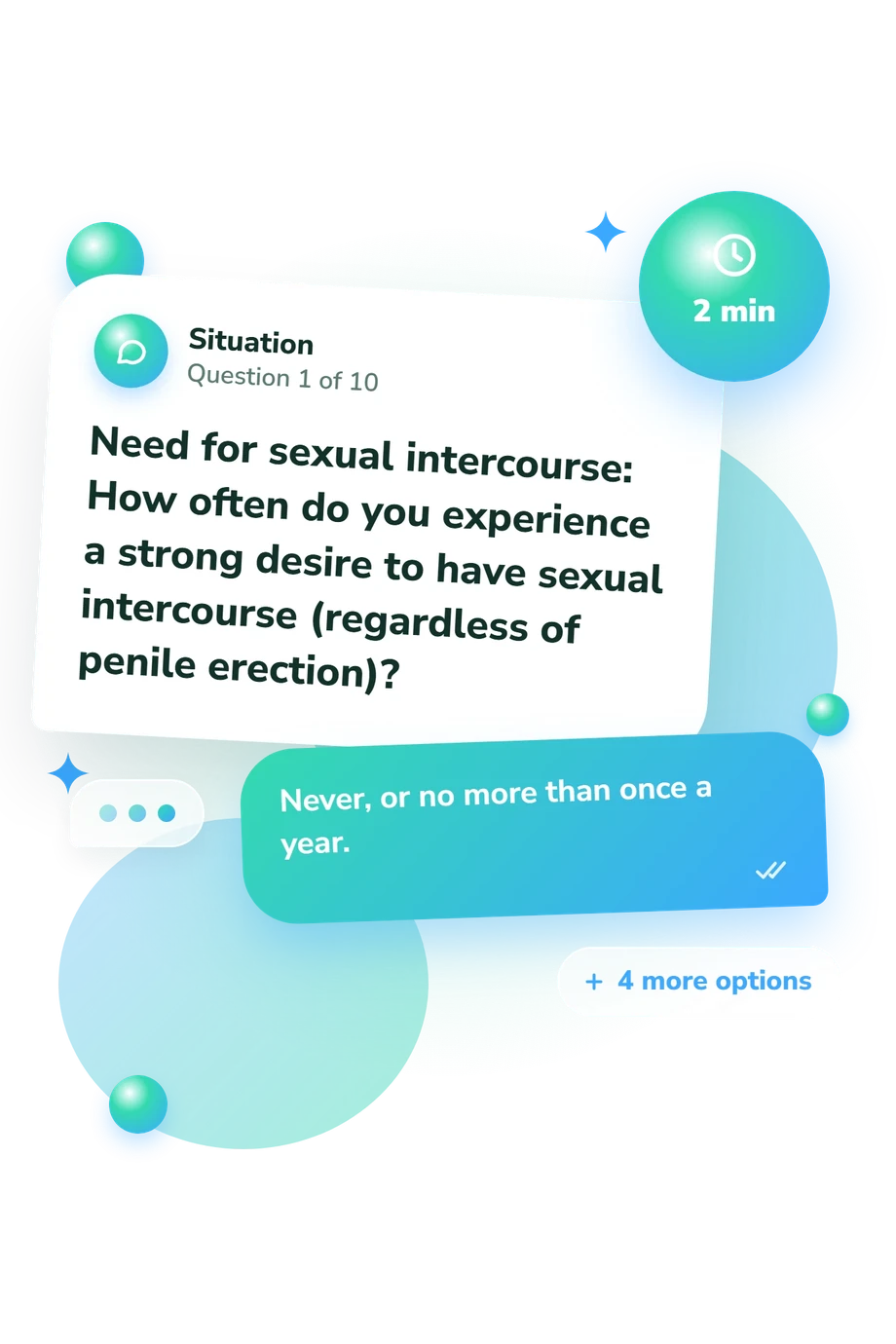
Example Questions From the Test
- Never, or no more than once a year.
- Several times a year, but no more than once a month.
- 4 times a month.
- Twice a week or slightly more often.
- Daily, once or several times.
- Not at all, or only at intervals of one year or more.
- Several times a year, but no more than once a month.
- Several times a month, but no more than once a week.
- Twice a week or more often.
- Daily, once or several times.
- Does not occur at all, or no more than once per year.
- Several times per year, but no more than once per month.
- Several times per month, but no more than once per week.
- Twice per week or slightly more often.
- Daily, once or several times.
Male Sexual Formula Test - Description and methodology of the test
For a man trying to make sense of sexual concerns, this Male Sexual Formula Test offers an organized way to see which experiences fit together rather than reducing them to a single yes-or-no judgment. This male sexual functioning test examines how the questionnaire's answers relate within the result, helping organize concerns into a pattern. It can support personal reflection, pattern recognition, and decisions about which experiences deserve closer attention.
What This Assessment Explores
The questionnaire follows experience from anticipation to outcome. It examines desire, initiative, confidence before intercourse, erection, penetration, ejaculation, mood afterward, satisfaction, and whether difficulties are current or longstanding. This questionnaire is a male sexual formula questionnaire in which subjective experience is interpreted alongside functional responses; the result is therefore read as a pattern rather than an isolated symptom.
The displayed dimensions are interpreted as follows:
- Duration of Dysfunction (0-4) shows when problems began: Recent onset 0-2; Long-standing 3-4.
- First Triad (0-12) covers arousal and preparation: Low 0-8; Typical 9-11; High 12-12.
- Second Triad (0-12) covers objective sexual-contact characteristics: Lower objective execution 0-8; Higher objective execution 9-12.
- Third Triad (0-12) covers subjective appraisal: Low 0-8; Elevated 9-11; High 12-12.
- Overall (Prognostic) Index (0-40) reflects total functioning across the triads: Lower overall functioning 0-29; Higher overall functioning 30-40.
Methodology and Scientific Basis
Self-report is the method: each item describes a situation or function and offers ordered choices about frequency, ability, timing, emotion, or perceived success. The options are item-specific rather than a universal rating scale, and the answer pattern produces the displayed profile.
The questionnaire is conceptually consistent with Male Sexual Formula (Vasilchenko, 1977), a published model with a comparable triad organization. This online version has no documented version-specific validation.
The result displays separate scores for the timing measure, the three triads, and the overall index; points per answer should not be inferred because the item-level conversion is not documented. Comparing the triads with the overall index can show whether the displayed pattern is concentrated in one stage or distributed across several, while the timing measure adds context about onset.
The result bands are descriptive, not population norms or clinical thresholds. A male sexual health assessment should be read alongside symptoms, physical health, relationships, and personal goals; memory, candour, self-awareness, current health, and relationship circumstances can affect responses.
- Botneva I.L., Vasilchenko G.S., Nokhurov A., et al. General Sexopathology: A Guide for Physicians. Edited by G.S. Vasilchenko. Moscow: Medicine; 1977. 487 p. (In Russian).
- Kibrik N.D., Prokopenko Yu.P. Sexologist's Tools in Men Examination. Lechaschiy Vrach. 2014;(10).
- Amelchenko A.A., Vinnik Yu.Yu. The Effect of Overweight and Obesity on the Severity of Manifestations of Chronic Nonbacterial Prostatitis with an Inflammatory Component. Urology Reports (St Petersburg). 2024;14(1):15-22. 10.17816/uroved623501
Updated: