
Richmond Compulsive Buying Scale Test
How the Scales are Structured
Who Usually Takes This Test?
See How You Compare
Below is a preview of how scores are typically distributed across each scale.
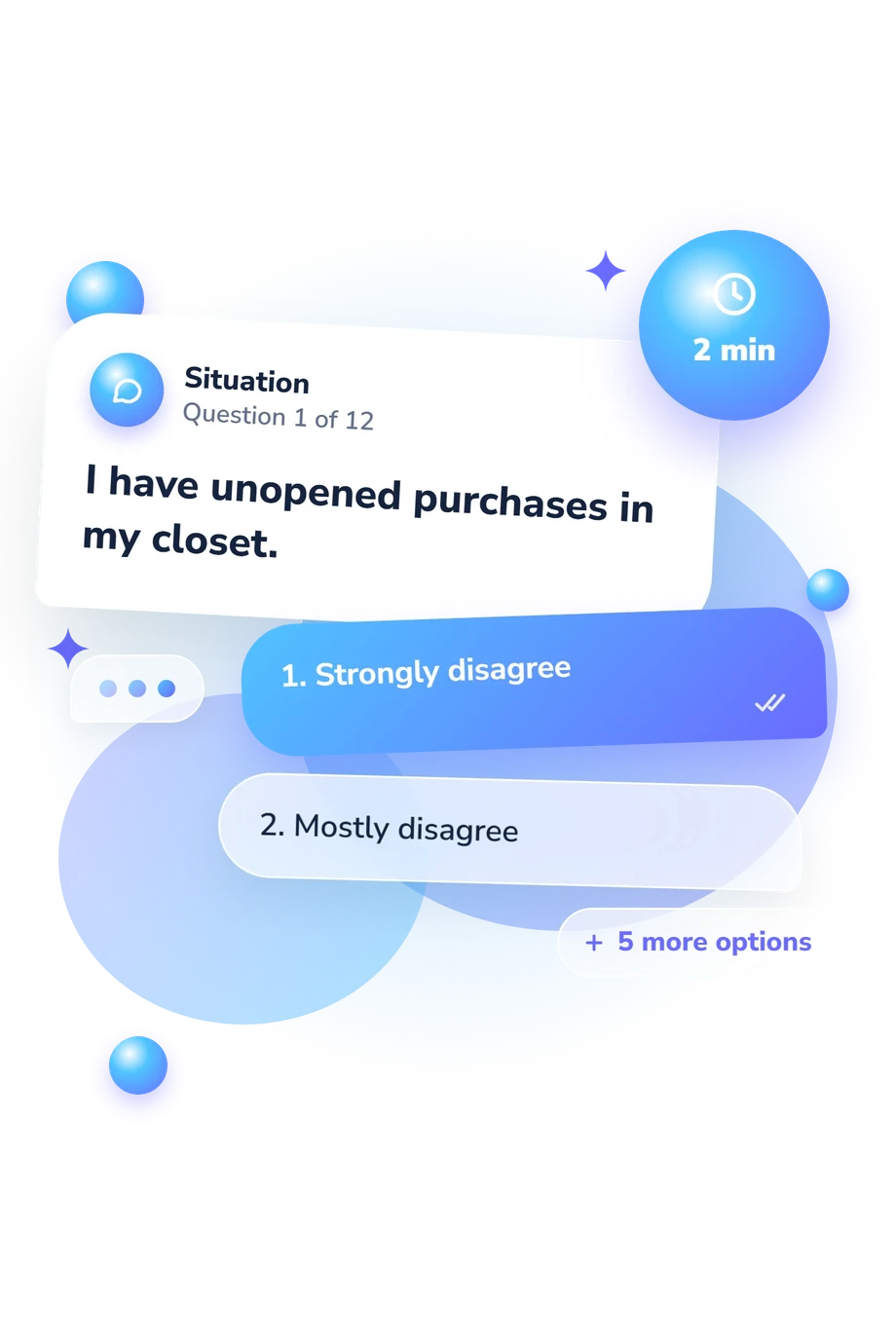
Example Questions From the Test
- Strongly disagree
- Mostly disagree
- Rather disagree than agree
- Neutral
- Partly agree
- Mostly agree
- Strongly agree
- Strongly disagree
- Mostly disagree
- Disagree somewhat more than agree
- Neutral
- Partly agree
- Mostly agree
- Strongly agree
- Strongly disagree
- Mostly disagree
- More disagree than agree
- Neutral
- Partly agree
- Mostly agree
- Strongly agree
Richmond Compulsive Buying Scale Test - Description and methodology of the test
People who wonder whether shopping has become difficult to regulate can use the Richmond Compulsive Buying Scale Test to examine recurring purchasing experiences. This compulsive buying questionnaire is intended for personal reflection on urges, unplanned purchases, and shopping-related preoccupation. The result organizes a concise picture of current buying patterns, helping respondents consider whether their habits feel manageable or disruptive.
What This Assessment Explores
Two aspects of problematic purchasing are examined. The first three items address obsessive-compulsive buying features: unopened purchases, being called a “shopaholic,” and a life centered on shopping. The last three address impulsive buying manifestations, including unnecessary or unplanned purchases and difficulty regulating urges.
For a respondent using a compulsive shopping test, results indicate whether responses lean toward impulsivity, obsessive-compulsive features, or a broader compulsive-buying pattern. The result types are:
- Impulsivity Index (3-21) reflects impulsive buying manifestations: Normal range 3-11; Elevated (yellow zone) 12-16; High (red zone) 17-21.
- Obsessive-Compulsive Index (3-21) measures obsessive-compulsive buying features: Normal range 3-11; Yellow zone 12-16; Red zone 17-21.
- Compulsive Buying Behavior Scale (6-42) assesses compulsive buying tendencies, or oniomania: No compulsive buying indicated 6-23; Moderate tendency 24-35; High tendency (oniomania range) 36-42.
Methodology and Evidence Base
Each statement uses a seven-point response format. The first three items use agreement choices from Strongly disagree to Strongly agree; the last three use frequency choices from Never to Very often. This captures how respondents relate to shopping statements and how often purchasing behaviors occur.
The first three responses are summed for the obsessive-compulsive component, and the last three for the impulsivity component. The overall result is interpreted alongside these findings, allowing the profile to show differences between obsessive-compulsive features and impulsive buying manifestations.
The questionnaire is conceptually consistent with the Richmond Compulsive Buying Scale, while the clinical screener by Faber and O’Guinn offers related background for identifying compulsive buying symptoms. Brazilian and Chinese validation studies examined translated versions of the published scale. This online form has no established norms or standardization, and those findings do not establish that status for it.
In this compulsive buying assessment, results depend on honest self-report, self-awareness, and current circumstances; interpret them as indications of tendencies, not a diagnosis or substitute for broader clinical assessment.
- Ridgway, Nancy M., Monika Kukar-Kinney, and Kent B. Monroe. "An Expanded Conceptualization and a New Measure of Compulsive Buying." Journal of Consumer Research 35, no. 4 (2008): 622-639. 10.1086/591108
- Faber, Ronald J., and Thomas C. O'Guinn. "A Clinical Screener for Compulsive Buying." Journal of Consumer Research 19, no. 3 (1992): 459-469. 10.1086/209315
- Leite, Priscilla, Bernard Rangé, Monika Kukar-Kiney, Nancy Ridgway, Kent Monroe, Rodolfo Ribas Junior, J. Landeira Fernandez, Antonio Egidio Nardi, and Adriana Silva. "Cross-cultural Adaptation, Validation and Reliability of the Brazilian Version of the Richmond Compulsive Buying Scale." Revista Brasileira de Psiquiatria 35, no. 1 (2013): 38-43. 10.1016/j.rbp.2012.10.004
- Lam, Simon Ching, Zoe Sze-Long Chan, Andy Chun-Yin Chong, Wendy Wing-Chi Wong, and Jiawen Ye. "Adaptation and Validation of Richmond Compulsive Buying Scale in Chinese Population." Journal of Behavioral Addictions 7, no. 3 (2018): 760-769. 10.1556/2006.7.2018.94
Updated: