
Attitude Toward One's Physical Appearance Test
How the Scales are Structured
Who Usually Takes This Test?
See How You Compare
Below is a preview of how scores are typically distributed across each scale.
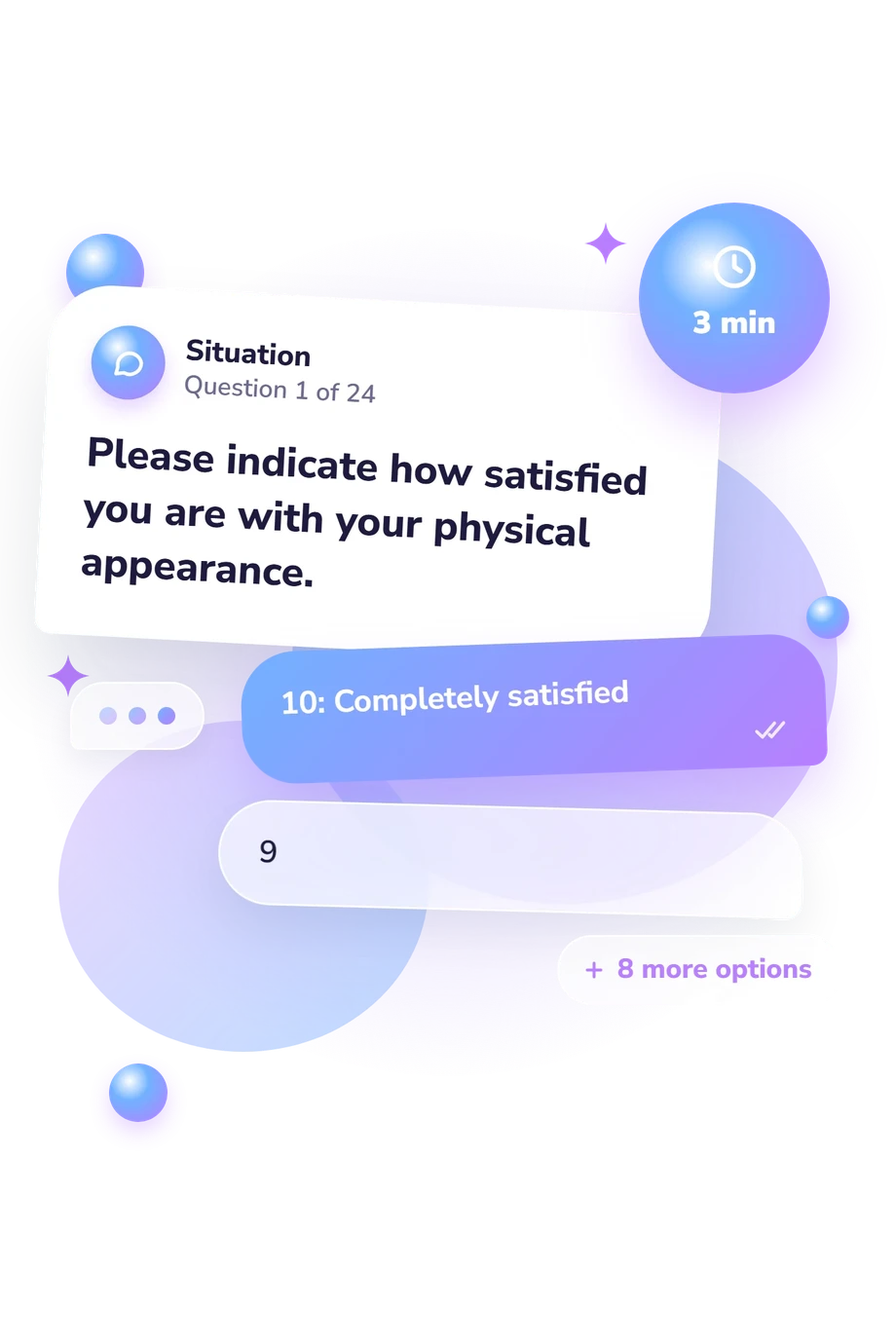
Example Questions From the Test
- 10: Completely satisfied
- 9
- 8
- 7
- 6
- 5
- 4
- 3
- 2
- 1: Not satisfied at all
- 10: Strongly agree
- 9
- 8
- 7
- 6
- 5
- 4
- 3
- 2
- 1: Strongly disagree
- 10: Work on improving it
- 9
- 8
- 7
- 6
- 5
- 4
- 3
- 2
- 1: Never work on improving it
Attitude Toward One's Physical Appearance Test - Description and methodology of the test
People who want to understand their appearance appraisals, change efforts, and reactions in social situations may find the Attitude Toward One's Physical Appearance Test useful. Questions about satisfaction, desired changes, and reactions to social evaluation allow the appearance satisfaction questionnaire to show how appearance is appraised. The result shows how a positive or critical appraisal can coexist with motivation to change and appearance-related concern.
What This Assessment Explores
Questions move between direct judgments and socially focused situations: satisfaction, perceived attractiveness, efforts to improve, comparison with others, embarrassment, self-consciousness, and worry about other people's reactions. Together, these themes show how respondents appraise appearance, want to change it, and experience concern or self-consciousness; the dimensions may occur in combination. For people using self-reflection, the physical appearance attitude test links comparison, embarrassment, and social evaluation to their everyday appearance-related experiences.
The result organizes these themes into three dimensions:
- Desire to Improve One's Physical Appearance (2-20) shows motivation to change appearance: Low desire 2-8, Moderate desire 9-14, High desire 15-20.
- Satisfaction With One's Physical Appearance (4-40) reflects a positive or self-critical appraisal: Low satisfaction 4-18, Moderate satisfaction 19-30, High satisfaction 31-40.
- Degree of Concern About Physical Appearance (6-60) indicates appearance-related anxiety and preoccupation: Low concern 6-24, Moderate concern 25-42, High concern 43-60.
Methodology and Evidence Base
Each item uses a ten-point self-report continuum with opposite anchors, such as completely satisfied and not satisfied at all, or always and never. The respondent turns an appraisal, habit, comparison, or social worry into an ordered rating. In this appearance self-assessment questionnaire, responses are combined into three dimensions, with the scoring separating a wish to change appearance from dissatisfaction or preoccupation.
The evidence base is conceptually consistent with the 2016 study by Labunskaya and Kapitanova, which offers a conceptual comparison for the satisfaction and concern dimensions rather than evidence that this online questionnaire was adapted from or validated by it. The desire-to-improve result is a feature of this questionnaire, not a dimension established by that study.
Read the bands as a pattern, not an isolated score: a strong wish to improve can coexist with satisfaction, while concern may reflect embarrassment or social evaluation. Self-report scores can shift with mood, self-awareness, comparison standards, and concern about approval; the bands are descriptive rather than diagnostic and do not establish population norms.
- Labunskaya, Vera A., and Elena V. Kapitanova. (2016). Concerns and Satisfaction of Students with Their Appearance as Predictors of Self-Evaluations of Its Components and Characteristics. Russian Psychological Journal, 13(1), 167-183. 10.21702/rpj.2016.1.14
- Labunskaya, Vera A. (2019). Multifactorial Model of Attitudes towards Appearance: Empirical Investigations. Wisdom, 13(2), 63-74. 10.24234/wisdom.v13i2.287
- Labunskaya, Vera. (2020). Relationship Between Satisfaction and Concern with Own Appearance and Subjective Estimation of Economic Status. Behavioral Sciences, 10(1), 9. 10.3390/bs10010009
Updated: