
Freudly+971 508685814hello@freudly.ai
Freudly
affect

Perth Emotion Reactivity Scale (PERS-S) Test
Take the online Perth Emotion Reactivity Scale (PERS-S) Test - AI psychologist FreudlyYou can take Perth Emotion Reactivity Scale (PERS-S) Testhere. Online version of a simple and accurate psychological test with interpretation.en
Understand how quickly, strongly, and how long your emotions react in about 4 minutes. Get clear, actionable insight into positive and negative patterns in just 18 items.
Start Online Test
Questions: 184 minutes
08:30
October 2, 2025
October 2, 2025
Material has been updated
October 2, 2025
Material has been published
25,577 views
2,029 completions
1,588 likes
Verified by Daniel Hall
Psychologist with 25 years of experience
Share
Scale Explorer

How the Scales are Structured

example score
12/15
Intensity (Negative Emotions) (IE)
Measures how strongly and deeply you tend to experience negative emotions when they occur.
Lower intensity
Moderate intensity
Higher intensity
37: Lower intensity | 811: Moderate intensity | 1215: Higher intensity
A score of 12 falls in the Higher intensity range, suggesting your negative emotions tend to be experienced as relatively strong and impactful when they arise.
example score
6/15
Duration (Negative Emotions) (DE)
Measures how long negative emotional reactions tend to persist after something upsetting happens.
Short-lived
Moderate duration
Long-lasting
37: Short-lived | 811: Moderate duration | 1215: Long-lasting
A score of 6 falls in the Short-lived range, suggesting negative feelings typically fade relatively quickly after a trigger.
example score
6/15
Activation (Negative Emotions) (AE)
This scale measures how easily and quickly negative emotional reactions are triggered by stimuli.
Low activation
Moderate activation
High activation
37: Low activation | 811: Moderate activation | 1215: High activation
A score of 6 suggests negative emotions tend to activate relatively slowly and require more noticeable triggers compared with higher scores.
example score
20/45
Overall Negative Emotion Reactivity (ONER)
This scale measures how strongly, quickly, and how long you tend to experience negative emotions in response to stimuli.
Lower reactivity
Moderate reactivity
Higher reactivity
921: Lower reactivity | 2233: Moderate reactivity | 3445: Higher reactivity
A score of 20 suggests a lower overall tendency for negative emotions to activate quickly, feel intense, or persist for long periods compared with higher scores on this scale.
example score
6/15
Intensity (Positive Emotions) (IE)
This scale measures how strong and deep your positive emotional experiences tend to feel.
Lower intensity
Moderate intensity
Higher intensity
37: Lower intensity | 811: Moderate intensity | 1215: Higher intensity
A score of 6 suggests your positive emotions are generally experienced with lower intensity compared with higher scores on this scale.
example score
9/15
Duration (Positive Emotions) (DE)
Measures how long positive emotions tend to persist after a positive event or stimulus.
Short-lived
Moderate
Long-lasting
37: Short-lived | 811: Moderate | 1215: Long-lasting
A score of 9 falls in the Moderate range, suggesting your positive feelings typically last a moderate amount of time after uplifting experiences.
example score
6/15
Activation (Positive Emotions) (AE)
This scale measures how easily and quickly positive emotions are triggered in response to stimuli.
Low activation
Moderate activation
High activation
37: Low activation | 811: Moderate activation | 1215: High activation
A score of 6 indicates low positive emotional activation, suggesting positive feelings tend to start more slowly or require stronger cues to arise.
example score
32/45
Overall Positive Emotion Reactivity (OPER)
Measures how quickly, strongly, and how long a person tends to experience positive emotions in response to stimuli.
Lower reactivity
Moderate reactivity
Higher reactivity
921: Lower reactivity | 2233: Moderate reactivity | 3445: Higher reactivity
A score of 32 indicates moderately reactive positive emotions, suggesting positive feelings tend to arise fairly readily, feel noticeable, and last a moderate amount of time.
Start Online Test
just completed the test
DATA-BASED USER COHORTS

Who Usually Takes This Test?

Therapy and coaching clients
41%OF USERS
People in counseling or coaching take it to map how quickly, strongly, and how long their positive and negative emotions tend to show up.
Mood regulation seekers
34%OF USERS
People who feel their emotions swing fast or linger too long use it to pinpoint whether activation, intensity, or duration is the main issue.
Researchers and students
25%OF USERS
Psychology researchers and students take it to gather quick, structured data on emotional reactivity for studies and projects.
BASED ON AGGREGATED, ANONYMIZED DATA FROM TENS OF THOUSANDS OF FREUDLY USERS.
Benchmarking

See How You Compare

Once you complete the test, your results are compared with real-world data from people in your country.
Below is a preview of how scores are typically distributed across each scale.
Intensity (negative emotions) (I(e)
Average
10.2
Normal range
812.4
min.
3
max.
15
This curve shows how scores are typically distributed.
Once you complete the test, your result will appear on the scale so you can see how you compare.
Duration (negative emotions) (D(e)
Average
11.3
Normal range
9.812.8
min.
3
max.
15
This curve shows how scores are typically distributed.
Once you complete the test, your result will appear on the scale so you can see how you compare.
Activation (negative emotions) (A(e)
Average
11.5
Normal range
9.913.1
min.
3
max.
15
This curve shows how scores are typically distributed.
Once you complete the test, your result will appear on the scale so you can see how you compare.
Overall Level of Reactivity to Negative Emotions (OLoRtNE)
Average
23.9
Normal range
18.529.2
min.
9
max.
45
This curve shows how scores are typically distributed.
Once you complete the test, your result will appear on the scale so you can see how you compare.
Intensity (positive emotions) (I(e)
Average
11.6
Normal range
9.813.3
min.
3
max.
15
This curve shows how scores are typically distributed.
Once you complete the test, your result will appear on the scale so you can see how you compare.
Duration (positive emotions) (D(e)
Average
7.9
Normal range
5.710.1
min.
3
max.
15
This curve shows how scores are typically distributed.
Once you complete the test, your result will appear on the scale so you can see how you compare.
Activation (positive emotions) (A(e)
Average
11.6
Normal range
9.713.6
min.
3
max.
15
This curve shows how scores are typically distributed.
Once you complete the test, your result will appear on the scale so you can see how you compare.
Overall Level of Reactivity of Positive Emotions (OLoRoPE)
Average
26.9
Normal range
22.331.6
min.
9
max.
45
This curve shows how scores are typically distributed.
Once you complete the test, your result will appear on the scale so you can see how you compare.
Featured On
SAMPLE QUESTIONS

Example Questions From the Test

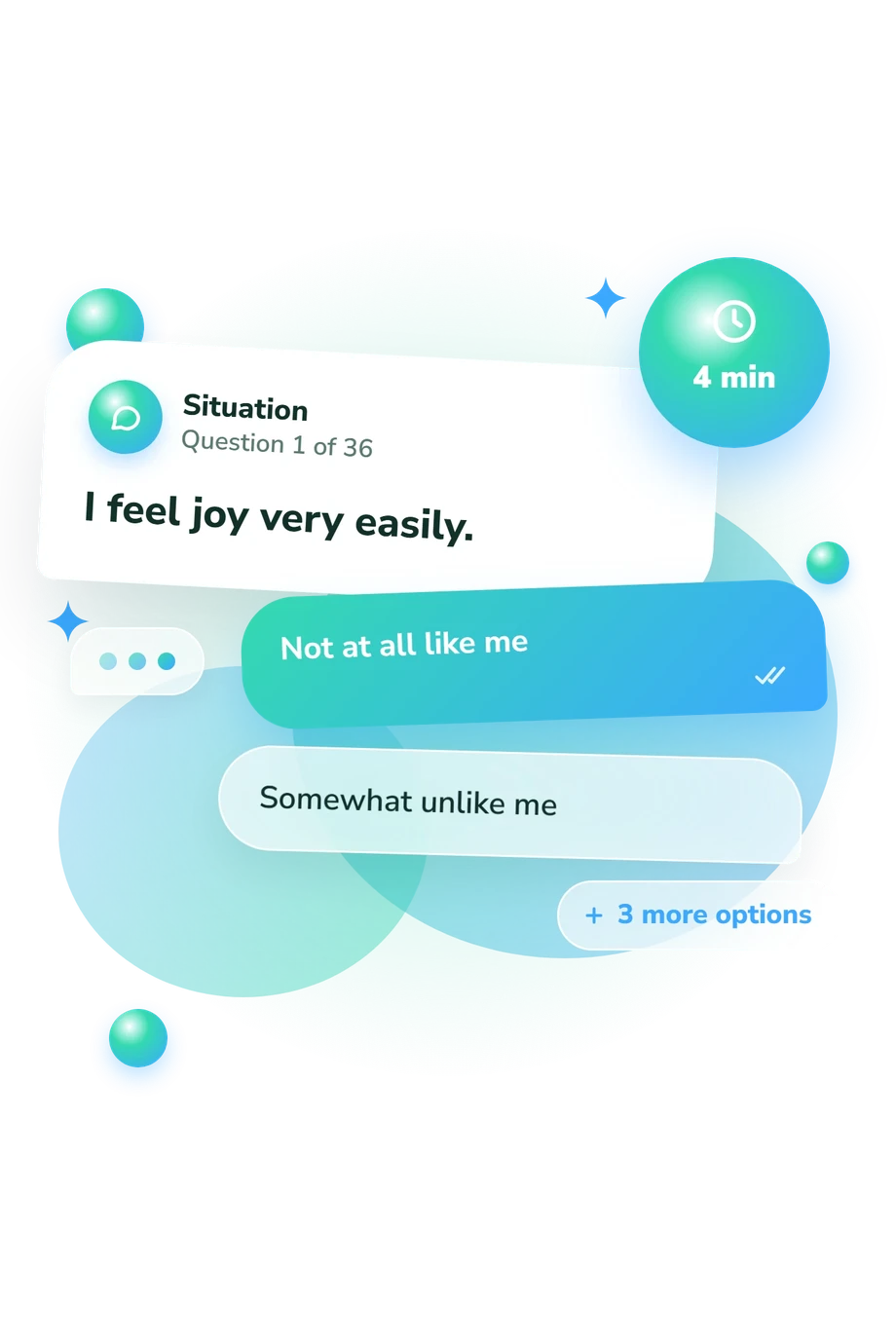
This questionnaire is designed to assess your typical response to life events and situations that are emotionally significant to you. Please rate the following statements according to how generally applicable or not applicable they are to you. Select the response option that best fits each statement.
    • Not at all like me
    • Somewhat unlike me
    • Neither like me nor unlike me
    • Somewhat like me
    • Very much like me
    • Not at all like me
    • Somewhat unlike me
    • Neither like nor unlike me
    • Somewhat like me
    • Very much like me
    • Not at all like me
    • Somewhat unlike me
    • Neither like me nor unlike me
    • Somewhat like me
    • Very much like me
WHAT THE TEST MEASURES
About This Assessment
Perth Emotional Reactivity Scale, PERS-S Test

Perth Emotion Reactivity Scale (PERS-S) Test - Symptoms and Signs

affect
emotionality

Emotional reactivity can vary meaningfully across individuals in how quickly emotions arise, how strongly they are felt, and how long they persist. The Perth Emotion Reactivity Scale (PERS-S) is a brief self-report measure designed to characterize these features for both positive and negative emotions.

The instrument includes 18 items and typically requires about 4 minutes to complete. Responses yield indices reflecting activation, intensity, and duration of emotional responses, with positive and negative domains considered separately.

In clinical and research contexts, the Perth Emotion Reactivity Scale (PERS-S) may be used to support structured assessment of individual differences in emotional responding and to inform case formulation when emotional reactivity is a presenting concern.

Author: James J. Gross, Richard J. Davidson
Literature: Gross, J. J. Emotion regulation: Conceptual and empirical foundations. In J. J. Gross (Ed.), Handbook of emotion regulation. Guilford Press. 2014.
Popular tests
Comments
Leave a Comment