
Team Assessment Test
How the Scales are Structured
Who Usually Takes This Test?
See How You Compare
Below is a preview of how scores are typically distributed across each scale.
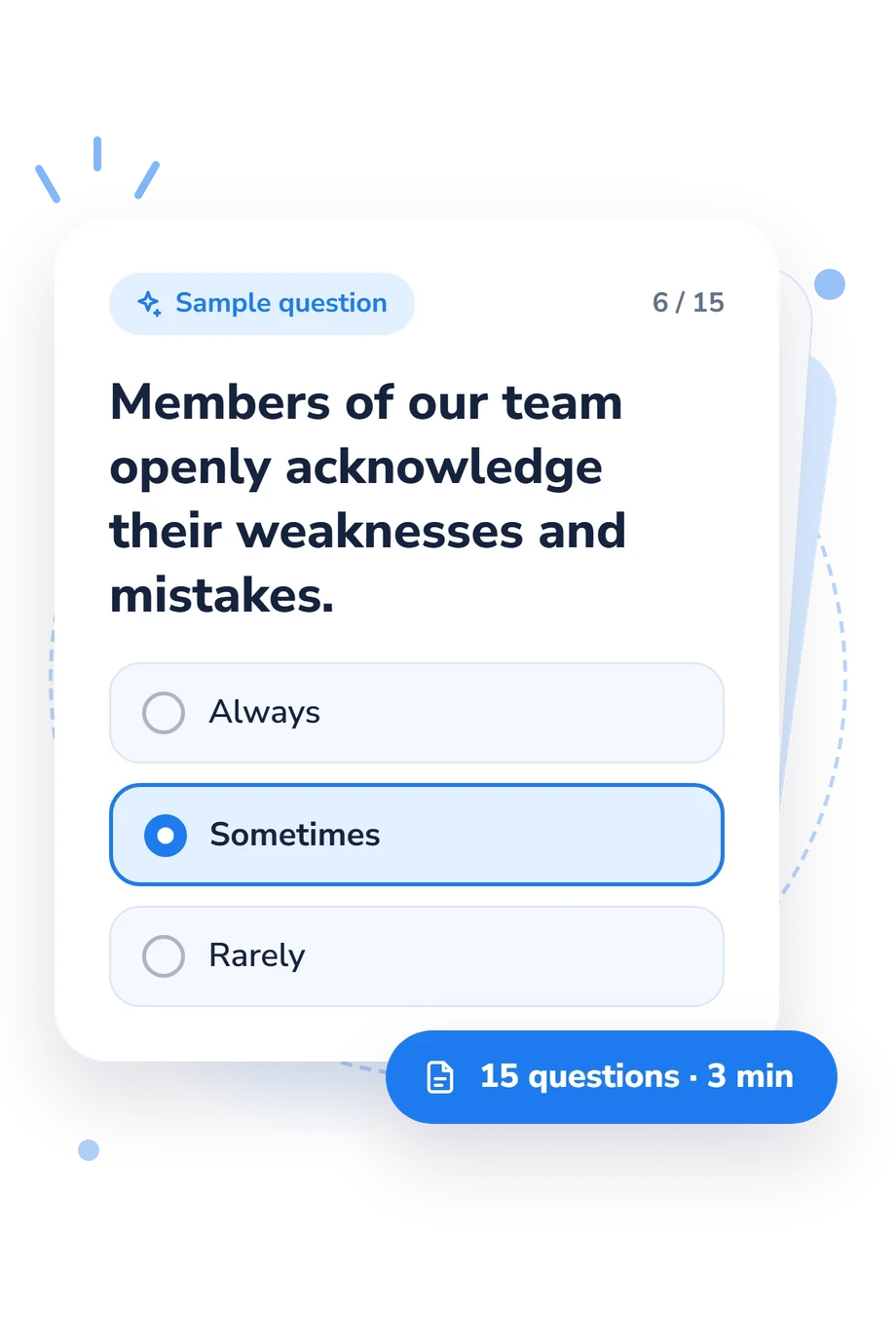
Example Questions From the Test
- Always
- Sometimes
- Rarely
- Always
- Sometimes
- Rarely
- Always
- Sometimes
- Rarely
Team Assessment Test - Description and methodology of the test
Managers, project leads, and team members who want a clearer view of collaboration can use the Team Assessment Test to examine patterns shaping everyday work. This team effectiveness assessment turns broad concerns about communication, follow-through, or morale into questions a team can discuss. It can help organize a conversation about whether current ways of working need attention, without reducing team dynamics to one overall label.
What This Assessment Explores
These results describe current team patterns rather than fixed traits. Items address candid discussion, challenge, mistakes, meetings, decisions, follow-through, and shared goals. As a team performance assessment, it is most useful to people who know the team's daily work. The five displayed dimensions cover these areas:
- Indifference to Results (3-9) measures engagement with shared goals; bands: Low indifference (3-5), Moderate indifference (6-7), High indifference (8-9).
- Low Demandingness (3-9) measures aspirations and expectations; bands: High standards (3-5), Mixed standards (6-7), Low standards (8-9).
- Irresponsibility (3-9) measures personal and collective accountability; bands: Low (3-5), Moderate (6-7), High (8-9).
- Fear of Conflict (3-9) measures avoidance of open discussion and disagreement; bands: Low fear (3-5), Moderate fear (6-7), High fear (8-9).
- Distrust (3-9) measures mutual trust and openness; bands: Low distrust (3-5), Moderate distrust (6-7), High distrust (8-9).
Methodology and Evidence Base
Respondents rate each statement as Always, Sometimes, or Rarely. The questions focus on observable team behavior, including openness, criticism, apology, support for decisions, monitoring progress, and reactions to success. Responses are grouped into thematic scores; the displayed bands indicate the direction and intensity of each tendency.
These team assessment results help members discuss whether meetings address difficult issues, colleagues challenge unproductive behavior, and agreed decisions are carried out. It suits members, managers, or facilitators with direct knowledge of the team's everyday functioning.
Its conceptual reference is Lencioni’s five-dysfunctions model, which links trust, productive conflict, commitment, accountability, and results. This online questionnaire is conceptually consistent with that model, but it is not documented as a formal adaptation of the published book’s framework.
Hamlin's 2008 validation study examined Lencioni's functions in relation to team effectiveness, while Aggarwal's 2023 study examined dysfunctional groups through the same model. The online questionnaire’s scoring has not been standardized; grouped scores summarize reported patterns in meetings, accountability, trust, and shared goals. Current context, self-awareness, and response bias can affect scores, so interpret the profile alongside observed behavior and team discussion.
- Lencioni, Patrick M. (2002). The Five Dysfunctions of a Team: A Leadership Fable. San Francisco, CA: Jossey-Bass.
- Hamlin, Judy L. (2008). Team effectiveness: A validation study of Lencioni's five functions of a team. Doctoral dissertation, University of La Verne.
- Aggarwal, Anil K. (2023). A Study of Lencioni's Model of Dysfunctional Groups. International Journal of e-Collaboration, 19(1), 1-19. 10.4018/IJeC.321557
Updated: