
Attitudes Toward Adherence to Moral Norms (Student Version) Test
How the Scales are Structured
Who Usually Takes This Test?
See How You Compare
Below is a preview of how scores are typically distributed across each scale.
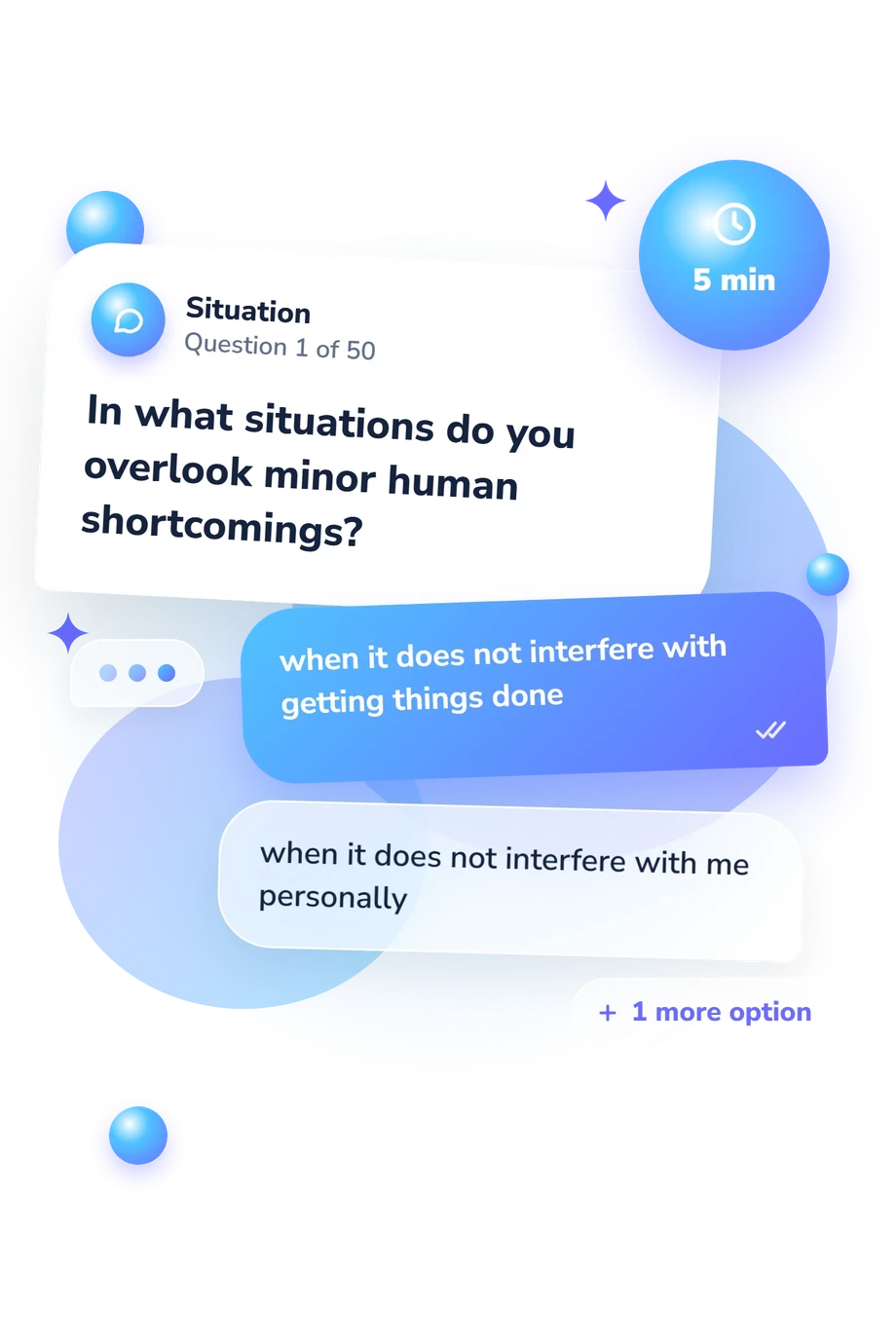
Example Questions From the Test
- When it does not interfere with the task
- When it does not affect me personally
- When it does not inconvenience others
- The person who made it is still inexperienced and can learn
- It was made for the first time
- A mistake should be punished
- Extremely rarely
- Because it creates a positive image
- Because everyone does it
Attitudes Toward Adherence to Moral Norms (Student Version) Test - Description and methodology of the test
For students who want to examine how ethical principles shape everyday choices, the Attitudes Toward Adherence to Moral Norms (Student Version) Test offers a structured self-reflection profile. It focuses on decisions involving obligations, honesty, fairness, authority, disagreement, and differences between people. As a moral attitudes questionnaire for students, it can show which patterns appear more consistent and where personal reflection may be useful.
What This Assessment Measures
Dilemmas turn student moral attitudes into practical choices; five dimensions follow:
- Responsibility (5-15) measures duties for self and others; higher scores show voluntary help, lower scores show compelled responsibility. Low 5-9; Moderate 10-12; High 13-15.
- Truthfulness (5-15) measures honesty; higher scores indicate honesty under pressure, lower scores indicate dishonest self-interest. Low 5-9; Moderate 10-13; High 14-15.
- Justice (5-15) measures equal rights; higher scores show commitment to equality, lower scores show passivity toward violations. Low 5-9; Moderate 10-12; High 13-15.
- Principledness (5-15) measures personal principles; higher scores show firmness, lower scores show compromise or deference to authority. More flexible 5-8; Balanced 9-12; Highly principled 13-15.
- Tolerance (5-15) measures attitudes to opinions, differences, and weaknesses; higher scores show humanistic motives, lower scores show low tolerance or selfish motives. Low tolerance 5-9; Moderate tolerance 10-13; High tolerance 14-15.
Methodology and Evidence Base
Situational prompts offer three answer choices. Respondents select the option closest to their likely action or attitude. The questionnaire combines responses into scale totals, but it does not specify how many points each option contributes, so the displayed bands should not be read as a per-answer scoring rule.
The questionnaire is conceptually consistent with the student instrument examined in the 2018 study and with the work of Zhuravlev and Kupreychenko. However, its online version is not established as an identical adaptation or as having the published instrument’s psychometric properties. The framework treats moral norms as regulators of conduct, obligations, fairness, and interaction.
The 2018 study reported reliability, validity, item discrimination, internal consistency, and sample norms for the published instrument. The result offers a profile of adherence to moral norms; self-report can reflect social desirability, current circumstances, and limited self-awareness, while displayed bands are interpretive rather than clinical.
- Rezazadeh, Z., Bayanova, L. F., & Gilemkhanova, E. N. (2018). Adaptation of the Test “Attitude to Observance of Moral Standards” on the Sample of Russian Students. Psychological Journal, 39(3), 102-112. 10.7868/S0205959218030091
- Zhuravlev, A. L., & Kupreychenko, A. B. (2003). Moral-Psychological Regulation of Economic Activity. Moscow: Institute of Psychology of the Russian Academy of Sciences.
Updated: