
Emotion Regulation and Management Test
How the Scales are Structured
Who Usually Takes This Test?
See How You Compare
Below is a preview of how scores are typically distributed across each scale.
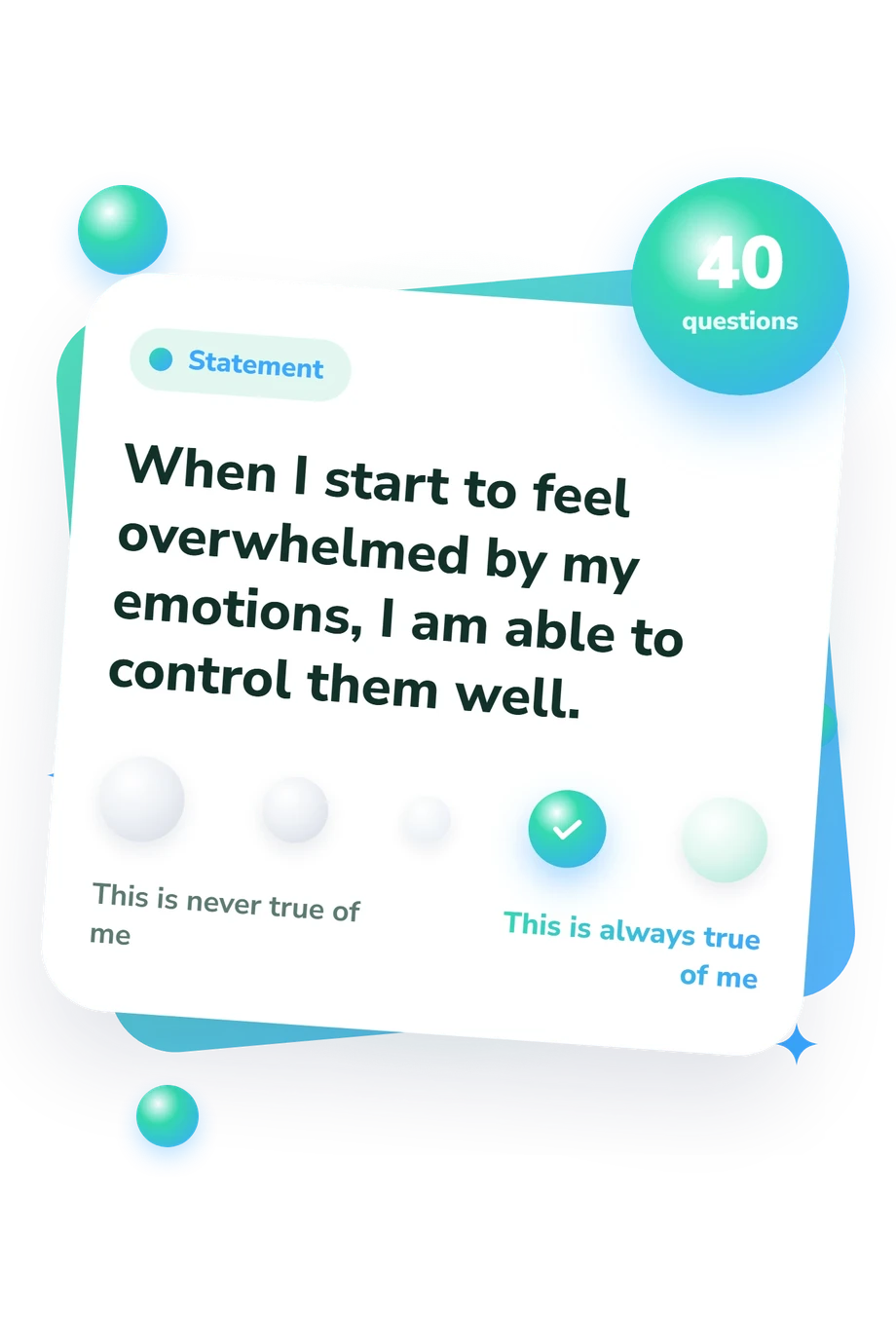
Example Questions From the Test
- This is never true of me
- This is rarely true of me
- This is sometimes true of me
- This is often true of me
- This is always true of me
- This is never true of me
- This is rarely true of me
- This is sometimes true of me
- This is often true of me
- This is always true of me
- This is never true of me
- This is rarely true of me
- This is sometimes true of me
- This is often true of me
- This is always true of me
Emotion Regulation and Management Test - Description and methodology of the test
People seeking a clearer picture of how they handle intense feelings and influence emotional situations with others can use the Emotion Regulation and Management Test as a structured self-reflection exercise. The emotion regulation assessment focuses on everyday patterns rather than isolated incidents, showing how composure, impulse control, encouragement, and calming skills appear across personal and interpersonal situations.
What This Assessment Explores
The questionnaire examines two connected forms of emotional functioning. One concerns moods, impulses, anger, frustration, and balance; the other concerns responding constructively when someone else is distressed, discouraged, angry, or caught in conflict. As an emotional self-regulation test, it invites reflection on behavior in relationships, work, and everyday pressure.
The displayed dimensions are:
- Regulation of Others' Emotions: -20-20. This score describes influencing another person’s emotional state through support, comfort, motivation, humor, and calming actions; Needs development covers -20-9, and Effective covers 10-20.
- Self-Emotion Regulation: -20-20. This score describes control of emotions, desires, and impulses, including composure under challenge and goal-directed choices consistent with personal standards; Lower control covers -20--5, Variable control covers -4-2, and Stronger control covers 3-20.
The two indicators are read alongside each other; each result describes its own area, without assigning a combined profile.
Methodology and Scientific Basis
Each statement asks how true it is, using five ordered choices from "never true" to "always true." Items cover self-directed situations-mood, anger, impulses, and balance-and interpersonal situations involving reassurance, motivation, conflict, and calming. The emotion management questionnaire displays two separate scores; item-level weighting is not stated, so readers should interpret the displayed bands rather than calculate an unprovided formula.
EROS, a measure distinguishing regulation of other people’s emotions from regulation of one’s own, offers the closest conceptual match because it separates those two abilities. The broader Survey of Emotional Intelligence treats emotional intelligence as a multidimensional domain, while Gross and John’s work describes individual differences in emotion-regulation processes. This questionnaire is conceptually consistent with those works, not a direct adaptation or revalidation of them.
The questionnaire is a self-report profile rather than a documented standardized clinical instrument, so its bands are prompts for reflection rather than clinical thresholds or explanations of causes. Mood, current circumstances, self-awareness, and self-presentation can shape answers, and the two displayed dimensions are best interpreted separately when considering reported tendencies at completion.
- Tett, R. P., Fox, K. E., & Wang, A. (2005). Development and Validation of a Self-Report Measure of Emotional Intelligence as a Multidimensional Trait Domain. Personality and Social Psychology Bulletin, 31(7), 859-888. 10.1177/0146167204272860
- Niven, K., Totterdell, P., Stride, C. B., & Holman, D. (2011). Emotion Regulation of Others and Self (EROS): The Development and Validation of a New Individual Difference Measure. Current Psychology, 30(1), 53-73. 10.1007/s12144-011-9099-9
- Gross, J. J., & John, O. P. (2003). Individual Differences in Two Emotion Regulation Processes: Implications for Affect, Relationships, and Well-Being. Journal of Personality and Social Psychology, 85(2), 348-362. 10.1037/0022-3514.85.2.348
Updated: