
Occupational Future Time Perspective (OFTP) Test
How the Scales are Structured
Who Usually Takes This Test?
See How You Compare
Below is a preview of how scores are typically distributed across each scale.
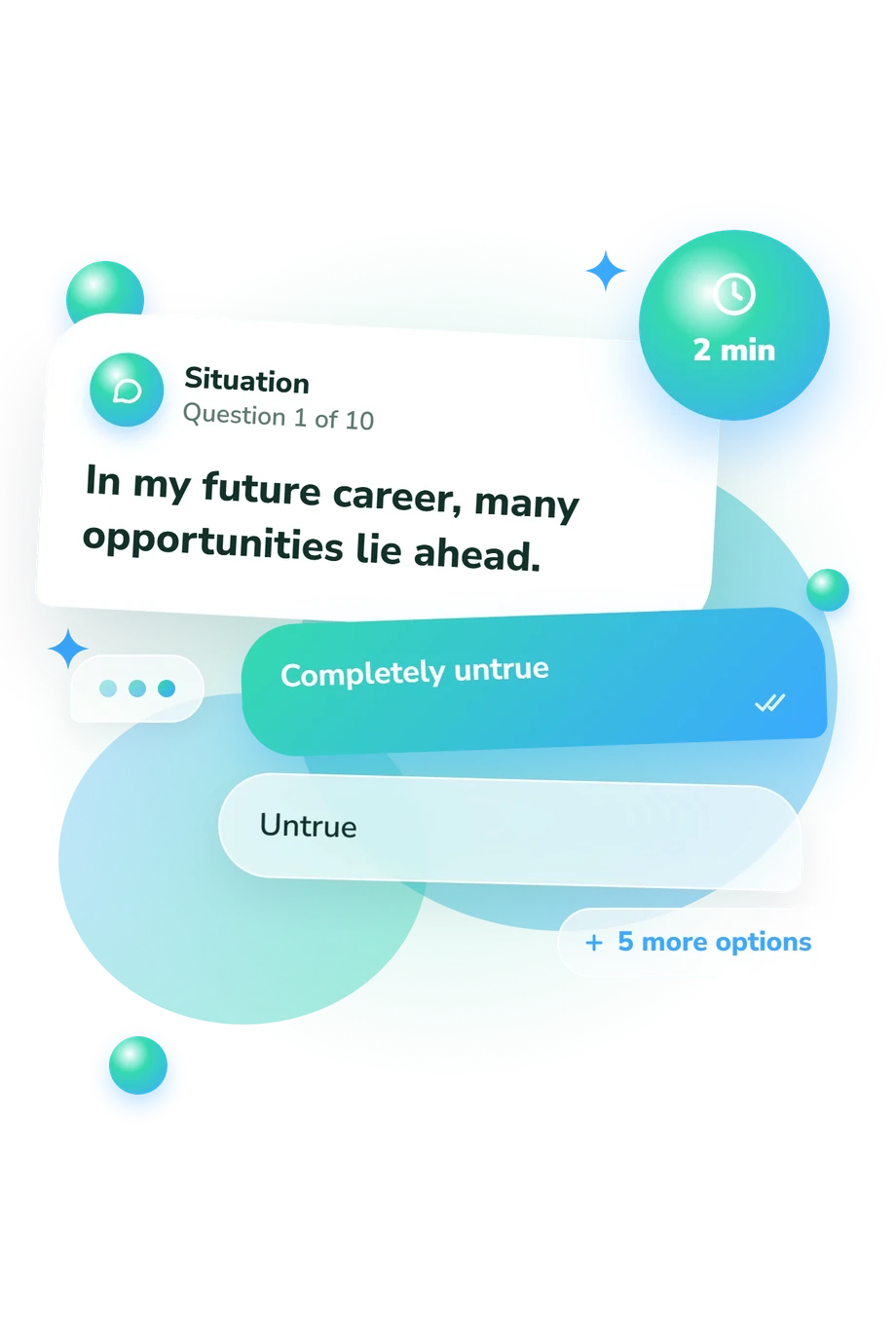
Example Questions From the Test
- Completely untrue
- Untrue
- Mostly untrue
- Neither true nor untrue
- Mostly true
- True
- Completely true
- Completely untrue
- Untrue
- Somewhat untrue
- Neither true nor untrue
- Somewhat true
- True
- Completely true
- Completely untrue
- Untrue
- Somewhat untrue
- Neither true nor untrue
- Somewhat true
- True
- Completely true
Occupational Future Time Perspective (OFTP) Test - Description and methodology of the test
For employees, job seekers, and anyone reflecting on career direction, the Occupational Future Time Perspective (OFTP) Test helps organize how working life is mentally framed. It clarifies occupational future perspective by showing whether expectations emphasize possibilities, constraints, or the amount of time left for professional goals. The result offers a focused way to examine planning, goals, and perceived limits when considering a career decision.
What This Assessment Explores
Items address opportunities, goals, available time, endings, and restrictions. The assessment suits people considering career development, work transitions, later-career priorities, or professional direction, regardless of occupation or employment status.
In practical terms, the result describes a future career outlook, mapping perceived possibilities and constraints rather than objective prospects. The result has three dimensions:
- Focus on Limitations (3-21) shows whether the future is seen as constrained: Low limitations focus (3-9), Moderate limitations focus (10-15), or High limitations focus (16-21).
- Focus on Opportunities (3-21) shows attention to plans, goals, and possibilities: Limited opportunities focus (3-9), Balanced opportunities focus (10-15), or Strong opportunities focus (16-21).
- Remaining Time (3-21) shows whether occupational time feels limited or open-ended: Limited time (3-9), Moderate time (10-15), or Open-ended time (16-21).
Methodology and Scientific Basis
Each statement uses seven response options, from strong disagreement or complete untruth to strong agreement or complete truth. Items ask about perceived opportunities, goals, time, and endings, so responses describe personal expectations rather than verified career conditions. Responses produce the three displayed profile scores, while the published studies do not establish equivalence, norming, or clinical thresholds for this online version.
The closest instrument source is Zacher and Frese (2009), which examines Occupational Future Time Perspective alongside age and work characteristics. Zacher (2013) applies the construct to work goals and behavior, while Topa and Zacher (2018) report psychometric evidence for a Spanish version. Together, these studies contextualize the questionnaire’s career time perspective; it is conceptually consistent with the construct, not automatically identical to, adapted from, or normed like those published versions.
Interpret the result as a current self-report profile. Work conditions, mood, self-awareness, and socially desirable responding can shape answers. Read the pattern as a prompt to examine how current planning responds to perceived goals, opportunities, constraints, and available time.
- Zacher, H. (2013). Older job seekers' job search intensity: The interplay of proactive personality, age and occupational future time perspective. Ageing & Society, 33(7), 1139-1166. 10.1017/S0144686X12000451
- Zacher, H., & Frese, M. (2009). Remaining time and opportunities at work: Relationships between age, work characteristics, and occupational future time perspective. Psychology and Aging, 24(2), 487-493. 10.1037/a0015425
- Topa, G., & Zacher, H. (2018). Occupational Future Time Perspective: Psychometric Properties of a Spanish Scale. Frontiers in Psychology, 9, 2237. 10.3389/fpsyg.2018.02237
Updated: