
Freudly+971 508685814hello@freudly.ai
Freudly
communication style

Relationship Feelings Profile Test
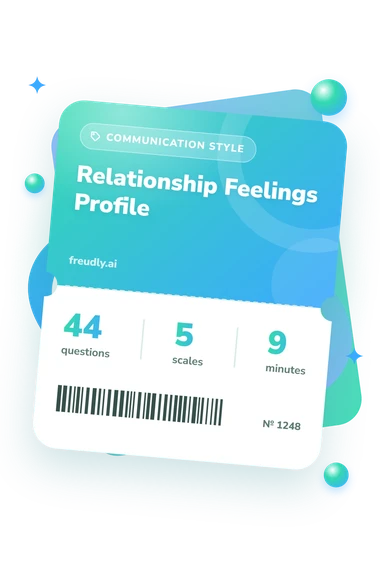
Take the online Relationship Feelings Profile Test - AI psychologist FreudlyYou can take Relationship Feelings Profile Test here. Online version of a simple and accurate psychological test with interpretation.en
With 44 questions and a nine-minute completion time, the Relationship Feelings Profile Test explores the intensity of positive, difficult, and closeness-related feelings toward another person. Your result highlights emotional patterns in the relationship, offering a focused starting point for self-reflection and clearer understanding of your interpersonal experience.
Questions: 449 minutes
Relationship Feelings Profile Test: test ticket with numbers
October 2, 2025October 2, 2025Material has been updatedOctober 2, 2025Material has been published
24,695 views
1,589 completions
1,252 likes
Daniel HallPsychologist · Test reviewer
1,252 likes
Scale Explorer

How the Scales are Structured

DistancingD
Measures the degree of emotional numbing and detachment a person experiences toward someone in a relationship.
example score33/63
33/63Moderateexample score
0 – 21Low
22 – 42Moderate
43 – 63High
A score of 33 falls in the Moderate range, suggesting a noticeable but not pervasive tendency to distance emotionally or feel less engaged in interactions with this person.
Affiliative FeelingsAF
This scale measures the intensity of feelings that motivate seeking emotional closeness, connection, and supportive contact with another person.
example score44/63
44/63High closeness-seekingexample score
0 – 21Low closeness-seeking
22 – 42Moderate closeness-seeking
43 – 63High closeness-seeking
A score of 44 falls in the High closeness-seeking range, suggesting a strong current tendency to move toward the other person for emotional connection and support.
MelancholicM
Measures the degree of sadness and low mood you experience toward a specific person in your relationship or interaction.
example score38/49
38/49Highexample score
0 – 16Low
17 – 33Moderate
34 – 49High
A score of 38 falls in the High range, suggesting melancholic feelings (sadness or low mood) are relatively prominent in your current experience with this person.
Asthenic FeelingsAF
Measures the degree of low-energy, fatigued, and passive feelings experienced in relation to another person.
example score24/63
24/63Moderateexample score
0 – 21Low
22 – 42Moderate
43 – 63High
A score of 24 falls in the Moderate range, suggesting some tiredness or reduced emotional energy in this relationship while still retaining overall engagement.
Hedonistic FeelingsHF
This scale measures the degree of pleasure, joy, and overall satisfaction experienced in the relationship.
example score23/70
23/70Lowexample score
0 – 23Low
24 – 46Moderate
47 – 70High
A score of 23 falls in the Low range, suggesting relatively limited pleasure and joy reported in interactions with this person at the moment.
just completed the test
DATA-BASED USER COHORTS

Who Usually Takes This Test?

Couples in a tough spot
41%OF USERS
People in romantic relationships use it to clarify what they truly feel toward their partner during conflict, distance, or big decisions.
Therapy and coaching clients
34%OF USERS
Individuals in counseling take it to map their emotional tone toward someone important and bring clearer material into sessions.
Team and work relationships
25%OF USERS
Professionals use it to understand feelings toward a colleague or manager and adjust communication in high-stakes collaborations.
BASED ON AGGREGATED, ANONYMIZED DATA FROM TENS OF THOUSANDS OF FREUDLY USERS.
Benchmarking

See How You Compare

Once you complete the test, your results are compared with real-world data from people in your country.
Below is a preview of how scores are typically distributed across each scale.
Shaded area — where most people score
Dot — the average
You — your score lands on each curve after the test— your score, after the test
deletingd
You?
Average20.8
Typical rangeTypical9.8 – 31.8
Possible0 – 63
bringing closerbc
You?
Average28.5
Typical rangeTypical19.8 – 37.2
Possible0 – 63
melancholicm
You?
Average27
Typical rangeTypical19.2 – 34.8
Possible0 – 49
asthenica
You?
Average23
Typical rangeTypical14 – 31.9
Possible0 – 63
hedonistich
You?
Average37
Typical rangeTypical27.3 – 46.8
Possible0 – 70
Featured On
SAMPLE QUESTIONS

Example Questions From the Test

Please recall your feelings and emotional experiences in situations involving interaction with a person who is significant to you. Unless you have received additional instructions from the psychologist, decide for yourself who this person is for you (e.g., a friend, an adversary, a romantic partner). As you read the list of feelings below, rate how intense each feeling was. Complete the task carefully and without rushing. Keep in mind that the same person, in different situations, may elicit many very different emotional experiences.
    • The feeling did not occur at all
    • A very mild feeling
    • A mild feeling
    • Somewhat below average in intensity
    • A feeling of average intensity
    • Somewhat above average in intensity
    • A strong feeling
    • A very strong feeling
    • The feeling did not occur at all
    • Very weak feeling
    • Weak feeling
    • Somewhat below average intensity
    • Moderate intensity
    • Somewhat above average intensity
    • Strong feeling
    • Very strong feeling
    • Did not feel it at all
    • Very weak feeling
    • Weak feeling
    • Slightly below average intensity
    • Moderate intensity
    • Slightly above average intensity
    • Strong feeling
    • Very strong feeling
WHAT THE TEST MEASURES

Relationship Feelings Profile Test - Description and methodology of the test

communication style

For anyone trying to understand how a particular relationship feels from the inside, the Relationship Feelings Profile Test offers a structured way to organize that experience. It examines emotions in a particular relationship across contrasting dimensions, including warmth, closeness, withdrawal, and difficult reactions. The result helps the respondent decide which interactions or feelings deserve closer attention.

What This Assessment Explores

The questionnaire treats listed feelings as reports of emotional involvement in a relationship. The items cover pleasant, difficult, self-evaluative, and closeness-oriented responses, with many later feelings framed toward one person. This profile of relationship emotions describes reported relational feelings without assigning a fixed personality label.

The five displayed scales organize this profile:

  • Hedonistic Feelings (0-70) indicates pleasure, joy, and satisfaction: Low 0-23; Moderate 24-46; High 47-70.
  • Distancing (0-63) indicates withdrawal, detachment, or reduced emotional involvement: Low 0-21; Moderate 22-42; High 43-63.
  • Affiliative Feelings (0-63) indicates a desire for closeness and support: Low closeness-seeking 0-21; Moderate closeness-seeking 22-42; High closeness-seeking 43-63.
  • Melancholic (0-49) indicates sadness, sorrow, or lowered mood: Low 0-16; Moderate 17-33; High 34-49.
  • Asthenic Feelings (0-63) indicates reduced activity, fatigue, or passivity: Low 0-21; Moderate 22-42; High 43-63.

Methodology and Scientific Basis

Items ask respondents to rate listed feelings by intensity. Many later items explicitly frame a feeling toward the selected person, while others name general states such as alertness, calmness, interest, or fatigue. Responses move from absent or very weak through moderate to very strong. The online relationship feelings questionnaire reports totals for five displayed scales but does not document how each response option contributes to them.

The methodology is conceptually consistent with Kulikov’s 2003 Profile of Feelings in Relationships, which organizes interpersonal feelings by emotional tone and relational distance. The 2025 application manual guides the method; a 2017 friendship study applies it to closeness, distance, and unpleasant feelings in a defined relationship. Kulikov’s 2018 work addresses empirical classification of feeling clusters, including hedonic, asthenic, and melancholic groupings.

This online version is a structured self-report profile; no normative sample or standardization procedure is stated. Its bands are descriptive rather than clinical cutoffs. Scores may shift with the selected relationship, recent events, mood, word interpretation, or candour; results are best used to compare dimensions and reflect on concrete interactions.

Author: Clyde Hendrick, Susan S. Hendrick
Literature:
  • Kulikov, L. V. (2003). Guide to Methods for Diagnosing Mental States, Feelings, and Psychological Stability of the Individual: Description of Methods and Instructions for Use. Saint Petersburg: Saint Petersburg State University.
  • Kulikov, L. V. (2025). Instructions for Applying the Profile of Feelings in Relationships Method (2025 Revision). Author's manual.
  • Kulikov, L. V., & Griva, O. V. (2017). Emotional-Sensual Characteristics of Female Friendship. Psychology: Historical-Critical Reviews and Current Research, 6(6A), 23-31. ISSN 2223-5477.
  • Kulikov, L. V. (2018). The Problem of Finding Empirical Grounds in Classification of Feelings. Herald of Omsk University. Series: Psychology, 18(1), 4-12. DOI 10.24147/2410-6364.2018.1.4-12
Popular tests
Comments
Leave a Comment