
Professional Identity Test
How the Scales are Structured
Who Usually Takes This Test?
See How You Compare
Below is a preview of how scores are typically distributed across each scale.
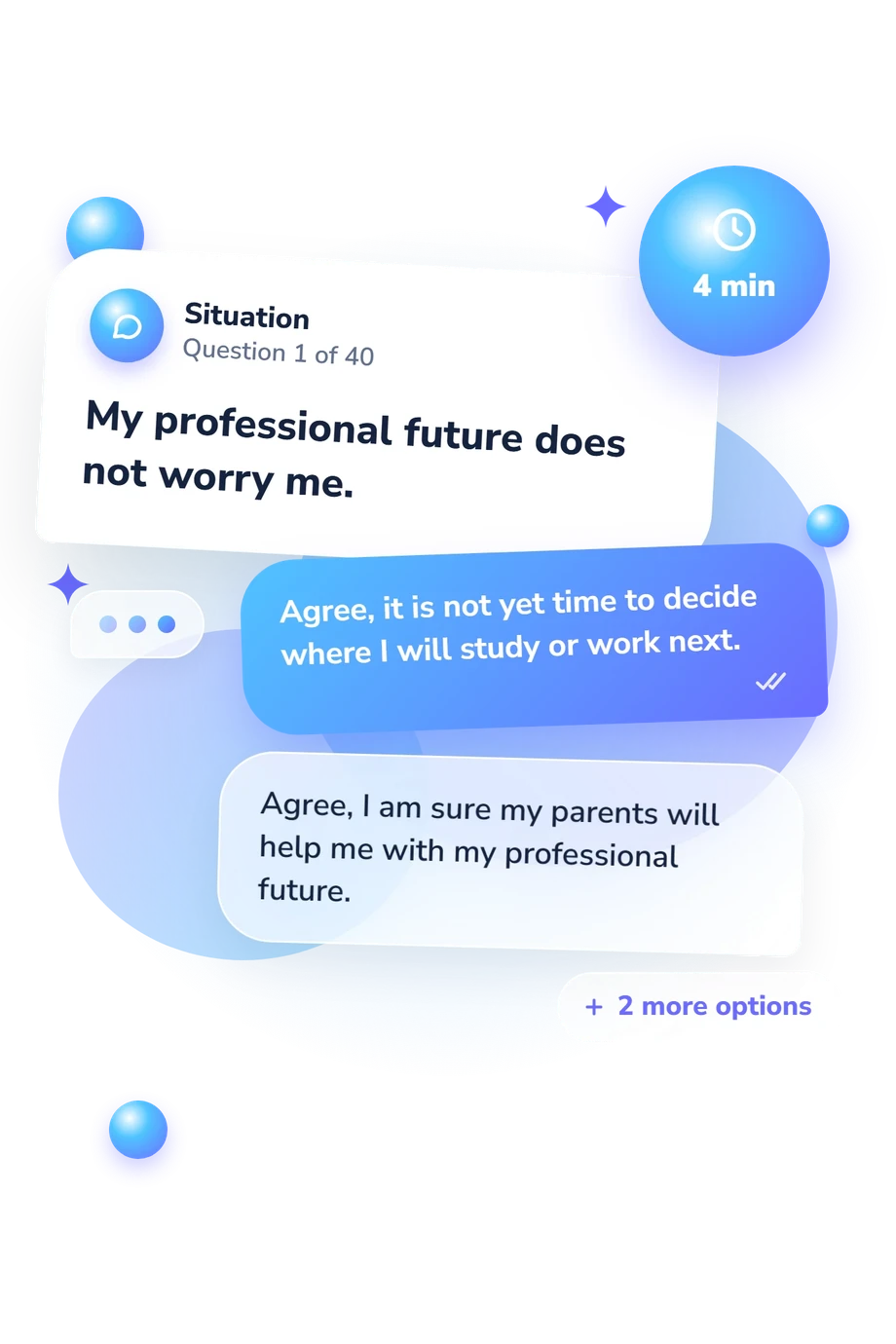
Example Questions From the Test
- Agree; it is not yet time to decide where I will study or work next.
- Agree; I am confident that my parents will help me with my professional future.
- Agree, because I have already decided about my professional future a long time ago, so there is no point in worrying.
- Disagree, because if I do not worry about the future now, it will be too late later.
- Agree, because I am interested in several fields that I would like to pursue.
- Agree, so I would rather follow the advice of someone I trust (parents, a trusted acquaintance, a friend).
- Disagree, because I have already decided where I will study or work in the future.
- Disagree, because I have not yet thought about this issue.
- Agree; labor market demand affects which specialty I will choose.
- Disagree; my parents know better which specialty to suggest to me.
- Disagree; it is not yet time to analyze demand for occupations.
- Disagree; I have already decided that I will pursue the specialty I want regardless.
Professional Identity Test - Description and methodology of the test
For anyone weighing education, work, or a change of direction, the Professional Identity Test offers a structured way to examine how career choices are taking shape. Its questions help distinguish personal commitment from outside pressure, active exploration from limited engagement with career planning, and uncertainty from an established plan. The result gives language to a decision that may still feel difficult to define.
What This Assessment Explores
Rather than measuring aptitude, the professional identity questionnaire examines plans, exploration, personal agency, and outside influence in education and career decisions. The result helps show whether a direction is consciously chosen, actively explored, externally shaped, or left undefined.
The profile reports four dimensions, each with its displayed bands:
- Achieved (0-25) measures a consciously defined path and independent choice: Not yet formed (0-8), Emerging (9-11), Formed (12-25).
- Moratorium (0-25) measures active exploration during a choice crisis: Low moratorium (0-9), Moderate moratorium (10-19), High moratorium (20-25).
- Foreclosed (0-25) measures a future shaped by outside influence: Self-directed (0-9), Mixed influences (10-19), Strongly imposed (20-25).
- Diffused (0-25) measures unclear plans and limited engagement: Low undefined (0-7), Moderate undefined (8-15), High undefined (16-25).
Methodology and Scientific Basis
Each item presents a statement followed by four alternatives. The options distinguish independent commitment, parental direction, active exploration, and postponement, so the response reflects why a choice fits, not agreement alone. Items cover career information, educational routes, family discussion, and confidence about plans.
The questionnaire organizes responses into four status scores. It does not state how many points each answer contributes; the profile should therefore be read through each status definition and displayed band rather than treated as a universal measure of career readiness.
The four-status framework is conceptually consistent with the method described by Azbel and Gretsov (2006) and with Marcia’s identity-status model, alongside Erikson’s developmental account of identity. The four-status model maps the current position of a career decision and the reasons behind it, including commitment, exploration, external direction, or non-engagement; it is not identical to Marcia’s instrument.
Self-report results can shift with current stress, family conversations, available information, and willingness to acknowledge uncertainty. The bands organize reflection, but they do not establish population norms or predict occupational success; consider the profile alongside goals, opportunities, and changing interests.
- Azbel, Anastasia A., and Andrei G. Gretsov. (2006). Methodology for studying professional identity statuses. In Know Yourself: Psychological Tests for Teenagers (pp. 143-155). St. Petersburg: Piter.
- Marcia, James E. (1966). Development and validation of ego-identity status. Journal of Personality and Social Psychology, 3(5), 551-558. 10.1037/h0023281
- Erikson, Erik H. (1968). Identity: Youth and Crisis. New York: W. W. Norton.
Updated: