
Psychological Types of Relatives' Reactions to a Loved One's Illness Test
How the Scales are Structured
Who Usually Takes This Test?
See How You Compare
Below is a preview of how scores are typically distributed across each scale.
Example Questions From the Test
- Strongly disagree
- Partly disagree
- Partly agree
- Strongly agree
- Strongly disagree
- Partly disagree
- Partly agree
- Strongly agree
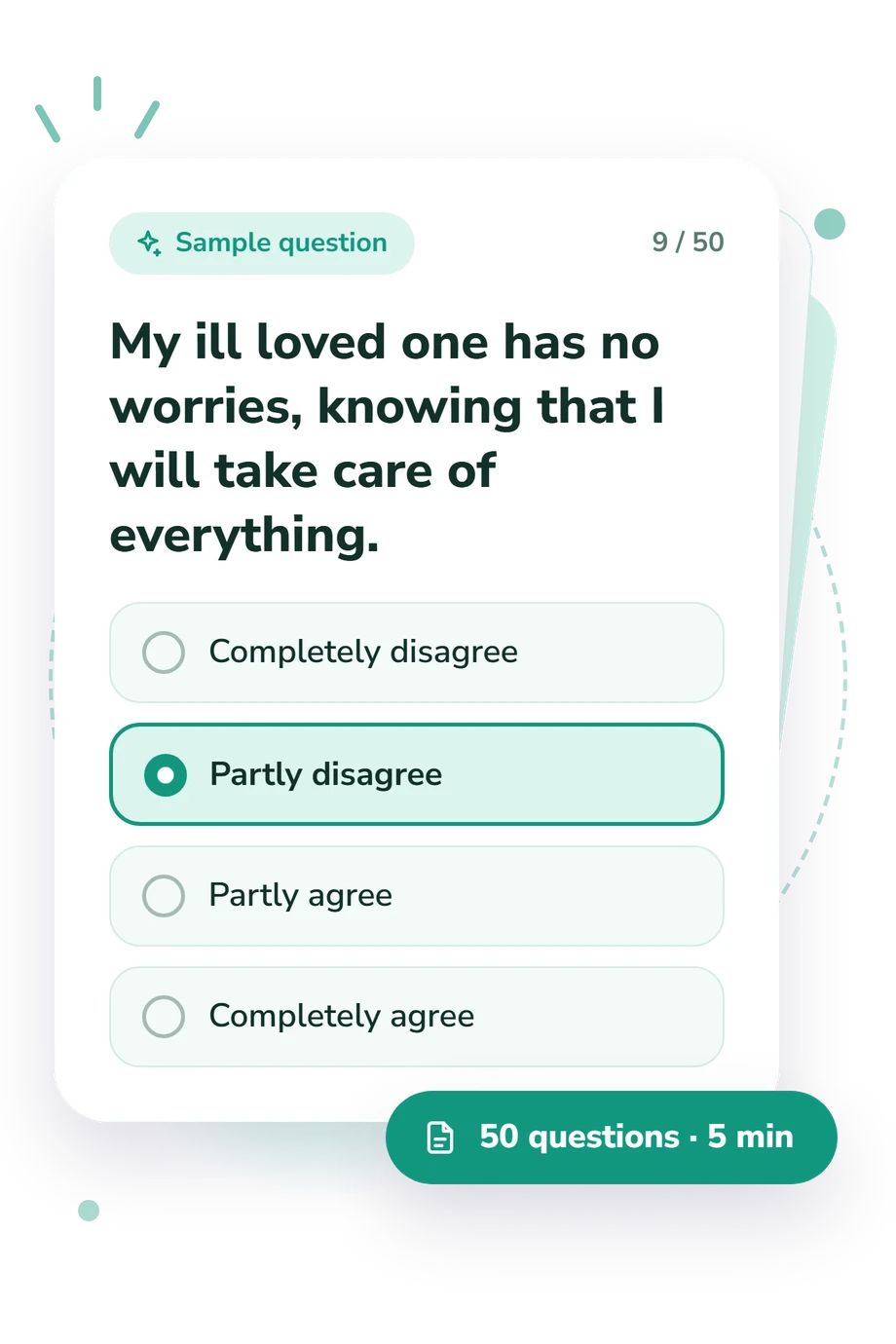
- Completely disagree
- Partly disagree
- Partly agree
- Completely agree
Psychological Types of Relatives' Reactions to a Loved One's Illness Test - Description and methodology of the test
Understanding how illness has changed support, closeness, or family roles can clarify day-to-day caregiving for relatives and other close supporters. The Psychological Types of Relatives' Reactions to a Loved One's Illness Test gives a structured way to reflect on those changes without treating one response as a fixed identity. Its result helps a respondent consider their family caregiving response, current emotional strain, involvement, and patterns of support within the relationship.
What This Assessment Explores
The questions examine involvement, boundaries, family cooperation, and balance between the patient's needs and the caregiver's life. Reactions to a loved one's illness may include balanced judgment, distress, withdrawal, or excessive involvement. Results reflect current caregiving situation, emotional state, and relationship patterns, including changes in closeness, roles, and support.
These scales describe the dimensions:
- Detachment (0-100) shows indifferent, formal assistance with reduced closeness; Engaged 0-43, Somewhat detached 44-63, Strongly detached 64-100.
- Harmonious Reaction (0-100) reflects realistic appraisal, balanced caregiving and personal needs, constructive relationships, and effective support; Low harmony 0-43, Moderate harmony 44-63, High harmony 64-100.
- Emotional Reaction (0-100) captures distress, anxiety, worry, guilt, fatigue, irritability, possible aggression, and internal strain; Low 0-43, Moderate 44-73, High 74-100.
- Overprotectiveness (0-100) indicates excessive caregiving that may neglect the caregiver's needs or hinder the patient's independence; Low 0-33, Moderate 34-63, High 64-100.
Methodology and Scientific Basis
Each item is a self-report statement with four graded choices. Most ask about agreement; others ask frequency, using options such as Rarely, Sometimes, Often, and Always. Themes include protection, despair, sleep, family discussion, shared responsibilities, treatment decisions, and preserving ordinary activities.
The four displayed scores describe a caregiver's emotional response across separate tendencies. Higher values indicate more of the tendency named by each scale, while the displayed bands summarize intensity. This version does not state the points assigned to individual answers, so the ranges do not justify inferring an undisclosed scoring formula.
The closest conceptual source is Relatives' Illness Reaction Types by Bespanskaya-Pavlenko and Fursa (2014). This online questionnaire is conceptually consistent with that work, but it is not presented as an adaptation of the published instrument.
No normative sample, reliability estimates, or clinical cutoffs are stated. Scores may shift with stress, family circumstances, self-awareness, and pressure to appear capable or caring, so interpret the pattern alongside the context.
- Bespanskaya-Pavlenko, E. D., & Fursa, K. A. (2014). Psychological Types of Relatives' Reactions to a Loved One's Illness. Psychological Journal (Minsk), no. 1-2.
- Rolland, J. S. (1987). Chronic Illness and the Life Cycle: A Conceptual Framework. Family Process, 26(2), 203-221. 10.1111/j.1545-5300.1987.00203.x
- Kübler-Ross, E. (1969). On Death and Dying. New York: Macmillan.
Updated: