
Occupational Hardiness Questionnaire (OHQ) Test
How the Scales are Structured
Who Usually Takes This Test?
See How You Compare
Below is a preview of how scores are typically distributed across each scale.
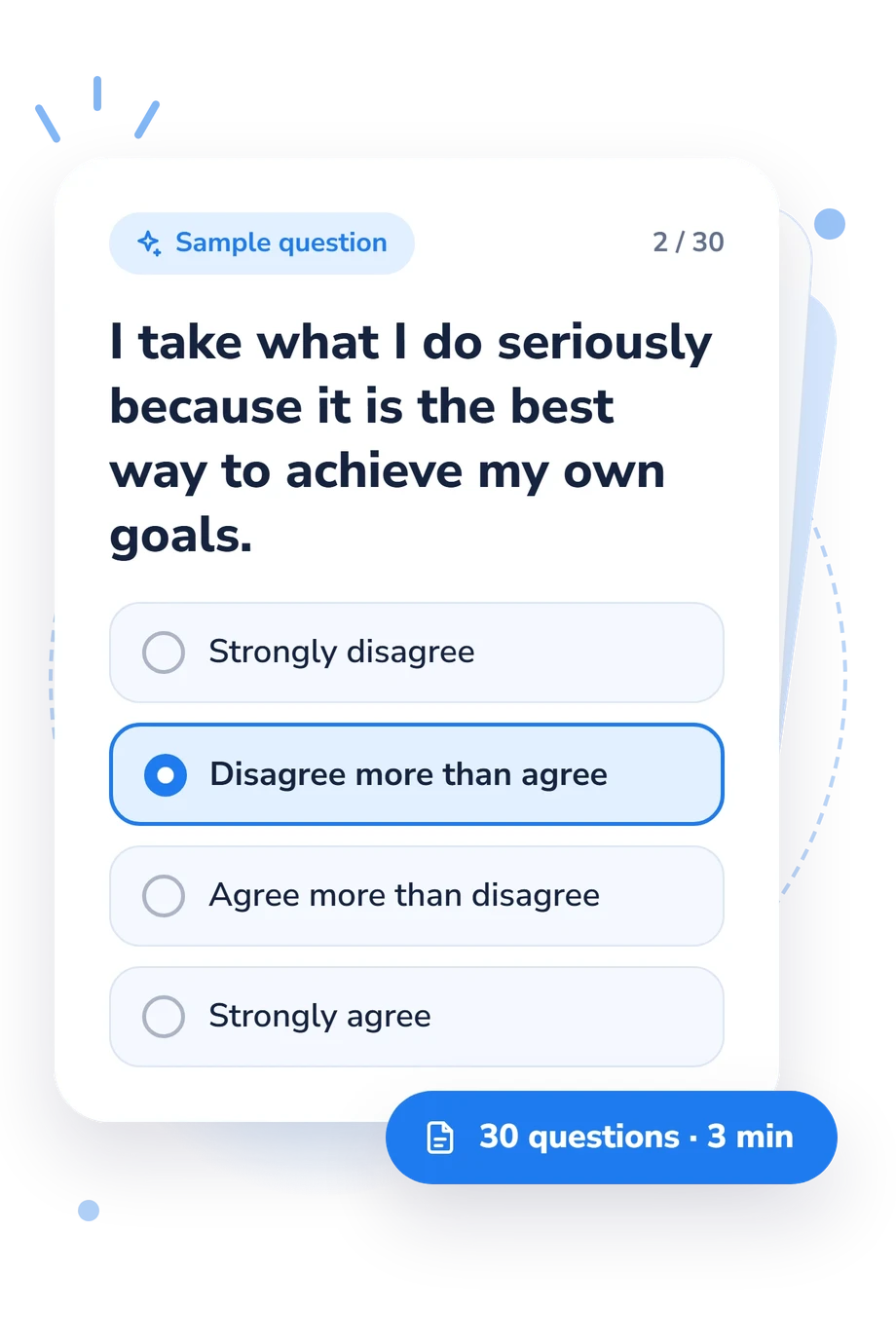
Example Questions From the Test
- Strongly disagree
- Disagree more than agree
- Agree more than disagree
- Strongly agree
- Strongly disagree
- Disagree rather than agree
- Agree rather than disagree
- Strongly agree
- Strongly disagree
- Disagree more than agree
- Agree more than disagree
- Strongly agree
Occupational Hardiness Questionnaire (OHQ) Test - Description and methodology of the test
For anyone deciding whether their current way of working fits the demands of a role, the Occupational Hardiness Questionnaire (OHQ) Test offers a structured way to consider that choice. This occupational hardiness assessment focuses attention on responsibility, uncertainty, and involvement, helping a respondent identify which aspects of work deserve closer reflection before making changes. It is suited to people seeking a practical snapshot of their occupational outlook.
What This Assessment Measures
These items examine how a person approaches occupational difficulty, including work involvement, responsibility, planning, challenge, and openness to new experiences. The themes form a work-focused hardiness profile, so this workplace hardiness test focuses on patterns of professional coping rather than a fixed verdict. Each scale is defined as follows:
- Risk Taking (5-20) measures willingness to accept new challenges and make nonstandard decisions in professional activities; higher scores indicate seeking new opportunities and adapting to change: Cautious (5-9), Balanced (10-15), Adventurous (16-20).
- Control (5-20) measures confidence in influencing work outcomes: Low control (5-10), Moderate control (11-15), High control (16-20).
- Commitment (5-20) measures interest and involvement in work: Low (5-10), Moderate (11-15), High (16-20).
- Occupational Hardiness (15-60) measures resilience to work difficulty through commitment, control, and risk acceptance: Lower resilience (15-29), Moderate resilience (30-44), High resilience (45-60).
Methodology and Scientific Basis
Each statement uses a four-point agreement response from Strongly disagree to Strongly agree. The items cover involvement in work, perceived influence, and openness to challenge. Results report three component scores and an overall score; displayed ranges categorize each result through the questionnaire’s interpretation bands.
Its evidence base is conceptually consistent with Occupational Hardiness Questionnaire (Moreno-Jiménez et al., 2014), Kobasa’s hardiness model (1979), and later prospective work by Kobasa, Maddi, and Kahn (1982). These sources describe hardiness through commitment, control, and challenge; this questionnaire is only conceptually consistent with that model, while retaining the catalogue’s labels and definitions. The online questionnaire is not presented as a documented adaptation of the published instrument, and its displayed bands are the interpretation categories shown for its results.
The result is best read as a structured self-report profile from an occupational resilience questionnaire. Current workload, workplace culture, mood, memory, and self-presentation can influence answers, so the result is most useful for examining work habits and coping patterns alongside real-life context rather than as a clinical conclusion.
- Moreno-Jiménez, B., Rodríguez-Muñoz, A., Garrosa Hernández, E., & Blanco, L. M. (2014). Development and validation of the Occupational Hardiness Questionnaire. Psicothema, 26(2), 207-214. 10.7334/psicothema2013.49
- Kobasa, S. C. (1979). Stressful life events, personality, and health: An inquiry into hardiness. Journal of Personality and Social Psychology, 37(1), 1-11. 10.1037/0022-3514.37.1.1
- Kobasa, S. C., Maddi, S. R., & Kahn, S. (1982). Hardiness and health: A prospective study. Journal of Personality and Social Psychology, 42(1), 168-177. 10.1037/0022-3514.42.1.168
Updated: