
Freudly+971 508685814hello@freudly.ai
Freudly
deviant behavior

Deviant Behavior Risk Scale Test
Take the online Deviant Behavior Risk Scale Test - AI psychologist FreudlyYou can take Deviant Behavior Risk Scale Testhere. Online version of a simple and accurate psychological test with interpretation.en
Understand a student’s risk for destructive behavior and what skills may be missing in about 13 minutes. Clear results flag key risk areas and guide timely, targeted support plans.
Start Online Test
Questions: 7013 minutes
08:30
October 2, 2025
October 2, 2025
Material has been updated
October 2, 2025
Material has been published
28,939 views
2,126 completions
1,784 likes
Verified by Daniel Hall
Psychologist with 25 years of experience
Share
Scale Explorer

How the Scales are Structured

example score
14/30
Risk of Aggressive Behavior (RoAB)
Measures the likelihood of aggressive reactions that may cause harm to self or others in stressful or interpersonal situations.
Low
Moderate
High
010: Low | 1120: Moderate | 2130: High
A score of 14 falls in the Moderate range, suggesting some tendency toward aggressive reactions that may emerge in challenging situations while restraint is still present.
example score
6/30
Risk of Disregarding Danger (RoDD)
Measures the tendency to ignore potential danger and act in risky situations rather than responding cautiously.
Low risk-taking
Moderate risk-taking
High risk-taking
010: Low risk-taking | 1120: Moderate risk-taking | 2130: High risk-taking
A score of 6 falls in the Low risk-taking range, suggesting a generally cautious approach with a lower tendency to dismiss potential dangers.
example score
9/30
Protest Risk (PR)
Measures the tendency toward defiant, oppositional behavior and conflict with the surrounding social environment.
Low
Moderate
High
010: Low | 1120: Moderate | 2130: High
A score of 9 falls in the Low range, suggesting generally low inclination toward protest behavior and conflicts in interactions.
example score
18/30
Suicide Risk (SR)
This scale measures the likelihood of suicidal thoughts and passive self-harm reactions emerging under stress as an indicator of maladaptive coping risk.
Low
Moderate
High
010: Low | 1120: Moderate | 2130: High
A score of 18 falls in the Moderate range, suggesting an elevated tendency for passive suicidal thoughts or stress-related maladaptive reactions compared with low-risk levels.
example score
24/30
Risk of Socio-Psychological Isolation (RoSPI)
Measures the likelihood of social-psychological isolation, including loneliness, reduced social contact, and emotional detachment.
Low risk
Moderate risk
High risk
010: Low risk | 1120: Moderate risk | 2130: High risk
A score of 24 falls in the High risk range, suggesting pronounced emotional detachment and a notable deficit in communication and social interaction.
example score
19/30
Psychological Climate Favorability (PCF)
Measures how supportive and conflict-free the group environment is for interpersonal relations and personal development.
Unfavorable
Mixed/Moderate
Favorable
010: Unfavorable | 1120: Mixed/Moderate | 2130: Favorable
A score of 19 falls in the Mixed/Moderate range, suggesting generally workable relationships with some signs of tension or inconsistency in the group climate.
example score
23/30
Well-Being and Health (WBaH)
Measures perceived physical well-being as reflected in health-preserving habits and comfort in one’s current physical state.
Low well-being
Moderate well-being
High well-being
010: Low well-being | 1120: Moderate well-being | 2130: High well-being
A score of 23 falls in the High well-being range, suggesting generally good physical comfort and supportive health-preserving behavior.
Start Online Test
just completed the test
DATA-BASED USER COHORTS

Who Usually Takes This Test?

School psychologists and counselors
41%OF USERS
Use it to screen for early warning signs of destructive behavior and plan targeted support for individual students.
Teachers and homeroom staff
34%OF USERS
Take it to better understand classroom risk factors and coordinate prevention steps with student support teams.
Parents of adolescents
25%OF USERS
Complete it when concerned about a teen’s behavior to clarify what skills or supports may be missing at home or school.
BASED ON AGGREGATED, ANONYMIZED DATA FROM TENS OF THOUSANDS OF FREUDLY USERS.
Benchmarking

See How You Compare

Once you complete the test, your results are compared with real-world data from people in your country.
Below is a preview of how scores are typically distributed across each scale.
Risk of Aggressive Behavior (RoAB)
Average
17.1
Normal range
11.622.7
min.
0
max.
30
This curve shows how scores are typically distributed.
Once you complete the test, your result will appear on the scale so you can see how you compare.
Risk of Neglecting Danger (RoND)
Average
16
Normal range
11.520.5
min.
0
max.
30
This curve shows how scores are typically distributed.
Once you complete the test, your result will appear on the scale so you can see how you compare.
Risk of Protest (RoP)
Average
12.2
Normal range
6.717.8
min.
0
max.
30
This curve shows how scores are typically distributed.
Once you complete the test, your result will appear on the scale so you can see how you compare.
Suicide Risk (SR)
Suicide Risk (SR)
Average
12.8
Normal range
7.817.8
min.
0
max.
30
This curve shows how scores are typically distributed.
Once you complete the test, your result will appear on the scale so you can see how you compare.
Risk of Socio-Psychological Isolation (RoSI)
Average
11.8
Normal range
7.516.1
min.
0
max.
30
This curve shows how scores are typically distributed.
Once you complete the test, your result will appear on the scale so you can see how you compare.
Favorability of the psychological climate (Fotpc)
Average
16.7
Normal range
12.920.5
min.
0
max.
30
This curve shows how scores are typically distributed.
Once you complete the test, your result will appear on the scale so you can see how you compare.
Well-being – health (W–h)
Average
13.2
Normal range
917.3
min.
0
max.
30
This curve shows how scores are typically distributed.
Once you complete the test, your result will appear on the scale so you can see how you compare.
Featured On
SAMPLE QUESTIONS

Example Questions From the Test

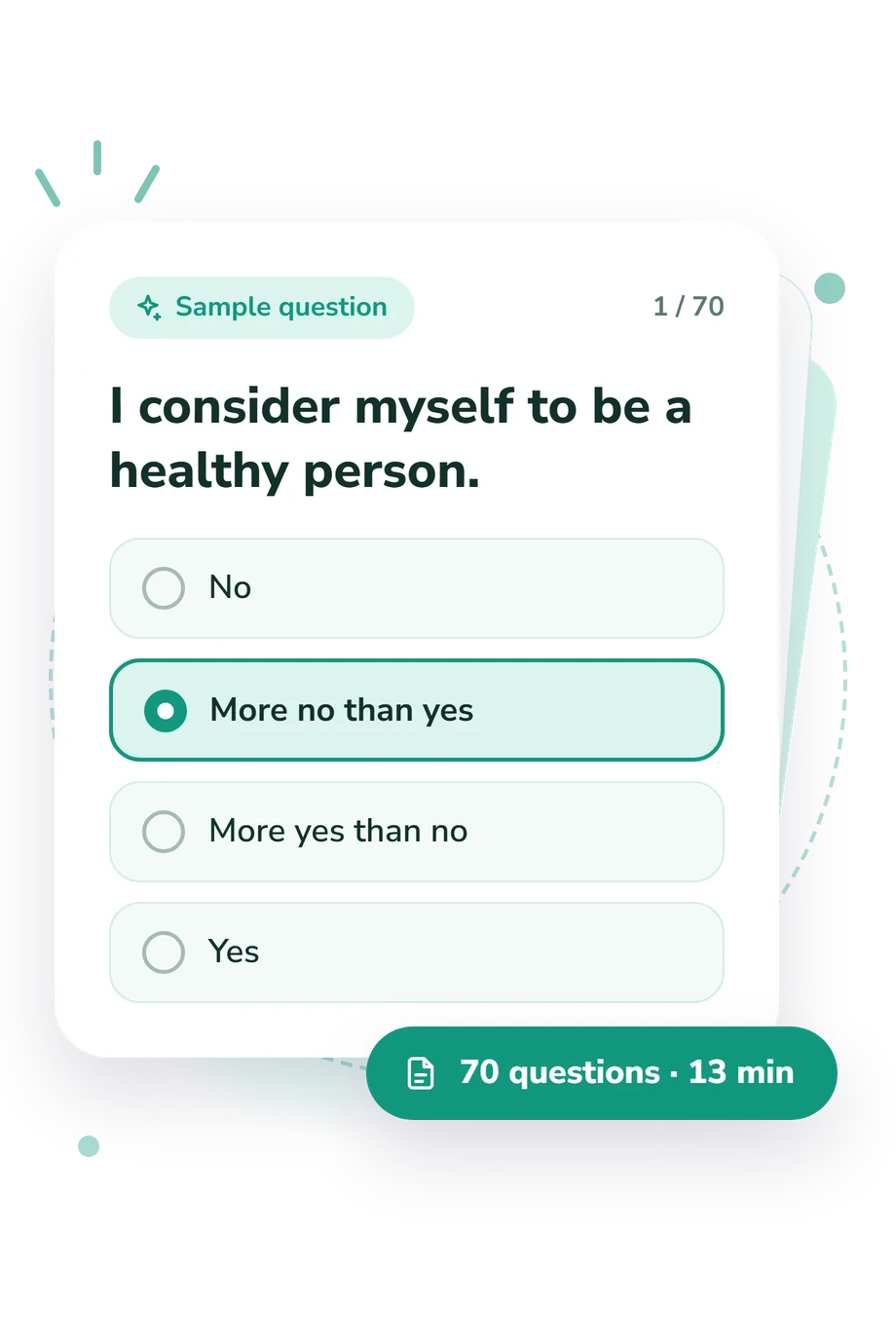
You will be presented with a series of statements. When rating each one, do not spend too much time thinking. The most appropriate response is your first, immediate reaction. There are no right or wrong answers. Please respond honestly; otherwise, your responses may be identified as unreliable. Read each statement carefully, making sure to read it to the end, and indicate whether it is true or false as it applies to you.
    • No
    • More no than yes
    • More yes than no
    • Yes
    • No
    • Rather no than yes
    • Rather yes than no
    • Yes
    • False
    • More false than true
    • More true than false
    • True
WHAT THE TEST MEASURES
About This Assessment

Deviant Behavior Risk Scale Test - Symptoms and Signs

deviant behavior
suicidal risk

This measure is designed to support structured screening of risk for problematic or rule-breaking behavior in adolescents and related psychosocial vulnerabilities. The Deviant Behavior Risk Scale is typically used in school or youth-serving settings to inform early identification and care planning.

The instrument consists of 70 items and generally requires about 13 minutes to complete. It uses self-report responses to summarize patterns associated with elevated behavioral risk, with results intended to guide clinical judgment and discussion rather than serve as a stand-alone diagnostic determination.

When integrated with collateral information and professional evaluation, the Deviant Behavior Risk Scale can help identify areas for targeted intervention (e.g., self-regulation and interpersonal functioning). Authors: Travis Hirschi and Michael R. Gottfredson.

Author: Michael R. Gottfredson, Travis Hirschi
Literature: Bandura, A. Self-efficacy: The exercise of control. W. H. Freeman. 1997.
Popular tests
Comments
Leave a Comment