
Attitudes Toward Athletes' Psychological Preparation Test
How the Scales are Structured
Who Usually Takes This Test?
See How You Compare
Below is a preview of how scores are typically distributed across each scale.
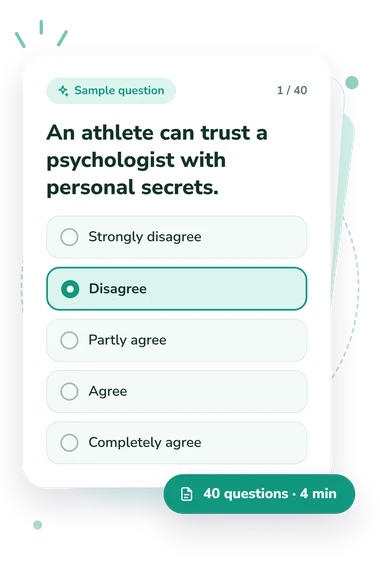
Example Questions From the Test
- Strongly disagree
- Disagree
- Partly agree
- Agree
- Strongly agree
- Strongly disagree
- Disagree
- Partly agree
- Agree
- Strongly agree
- Completely disagree
- Disagree
- Partly agree
- Agree
- Strongly agree
Attitudes Toward Athletes' Psychological Preparation Test - Description and methodology of the test
For athletes and coaches considering how they relate to psychological support, the Attitudes Toward Athletes' Psychological Preparation Test offers a focused way to examine beliefs about working with a sport psychologist. The athlete psychology questionnaire format gives readers a defined result band for considering whether their current attitude toward psychological preparation merits closer reflection.
What This Assessment Explores
Items address trust, privacy, weakness, usefulness, competition states, and roles of psychologists, coaches, friends, and relatives in psychological preparation. This psychological preparation test for athletes links those beliefs to openness to support.
These themes guide the result:
- Trust and openness show whether concerns can be shared with a psychologist.
- Usefulness and self-regulation show whether psychological methods seem practical.
- Help-seeking attitudes show whether support feels natural, responsible, or weak.
- Role boundaries show whether close contacts can replace a psychologist.
One displayed scale, Attitudes Toward Psychological Preparation (0-52), describes these views. Skeptical/low readiness (0-20) indicates skeptical or negative attitudes and limited readiness to work with a psychologist; Positive/aware (21-32) indicates positive attitudes and awareness of the psychologist’s role; High need/strong interest (33-52) may indicate a pronounced need for psychological support and possible psychological difficulties. The result describes a tendency, not a trait.
Methodology and Scientific Basis
Each statement uses a five-point response from disagreement to agreement. Because items cover supportive and skeptical positions, respondents should answer each against their own view rather than infer meaning from one response. The sport psychology attitudes questionnaire reports a result on the displayed scale, but the exact contribution of each response is not documented; no aggregation, weighting, reversal, or per-answer formula can be inferred from the 0-52 range.
Silich and Melnik's 2010 study addresses attitudes toward athletes' psychological preparation, so its subject is conceptually consistent with this online questionnaire. The coach-focused context is consistent with Melnik, Silich, and Kukhtova (2020). Martin and colleagues (2004) offer related cross-national evidence about sport psychology consulting. These sources do not establish that this online questionnaire adapts or validates their work.
The displayed bands are descriptive categories rather than clinical thresholds, so this online questionnaire is best read as structured self-reflection. Current stress, competitive experience, candor, and self-awareness can influence self-report, and the result is a snapshot of the respondent's present perspective on support, communication, and preparation.
- Silich, Elena V., and Elizaveta V. Melnik. Athletes' and Coaches' Attitudes Toward Psychological Preparation. Young Sports Science of Ukraine: Collection of Scientific Papers in Physical Culture and Sport, issue 14, volume 1, 2010, pp. 298-303.
- Melnik, Elizaveta V., Elena V. Silich, and Natalia V. Kukhtova. Psychology of the Coach: Theory and Practice: Methodological Recommendations. 2nd ed. Vitebsk: Vitebsk State University named after P. M. Masherov, 2020, 75 pp.
- Martin, Scott B., David Lavallee, Michael Kellmann, and Stephen J. Page. Attitudes Toward Sport Psychology Consulting of Adult Athletes from the United States, United Kingdom, and Germany. International Journal of Sport and Exercise Psychology, volume 2, issue 2, 2004, pp. 146-160. 10.1080/1612197X.2004.9671738