
Freudly+971 508685814hello@freudly.ai
Freudly
proactivity

Proactive Coping Inventory (PCI) Test
Take the online Proactive Coping Inventory (PCI) Test - AI psychologist FreudlyYou can take Proactive Coping Inventory (PCI) Testhere. Online version of a simple and accurate psychological test with interpretation.en
Understand how you plan ahead, take initiative, and handle challenges in about 5 minutes. Get a fast, focused snapshot of your proactive strengths to support coaching, growth, and stress resilience.
Start Online Test
Questions: 275 minutes
08:30
October 2, 2025
October 2, 2025
Material has been updated
October 2, 2025
Material has been published
22,759 views
1,484 completions
1,239 likes
Verified by Daniel Hall
Psychologist with 25 years of experience
Share
Scale Explorer

How the Scales are Structured

example score
2/4
Preventive Coping (PC)
Preventive coping reflects how well a person anticipates potential difficulties and prepares in advance using past experience.
Low
Moderate
High
12.3: Low | 2.313.44: Moderate | 3.454: High
A score of 2 indicates a low level of preventive coping, suggesting the person may less often anticipate and prepare for challenges based on past experience.
example score
3/4
Reflective Coping (RC)
Reflective coping measures how well a person thinks through possible actions, evaluates available resources, and anticipates likely outcomes before responding to challenges.
Limited reflection
Developing reflection
Strong reflection
12.4: Limited reflection | 2.413.58: Developing reflection | 3.594: Strong reflection
A score of 3 indicates a developing level of reflective coping, suggesting you often consider options and likely outcomes, though this process may be inconsistent across situations.
example score
2/4
Strategic Planning (SP)
Strategic Planning measures how well a person plans future actions by breaking goals into distinct, manageable tasks.
Limited planning
Developing planning
Strong planning
11.87: Limited planning | 1.883.35: Developing planning | 3.364: Strong planning
A score of 2 indicates a developing ability to plan ahead with some task differentiation, though planning may be inconsistent or not fully detailed.
example score
3/4
Proactive Coping (PC)
Measures the extent to which a person views challenging situations as opportunities for positive growth and takes initiative to prepare and act.
Low
Moderate
High
12.48: Low | 2.493.48: Moderate | 3.494: High
A score of 3 falls in the Moderate range, suggesting a generally proactive stance toward challenges with room to strengthen consistent forward planning and initiative.
example score
2/4
Emotional Support Seeking (ESS)
Measures how much a person regulates and stabilizes their emotional state by seeking comfort and understanding through communication with others.
Low
Moderate
High
11.94: Low | 1.953.4: Moderate | 3.414: High
A score of 2 indicates a moderate tendency to seek emotional support, using others sometimes to help manage emotions but not relying on it consistently.
example score
2/4
Instrumental Support Seeking (ISS)
Measures how much a person seeks practical information, advice, or resources from others to handle difficult situations.
Low seeking
Moderate seeking
High seeking
12.04: Low seeking | 2.053.34: Moderate seeking | 3.354: High seeking
A score of 2 falls in the Low seeking range, suggesting the respondent tends to rely more on their own approach than actively looking to others for instrumental guidance when facing challenges.
Start Online Test
just completed the test
DATA-BASED USER COHORTS

Who Usually Takes This Test?

Self-improvement goal setters
41%OF USERS
People who want to take more initiative, plan ahead, and build habits that make them feel in control of their life.
Coaching and training clients
34%OF USERS
Individuals in coaching or personal development programs who need a quick snapshot of how proactively they pursue goals and handle obstacles.
Stress and life transitions
25%OF USERS
People facing a demanding period (new job, burnout risk, relationship changes) who want to shift from reacting to problems to preventing them.
BASED ON AGGREGATED, ANONYMIZED DATA FROM TENS OF THOUSANDS OF FREUDLY USERS.
Benchmarking

See How You Compare

Once you complete the test, your results are compared with real-world data from people in your country.
Below is a preview of how scores are typically distributed across each scale.
Preventive Coping (PC)
Average
2.3
Normal range
1.72.8
min.
1
max.
4
This curve shows how scores are typically distributed.
Once you complete the test, your result will appear on the scale so you can see how you compare.
Reflective coping (Rc)
Average
3.2
Normal range
2.63.7
min.
1
max.
4
This curve shows how scores are typically distributed.
Once you complete the test, your result will appear on the scale so you can see how you compare.
Strategic Planning (SP)
Average
2.6
Normal range
2.13.2
min.
1
max.
4
This curve shows how scores are typically distributed.
Once you complete the test, your result will appear on the scale so you can see how you compare.
Proactive Coping (PC)
Average
3.1
Normal range
2.73.6
min.
1
max.
4
This curve shows how scores are typically distributed.
Once you complete the test, your result will appear on the scale so you can see how you compare.
Seeking emotional support (Ses)
Average
1.9
Normal range
1.52.3
min.
1
max.
4
This curve shows how scores are typically distributed.
Once you complete the test, your result will appear on the scale so you can see how you compare.
Searching for instrumental support (Sfis)
Average
2.9
Normal range
2.43.3
min.
1
max.
4
This curve shows how scores are typically distributed.
Once you complete the test, your result will appear on the scale so you can see how you compare.
Featured On
SAMPLE QUESTIONS

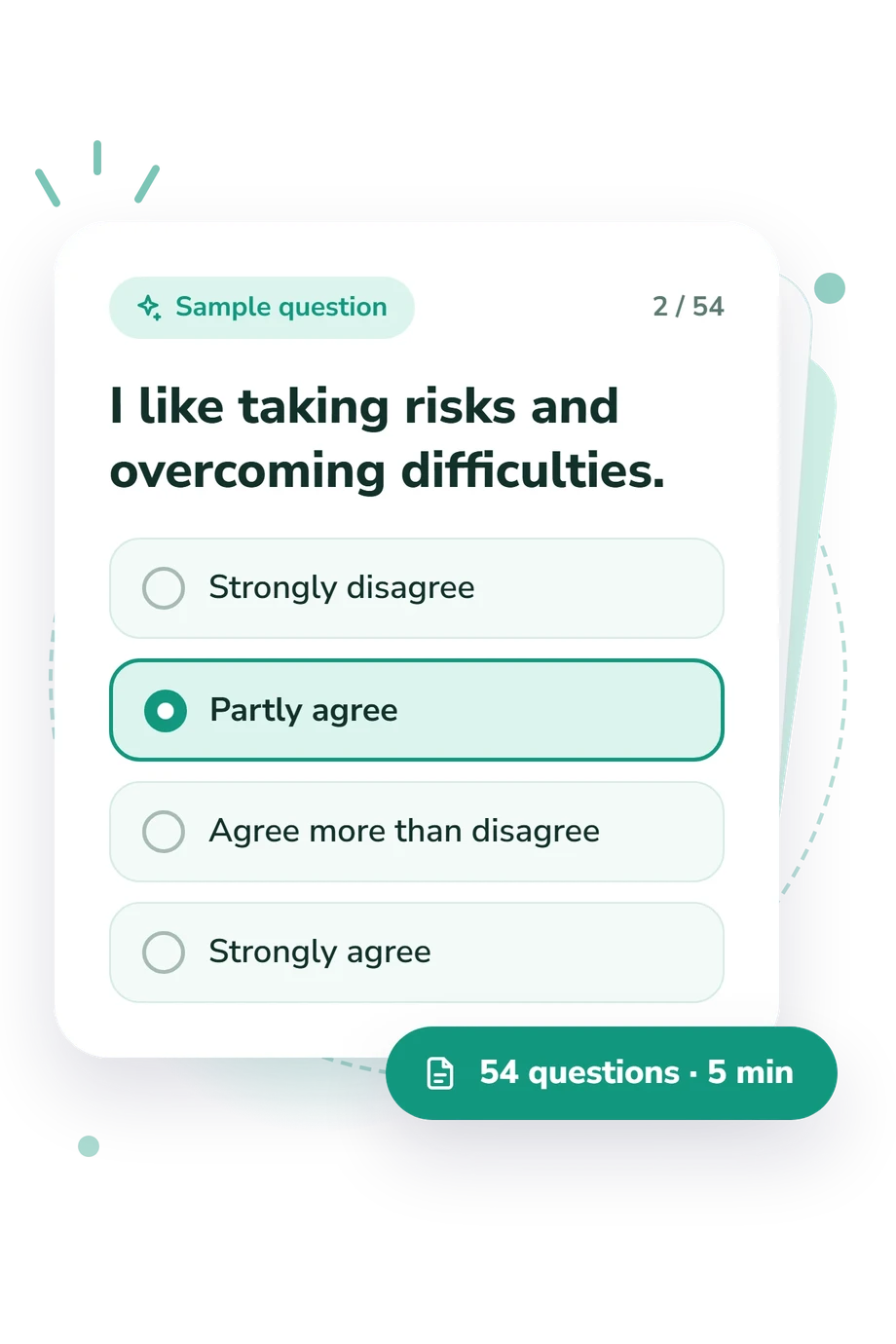
Example Questions From the Test

    • Strongly disagree
    • Partly agree
    • Agree more than disagree
    • Strongly agree
    • Completely disagree
    • Partly agree
    • Agree more than disagree
    • Completely agree
    • Strongly disagree
    • Partly agree
    • Agree more than disagree
    • Strongly agree
WHAT THE TEST MEASURES
About This Assessment

Proactive Coping Inventory (PCI) Test - Symptoms and Signs

proactivity
coping behavior

This measure assesses proactive coping as a self-regulatory style, emphasizing anticipatory planning, goal-directed action, and resource management in the face of potential stressors. The Proactive Coping Inventory (PCI) is a brief self-report questionnaire intended to characterize how individuals prepare for and respond to life challenges.

Developed by Erica S. Greenglass, it includes 27 items and typically takes about 5 minutes to complete. Results are commonly used to inform clinical case conceptualization or research by describing an individual’s tendency to take initiative, plan ahead, and engage in purposeful coping strategies. Interpretation of the Proactive Coping Inventory (PCI) should be integrated with other clinical information and not used as a stand-alone diagnostic indicator.

Author: Erica S. Greenglass, Ralf Schwarzer, Stevan E. Hobfoll
Literature: Lazarus, R. S., & Folkman, S. Stress, appraisal, and coping. Springer. 1984.; Aspinwall, L. G., & Taylor, S. E. A stitch in time: Self-regulation and proactive coping. Psychological Bulletin. 1997.; Carver, C. S., Scheier, M. F., & Weintraub, J. K. Assessing coping strategies: A theoretically based approach. Journal of Personality and Social Psychology. 1989.; Greenglass, E., Schwarzer, R., Jakubiec, D., Fiksenbaum, L., & Taubert, S. The proactive coping inventory (PCI): A multidimensional research instrument. Paper presented at the 20th International Conference of the Stress and Anxiety Research Society (STAR). 1999.
Popular tests
Comments
Leave a Comment