
School Situations Assessment Test
How the Scales are Structured
Who Usually Takes This Test?
See How You Compare
Below is a preview of how scores are typically distributed across each scale.
Example Questions From the Test
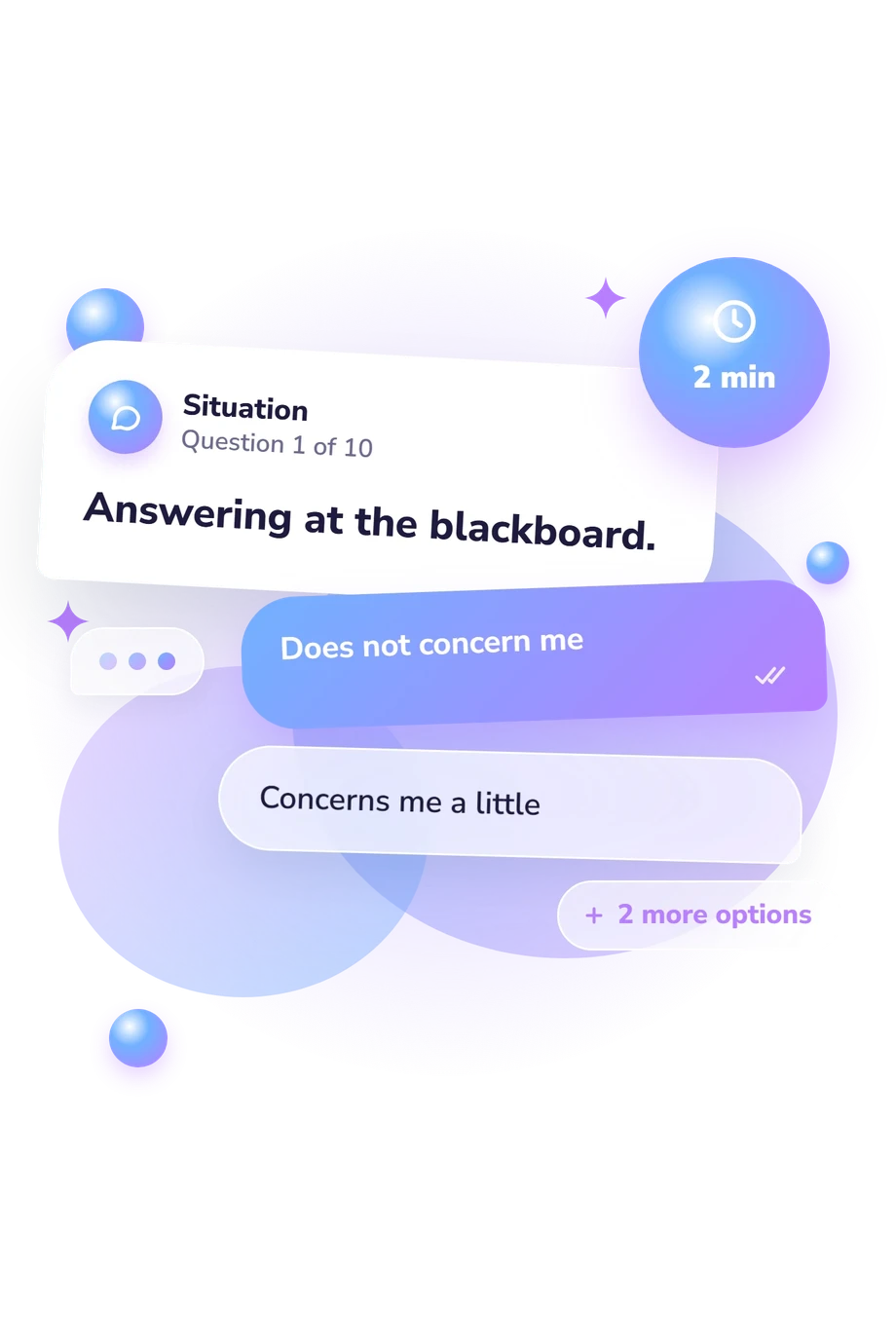
- Does not concern me
- Concerns me a little
- Concerns me
- Concerns me very much
- Does not concern me
- Concerns me a little
- Concerns me
- Concerns me very much
- Not concerning
- Slightly concerning
- Concerning
- Very concerning
School Situations Assessment Test - Description and methodology of the test
Students, parents, and educators who want to understand reactions to school pressure can use this assessment as a focused self-reflection tool. The School Situations Assessment Test connects familiar academic scenarios with one anxiety result, helping the reader notice which demands feel most activating. Used as a school anxiety assessment, it offers a starting point for discussing preparation, coping, or support.
What This Assessment Measures
The questionnaire examines anxiety when a student is evaluated, questioned, criticized, or asked to act under uncertainty at school. It is useful for reflecting on performance pressure, adult interactions, consequences at home, and decisions that feel high-stakes.
The items represent four practical areas:
- Public performance and evaluation show concern about answering aloud, tests, grades, or judgment.
- Authority interactions indicate how contact with a principal or teacher may feel.
- Uncertainty and exposure capture reactions to unexpected questions, selection, or decisions.
- Competition and consequences reflect concern around contests and waiting for parental feedback.
As an academic anxiety test, the result summarizes concern across these situations rather than identifying one cause. Anxiety Level ranges from 0-30: Low 0-10, Moderate 11-20, and High 21-30. A higher band indicates greater reported anxiety in the represented situations, not its source.
Methodology and Evidence Base
Each item describes a school situation and offers four ordered responses, from minimal to very strong concern. As a self-report measure, selections combine into one displayed score; thematic groups receive no separate totals. The school situations test therefore gives a broad profile of situational anxiety rather than separate traits.
Its conceptual reference is the School Anxiety Questionnaire (Dunn, 1968), which treats anxiety as a response to distinct academic and interpersonal situations. Dunn's 1970 account describes the instrument's theory and structure, while Bergan (1968) examined a scoring procedure intended to reduce response bias. These sources support the questionnaire's subject matter, but they do not establish that this online version is the published instrument or has identical norms.
Morris, Finkelstein, and Fisher (1976) reported distinguishable components of school anxiety across developmental and sex-related patterns. That finding supports viewing school anxiety as varied without transferring group results directly to an individual. Because the bands are reporting categories rather than diagnostic thresholds, current context, memory, expectations, and willingness to disclose concern can shape the result, which is best used for reflection or conversation.
- Dunn, James A. (1968). The theoretical rationale underlying the development of the School Anxiety Questionnaire. Psychology in the Schools, 5(3), 204-210.
- Dunn, James A. (1970). The School Anxiety Questionnaire: Theory, Instrument, and Summary of Results. Paper presented at the 1970 Annual Convention of the American Psychological Association, Miami Beach, Florida. ERIC Document ED045700.
- Bergan, John B. (1968). A special scoring procedure for minimizing response bias on the School Anxiety Questionnaire. Psychology in the Schools, 5(3), 210-216. 10.1002/1520-6807(196807)5:3<210::AID-PITS2310050304>3.0.CO;2-T
- Morris, Larry W., Finkelstein, Cynthia S., and Fisher, William R. (1976). Components of school anxiety: Developmental trends and sex differences. The Journal of Genetic Psychology, 128(1), 49-57. 10.1080/00221325.1976.10533971
Updated: