
Emotional Creativity Inventory (ECI) Test
How the Scales are Structured
Who Usually Takes This Test?
See How You Compare
Below is a preview of how scores are typically distributed across each scale.
Example Questions From the Test
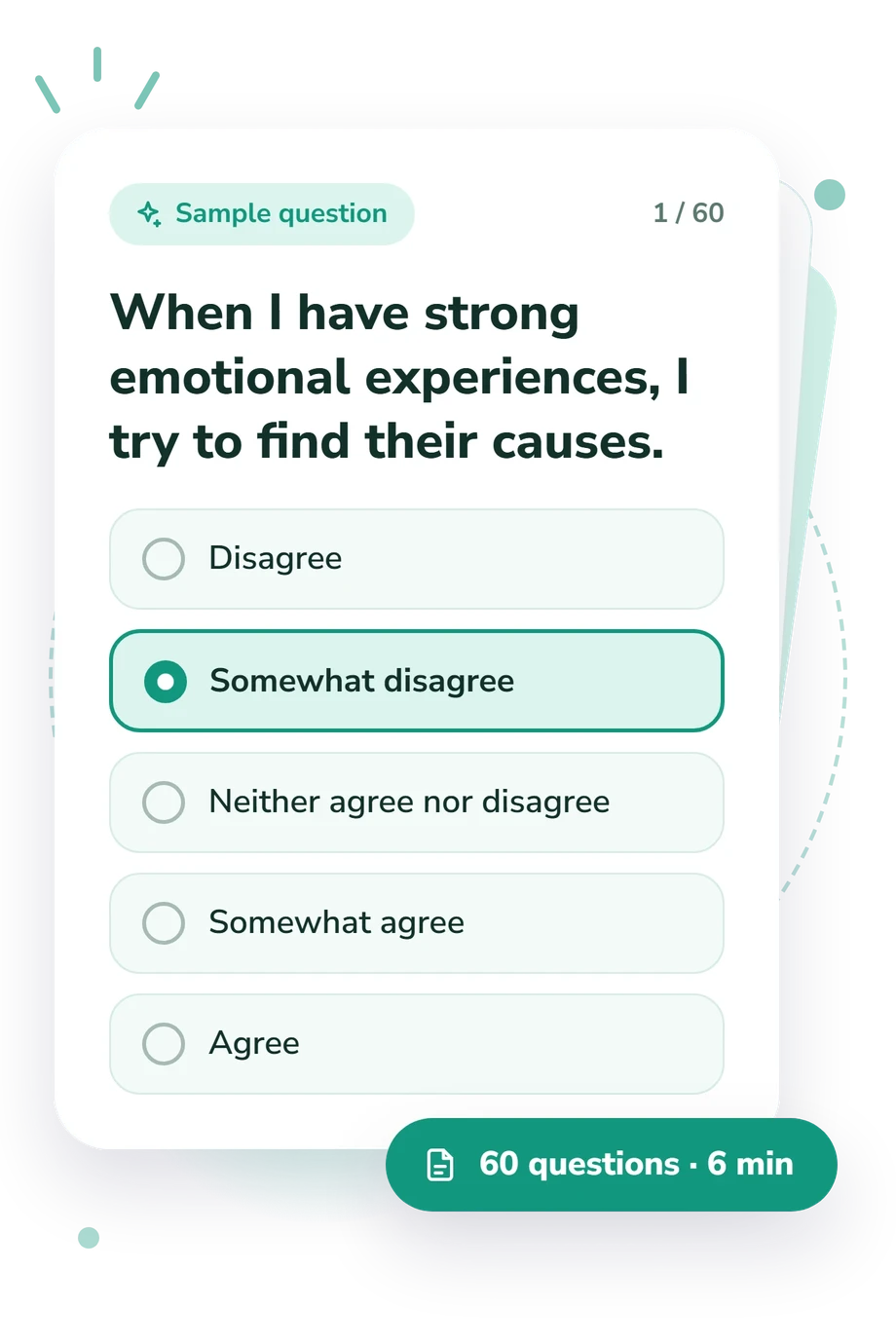
- Disagree
- Somewhat disagree
- Neither agree nor disagree
- Somewhat agree
- Agree
- Disagree
- Rather disagree
- Neither agree nor disagree
- Rather agree
- Agree
- Disagree
- Somewhat disagree
- Neither agree nor disagree
- Somewhat agree
- Agree
Emotional Creativity Inventory (ECI) Test - Description and methodology of the test
Readers wondering whether unusual or complex feelings can become authentic, effective, and adaptable responses may find the Emotional Creativity Inventory (ECI) Test a useful way to explore that question. This emotional creativity assessment asks whether emotional originality, learning from experience, and flexible expression shape the way a person responds. It is suited to self-reflection when familiar labels do not fully capture emotional life.
What This Assessment Explores
The questionnaire looks beyond emotional intensity. Items ask about understanding strong feelings, learning from past experiences, unusual or simultaneous emotions, flexible responses, and outward expression that matches inner states. This emotional creativity questionnaire suits readers seeking a structured self-reflection tool for their emotional style. Its displayed result contains four related dimensions:
- Effectiveness/Authenticity (9-45) shows sincere, skillful expression: Less authentic/less effective (9-20), Moderately authentic/effective (21-33), Highly authentic/effective (34-45).
- Novelty (14-70) shows unusual, hard-to-describe emotional experiences: Lower novelty (14-32), Moderate novelty (33-51), Higher novelty (52-70).
- Preparedness (7-35) shows use of past emotional learning: Developing (7-16), Typical (17-25), Well-developed (26-35).
- Emotional Creativity (30-150) shows novel, effective, authentic emotional patterns: Typical range (30-90), Elevated creativity (91-120), High creativity (121-150).
Taken together, higher totals indicate more of the quality named by each scale.
Methodology and Evidence Base
Each statement uses a five-point agreement response, moving from disagreement to agreement, with a middle option where appropriate. The assessment aggregates those responses into displayed dimension totals. The possible ranges show the span of each total, but a range alone cannot reconstruct individual scoring or reveal whether any statement is reverse-keyed.
The assessment is conceptually consistent with Averill's 1999 Emotional Creativity Inventory, which treats emotional creativity as novelty, effectiveness, authenticity, and preparedness. This online questionnaire should not be assumed to directly adapt every published version. The factor study by Ghadiri Nezhdyan and Abdi and work by Soroa and colleagues concern original or shortened Spanish versions; they cannot establish validity or norms for this online scoring format.
For this emotional creativity test, result bands are interpretive categories describing displayed score levels, not clinical thresholds or evidence of standing in a defined population. Honest responses remain important because current mood, memory, self-awareness, and impression management can influence self-report results. Use the profile to identify patterns worth examining rather than treating a score as a fixed identity or diagnosis.
- Averill, James R. (1999). Individual Differences in Emotional Creativity: Structure and Correlates. Journal of Personality, 67(2), 331-371. 10.1111/1467-6494.00058
- Ghadiri Nezhdyan, Fatemeh, and Beheshteh Abdi (2010). Factor Structure of Emotional Creativity Inventory (ECI-Averill, 1999) Among Iranian Undergraduate Students in Tehran Universities. Procedia - Social and Behavioral Sciences, 5, 1836-1840. 10.1016/j.sbspro.2010.07.374
- Soroa, Goretti, Arantxa Gorostiaga, Aitor Aritzeta, and Nekane Balluerka (2015). A Shortened Spanish Version of the Emotional Creativity Inventory (the ECI-S). Creativity Research Journal, 27(2), 232-239. 10.1080/10400419.2015.1030313
Updated: