
Emotion Recognition Assessment Test
How the Scales are Structured
Who Usually Takes This Test?
See How You Compare
Below is a preview of how scores are typically distributed across each scale.
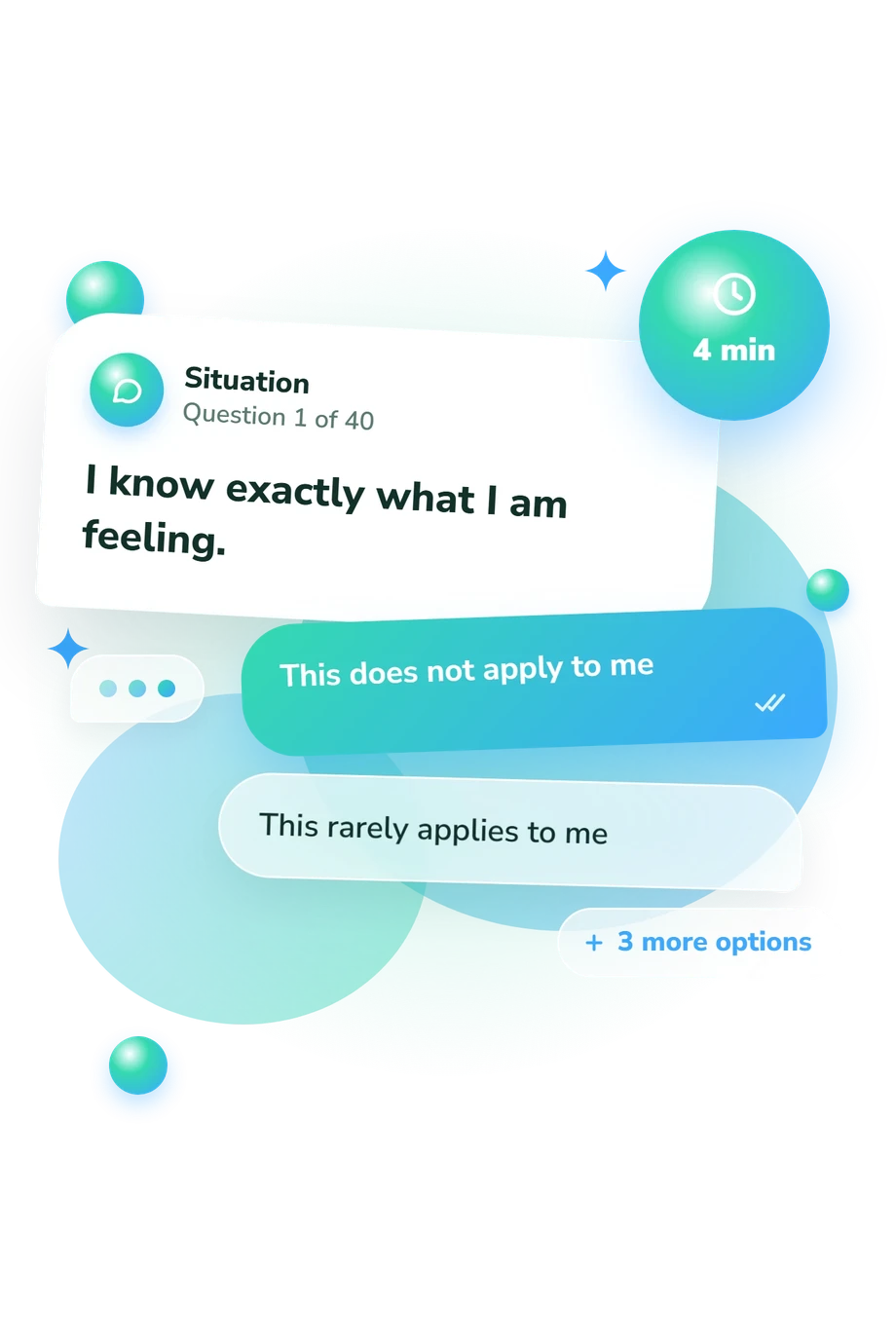
Example Questions From the Test
- This is not true of me
- This is rarely true of me
- This is sometimes true of me
- This is often true of me
- This is always true of me
- This does not apply to me
- This rarely applies to me
- This sometimes applies to me
- This is often true of me
- This is always true of me
- Does not apply to me
- Rarely applies to me
- Sometimes applies to me
- Often true of me
- Always true of me
Emotion Recognition Assessment Test - Description and methodology of the test
People who want a clearer picture of their emotional awareness may find the Emotion Recognition Assessment Test useful for examining how they notice, name, and interpret feelings in everyday interactions. It suits anyone seeking structured self-reflection about communication, relationships, and internal experience. As an emotional awareness test, it can help you examine communication patterns, emotional cues, and interpersonal reactions in situations that feel confusing or difficult to interpret.
What This Assessment Explores
The questionnaire examines emotional awareness in two directions: noticing feelings in other people and recognizing one's own states. Items cover mood changes, bodily signals, frustration, anger, sadness, stress, group atmosphere, and the ability to describe or interpret emotional experience. It is useful for reflecting on communication and self-understanding.
The result is organized into two catalogue scales:
- Recognition of Others' Emotions: -20-20. It reflects your reported emotion recognition skills, specifically your ability to identify other people's emotions accurately, supporting communication and relationships. Bands: Needs improvement -20-9; Developing 10-14; Strong 15-20.
- Recognition of One's Own Emotions: -20-20. It reflects clarity about feelings, mood shifts, bodily reactions, and reasons for responses; mixed or low-intensity emotions may be harder to identify. Bands: Low clarity -20-0; Moderate clarity 1-14; High clarity 15-20.
Comparing results may clarify how social and internal cues interact.
Methodology and Scientific Basis
The five-point self-report scale ranges from statements that are not true or do not apply to statements that are always true. Items cover self-observation, emotional description, social cues, and emotional situations. Responses combine into two displayed scores. The questionnaire presents descriptive bands, but its scoring has not been standardized against clinical norms; no scoring rule beyond the displayed results should be inferred.
The questionnaire is conceptually consistent with EmIn's distinction between one's own and other people's emotions, but it is not presented as an adaptation or verbatim administration. Mayer, Salovey, and Caruso describe emotional intelligence as perceiving and using emotional information; this is broad background, not evidence that this questionnaire is validated.
Interpret each band as a tendency reflected in the item situations, not a fixed trait: higher results suggest greater reported clarity or recognition, while lower results indicate an area for observation. In practice, reading other people's emotions depends on context and signal intensity. Current mood, self-awareness, and response bias can affect self-report, so use the profile as focused reflection rather than a complete account of emotional functioning.
- Lyusin, D. V. (2006). A New Method for Measuring Emotional Intelligence: The EmIn Questionnaire. Psychological Diagnostics, 4, 3-22.
- Pankratova, A. A., Osin, E. N., & Lyusin, D. V. (2013). Features of Emotional Intelligence in Representatives of Russian and Azerbaijani Cultures. Psychological Studies, 6(31). 10.54359/ps.v6i31.673
- Mayer, J. D., Salovey, P., & Caruso, D. R. (2004). Emotional Intelligence: Theory, Findings, and Implications. Psychological Inquiry, 15(3), 197-215. 10.1207/S15327965PLI1503_02
- Ekman, P. (2003). Emotions Revealed: Recognizing Faces and Feelings to Improve Communication and Emotional Life. New York: Times Books.
Updated: