
Assessment of the Emotional and Personality Domain in Children With Developmental Disorders Test
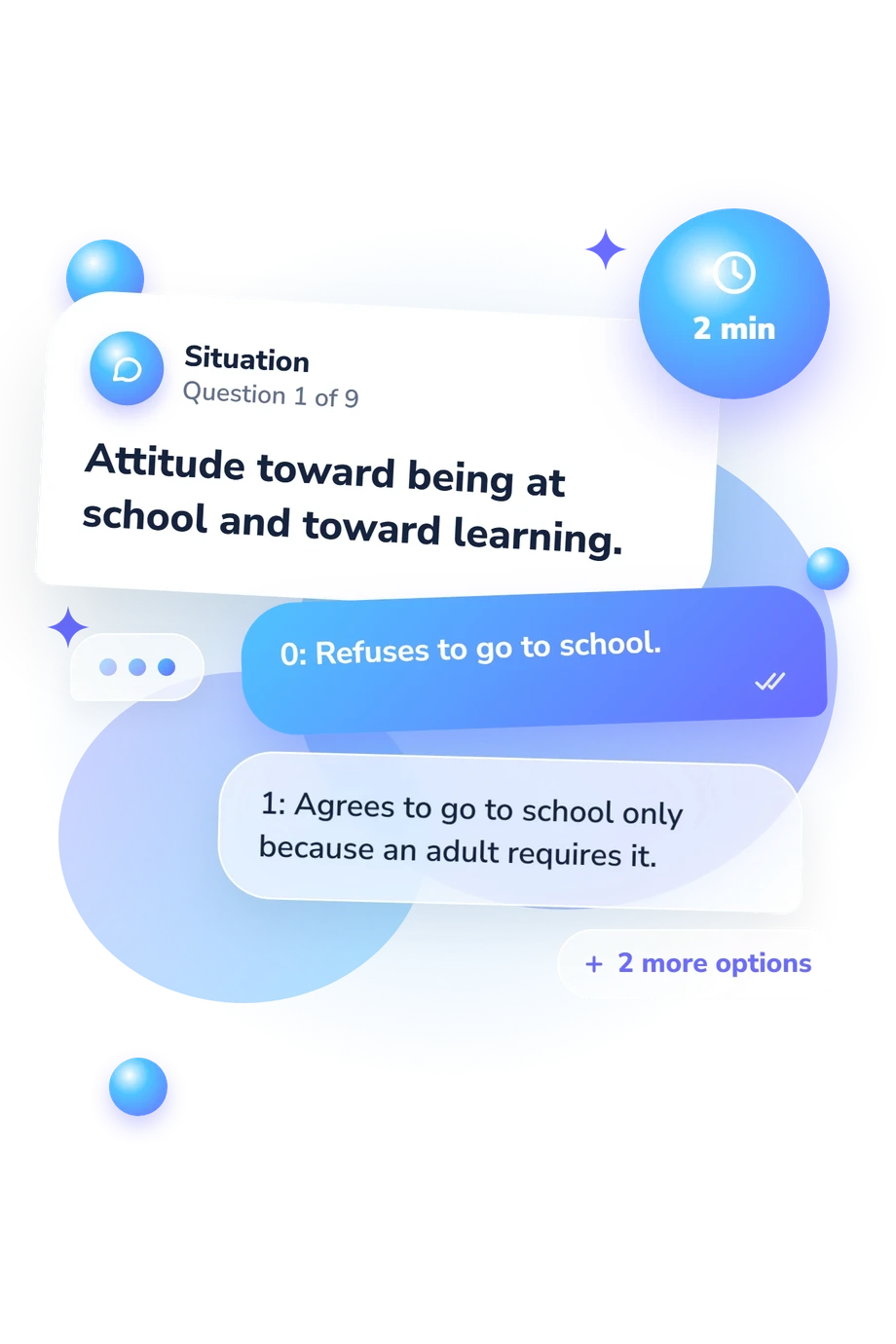
How the Scales are Structured
Who Usually Takes This Test?
See How You Compare
Below is a preview of how scores are typically distributed across each scale.
Example Questions From the Test
- 0: Refuses to accept the instruction (overt negativism).
- 1: Displays stubbornness.
- 2: Follows the instruction partially.
- 3: Follows the instruction completely.
- 0: Unable to complete a manageable task in a whole-group session.
- 1: Completes manageable tasks for 5 minutes.
- 2: Completes manageable tasks for 5–10 minutes.
- 3: Completes manageable tasks for 10–15 minutes.
- 0: No new skills acquired.
- 1: Acquisition of one skill.
- 2: Acquisition of two skills.
- 3: Acquisition of three or more skills.
Assessment of the Emotional and Personality Domain in Children With Developmental Disorders Test - Description and methodology of the test
For caregivers and educators observing a child’s everyday functioning, the Assessment of the Emotional and Personality Domain in Children With Developmental Disorders Test organizes observations of a child’s emotional, behavioral, and interpersonal functioning across settings. It focuses on everyday responses rather than one isolated behavior. This emotional and personality assessment for children provides a structured way to consider how those observations fit together.
What This Assessment Explores
Across school, home, and peer situations, the questionnaire examines emotional development in children through observable functioning rather than one symptom. It covers learning motivation, response to instructions, behavior rules, emotional reactions, task engagement, new skills, and contact with adults and peers. An adult familiar with the child’s everyday responses can use it to organize observations.
The Total Score: 0-27 represents the overall level of emotional and personality domain development. Higher scores indicate more pronounced emotional and personality characteristics, while lower scores indicate less pronounced manifestations. It supports preliminary assessment and recognition of possible support needs.
The questions cover three connected thematic areas:
- School participation and learning shows how the child approaches attendance, instruction, and acquiring skills.
- Relationships and social contact describes engagement with adults, parents, and peers.
- Emotional and behavioral functioning captures reactions, rule-following, persistence, and adaptation to demands.
Methodology and Evidence Base
Each item presents a familiar situation with four ordered response options labelled 0 through 3. The questionnaire reports one total score, and the stated definition explains what a higher or lower result means; it is not a simple measure of success. The structure groups observations across learning, social contact, behavior, emotion, persistence, and skill acquisition. This is a structured rating method.
Tkacheva’s 2004 monograph and 2006 textbook are relevant conceptual sources for emotional, communicative, and behavioral functioning in families supporting children with developmental disorders. They do not establish that this nine-item questionnaire is an adaptation of a named published instrument, so the questionnaire should be understood through its own item content.
In practice, an assessment for children with developmental disorders depends on adult observation and the child’s current setting. Bashinova, Kokoreva, Peshkova, and Khamdamova’s 2022 study offers related context on social behavior and parental attitudes in autistic preschoolers, but it does not validate this questionnaire. The displayed bands are Low 0-15, Moderate 16-23, and High 24-27.
- Tkacheva, Viktoriya V. (2004). Psychological Study of Families Raising Children with Developmental Disorders: Monograph. Moscow: UMK “Psychology”; Moscow Psychological and Social Institute, 194 pp.
- Tkacheva, Viktoriya V. (2006). Technologies of Psychological Study of Families Raising Children with Developmental Disorders: A Textbook for University Students Studying Psychology. Moscow: UMK “Psychology”; Moscow Psychological and Social Institute, 319 pp. ISBN 5-93692-068-2.
- Bashinova, Svetlana N., Kokoreva, Oksana I., Peshkova, Natalya A., & Khamdamova, Venera A. (2022). Determination of the Development of Social Behavior of Preschool Children with Autism Spectrum Disorder by the Type of Parental Attitude. Education and Self Development, 17(3), 142-157. 10.26907/esd.17.3.12
Updated: