
Mood Assessment Test
How the Scales are Structured
Who Usually Takes This Test?
See How You Compare
Below is a preview of how scores are typically distributed across each scale.
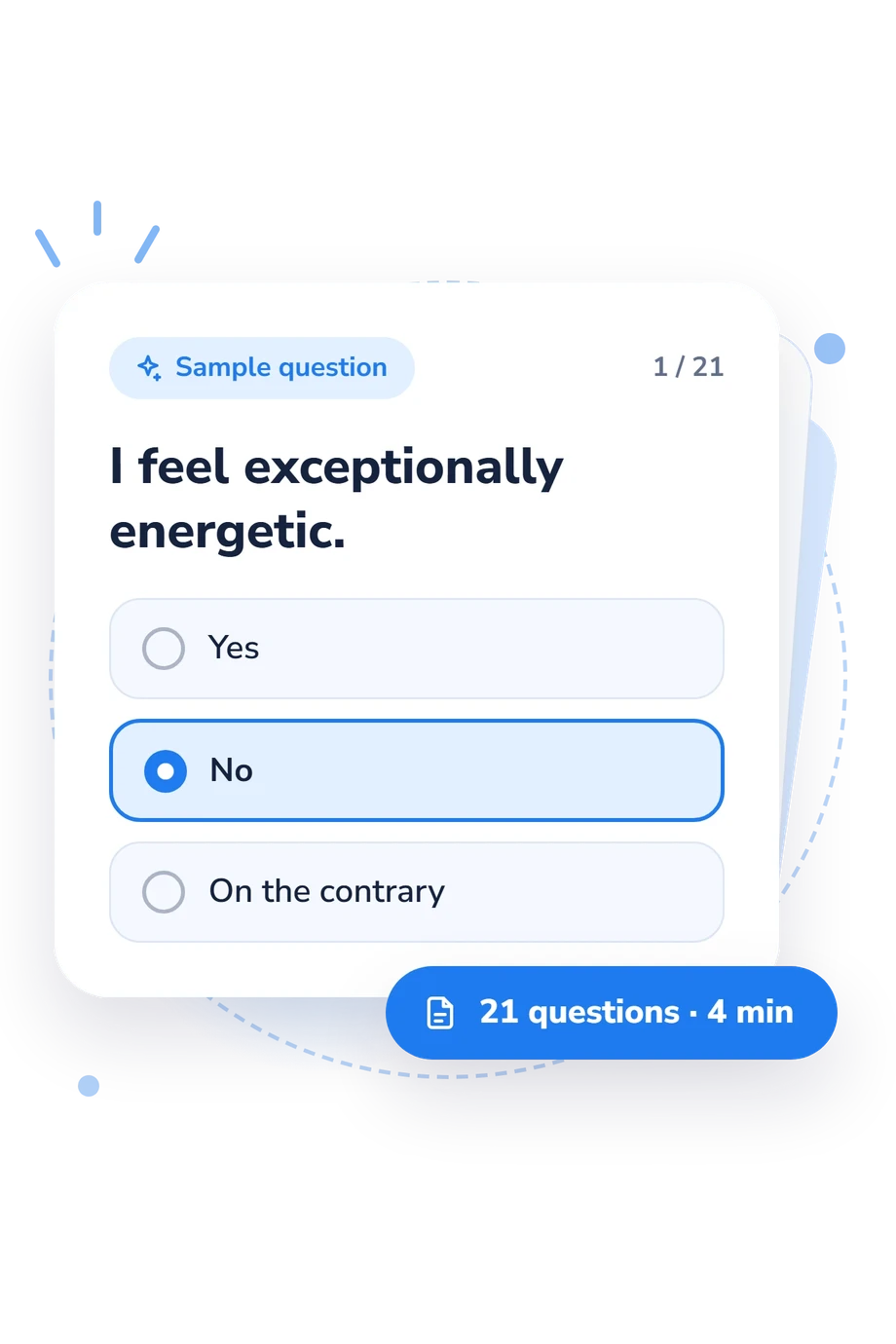
Example Questions From the Test
- Yes
- No
- On the contrary
- Yes
- No
- On the contrary
- Yes
- No
- On the contrary
Mood Assessment Test - Description and methodology of the test
People who want to understand a recent shift in energy, pleasure, irritability, or emotional flatness can use the Mood Assessment Test as a structured self-check. The questionnaire organizes present experiences as a mood self-assessment, helping the respondent compare the relative prominence of its three scores and identify what has changed recently. The result gives a compact way to connect that pattern with recent circumstances and feelings.
What This Assessment Explores
The questionnaire examines recent emotional tone through energy, pleasure, tension, irritability, social openness, trust, and outlook. It suits readers seeking a structured mood profile of current feelings, rather than a single positive-or-negative label.
The result contains three dimensions:
- Euphoric Mood (0-9) reflects elevated, joyful feelings; Low 0-3, Moderate 4-6, and High 7-9 show increasing prominence.
- Asthenic Mood (0-9) reflects fatigue and reduced energy; Low 0-3, Moderate 4-6, and High 7-9 show increasing severity.
- Neutral (0-9) reflects a stable, even state; Reduced usual mood 0-3, Moderately usual 4-6, and Strongly usual 7-9 show its predominance.
Together, the profile indicates which emotional direction is most noticeable now. A lower score on one dimension does not by itself show that its opposite is severe; another mood may simply be more prominent.
Methodology and Evidence Base
Each statement describes an emotional reaction, social perception, energy level, or expectation about the future. The respondent selects Yes, No, or On the contrary, indicating agreement, disagreement, or the opposite condition. The questionnaire reports separate scores for its three dimensions but does not specify how each response is converted into points.
The structure is conceptually consistent with the Mood Assessment Questionnaire (Marishchuk et al., 1984). It also relates to emotional-sphere methods discussed by Barkanova (2009) and differential self-assessment work by Doskin et al. (1973). This online version is not a documented adaptation of those publications, so they do not establish norms for it.
Interpret this mood assessment questionnaire by reading the pattern across dimensions alongside the situations that may have shaped it. Elevated energy, distrust, irritability, withdrawal, fatigue, optimism, or bleak expectations can reflect temporary context as well as a broader tendency. The displayed bands are the result labels used by this questionnaire. Because self-report depends on honesty, self-awareness, and current circumstances, the profile is a time-specific snapshot rather than a diagnosis.
- Marishchuk, Vladimir Lavrentyevich, Yuri Matveyevich Bludov, Viktor Aleksandrovich Plakhtienko, and Lidiya Konstantinovna Serova. Methods of Psychodiagnostics in Sport: Study Guide for Special Courses at Pedagogical Institutes. Moscow: Prosveshchenie, 1984. 191 pp.
- Barkanova, Olga Vladimirovna. Methods for Diagnosing the Emotional Sphere: A Psychological Workshop. Krasnoyarsk: Litera-Print, 2009. 237 pp.
- Doskin, Vladimir Alekseevich, Natalia Alekseevna Lavrentieva, Mikhail Petrovich Miroshnikov, and Vladimir Borisovich Sharai. Test of Differential Self-Assessment of Functional State. Questions of Psychology, no. 6, 1973, pp. 141-145.
Updated: