
Risk-Taking Behavior Assessment Test
How the Scales are Structured
Who Usually Takes This Test?
See How You Compare
Below is a preview of how scores are typically distributed across each scale.
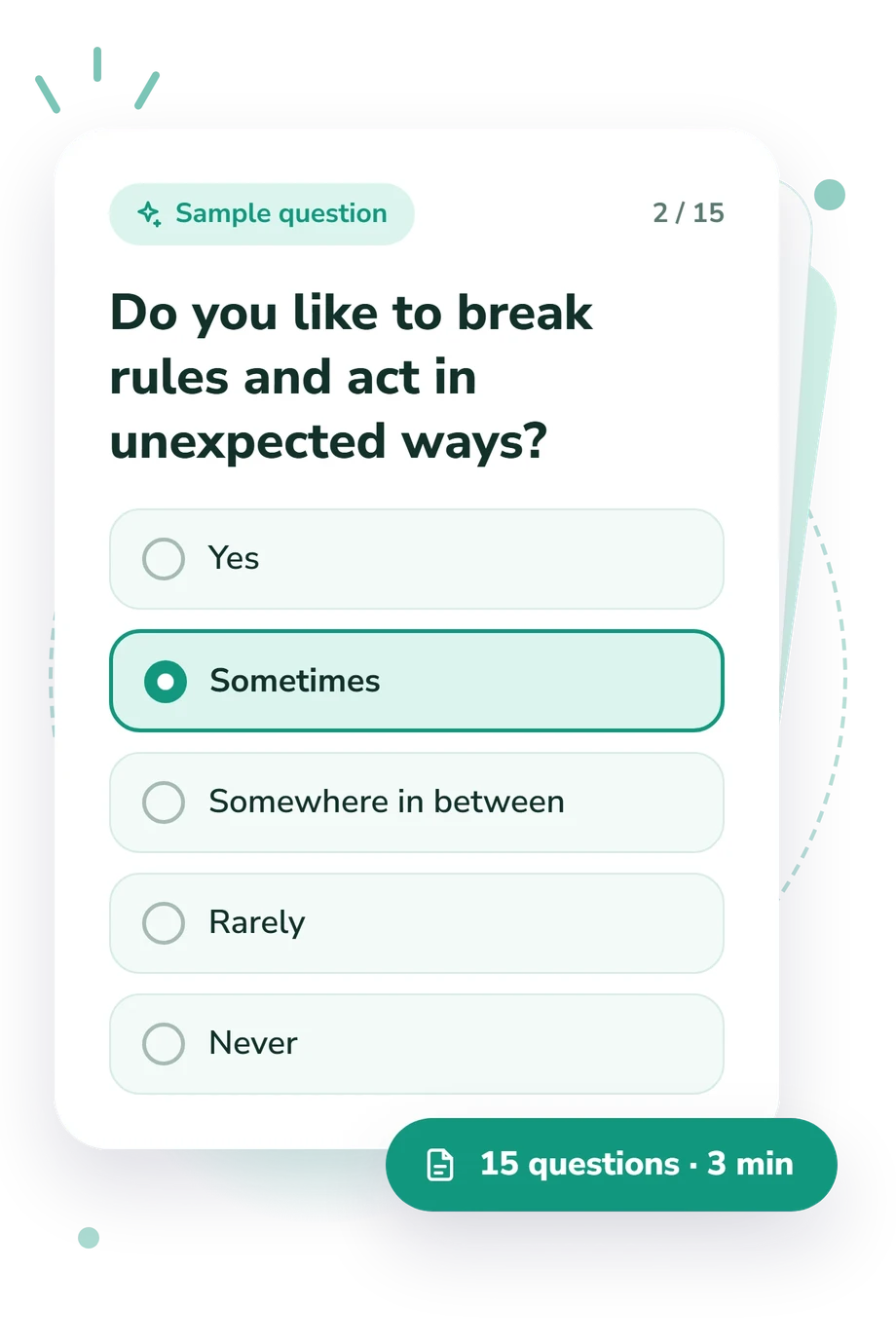
Example Questions From the Test
- Never
- Only if absolutely necessary
- Not sure
- Possibly
- I do this often
- Yes
- Sometimes
- Somewhere in between
- Rarely
- Never
- Under no circumstances
- It is harmful
- Better not
- You can try it
- That is quite normal
Risk-Taking Behavior Assessment Test - Description and methodology of the test
People who want to understand why they pursue danger, excitement, or uncertain outcomes may find the Risk-Taking Behavior Assessment Test useful for structured self-reflection. As a risk propensity test, it is intended for anyone examining personal choices and wanting a clearer picture of motives, impulses, and attitudes toward consequences. The result organizes these tendencies into a profile for more deliberate reflection.
What This Assessment Explores
Across its scenarios, the risk-taking behavior questionnaire examines dangerous choices, motives, excitement, independence, and attention to consequences. Its six displayed dimensions are:
- Risk-Taking Behavior (1-5) measures risky acts: Low 1-2.3; Moderate 2.4-3.6; High 3.7-5.
- Desire for Self-Understanding (1-5) measures identity exploration through risk: Low 1-2; Moderate 3-3; High 4-5.
- Intense Emotions (1-5) measures thrill seeking: Low thrill-seeking 1-2; Moderate thrill-seeking 3-3; High thrill-seeking 4-5.
- Demonstration of Maturity (1-5) measures independence through risk: Low 1-2.3; Moderate 2.4-3.6; High 3.7-5.
- Underestimation of Consequences (1-5) measures overlooked negative outcomes: Mindful of consequences 1-2; Sometimes overlooks consequences 3-3; Often underestimates consequences 4-5.
- Risk Propensity (15-75) measures readiness for risky action: Low 15-36; Moderate 37-56; High 57-75.
Methodology and Scientific Basis
Each item presents five ordered options, moving from rejection or never toward acceptance, frequent action, or positive feeling. Other prompts assess agreement, expected consequences, and judgments about maturity, so the format samples behavior, appraisal, and emotional response.
Responses are combined into dimension scores and an overall profile. Since points assigned to individual answers are not specified, the calculation cannot be reconstructed from the displayed ranges. Higher or lower values should be interpreted through the catalogue’s stated bands, not as universal thresholds; the questionnaire has no stated population norms or standardization.
The closest conceptual reference is Study of Risk Propensity (Avdulova, 2011), with related work by Avdulova, Vitkovskaya, and Ponevazh (2013). Mishra and Lalumière (2011) distinguish self-reported risk propensity from behavioral measures, while Zuckerman’s 1994 sensation-seeking framework addresses novelty and intense stimulation. Conceptually, it is a sensation seeking assessment consistent with those works, not identified as an adaptation of a published instrument. Self-report may vary with honesty, self-awareness, mood, social pressure, and interpretation of hypothetical situations, so the profile describes current tendencies rather than a fixed trait or diagnosis.
- Avdulova, T. P. (2011). Tendency to Take Risks in Adolescence. Psychology of Learning, no. 2, pp. 43-52. EDN NEADOF.
- Avdulova, T. P., Vitkovskaya, E. V., & Ponevazh, E. V. (2013). Risk Behavior in Youth: Deviation or Norm? Clinical Psychology and Special Education, 2(3), pp. 62-73, Article 4.
- Mishra, S., & Lalumière, M. L. (2011). Individual Differences in Risk-Propensity: Associations between Personality and Behavioral Measures of Risk. Personality and Individual Differences, 50(6), pp. 869-873. 10.1016/j.paid.2010.11.037
- Zuckerman, Marvin. (1994). Behavioral Expressions and Biosocial Bases of Sensation Seeking. Cambridge: Cambridge University Press, 463 pp.
Updated: