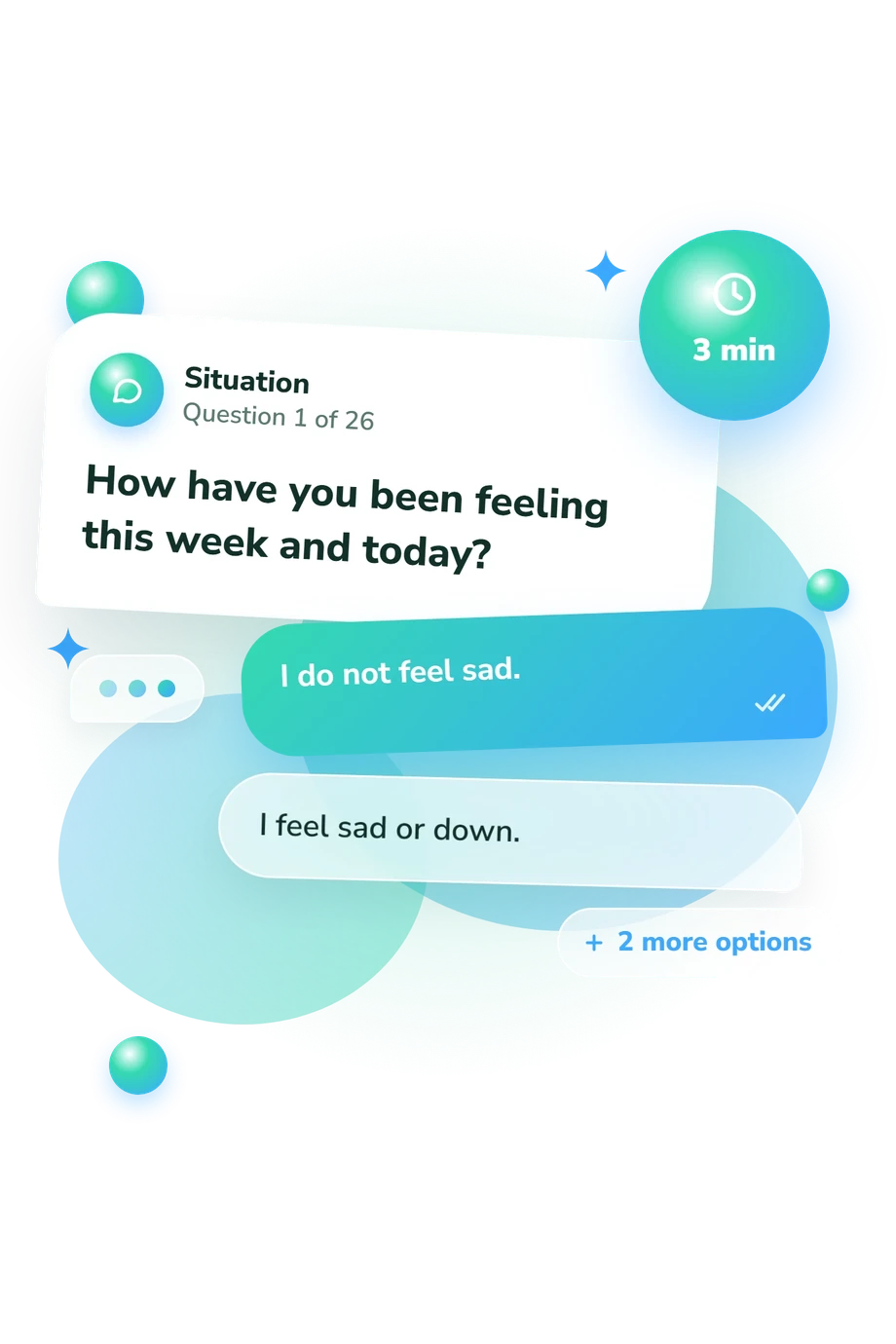
Depression Inventory Test Quiz

Understand a teen's depressive symptoms in just 3 minutes. This beck depression inventory test with 13 items delivers a clear score to help spot concerns early and guide appropriate next steps.
Start Online Test
Questions133 minutes
Hi! My name is Freudly, i am an AI therapist, I will give you an interpretation of the test after you complete it.
08:30
October 2, 2025
October 2, 2025
Material has been updated
22,334 views
2,096 completions
1,003 likes
Verified by Daniel Hall
Psychologist with 25 years of experience
Share
Scale Explorer

How the Scales are Structured

example score
26/39
Beck Depression Inventory for Youth (BDIfY)
Measures the severity of depressive symptoms in adolescents based on self-reported thoughts and feelings.
Satisfactory well-being
Mild to moderate symptoms
Severe symptoms
09Satisfactory well-being1022Mild to moderate symptoms2339Severe symptoms
A score of 26 falls in the Severe symptoms range, indicating a high level of depressive symptom severity compared with typical adolescent responses on this scale.
Start Online Test
just completed the test
DATA-BASED USER COHORTS

Who Usually Takes This Test?

Concerned parents and guardians
41%OF USERS
Parents take it to check whether mood changes, irritability, withdrawal, or sleep issues might point to depression and to decide if professional support is needed.
Teens seeking clarity
34%OF USERS
Teenagers take it privately when they feel persistently sad, unmotivated, overwhelmed, or unlike themselves and want a quick snapshot of how serious it may be.
School counselors and clinicians
25%OF USERS
School psychologists, counselors, and youth clinicians use it as a fast screening tool to guide next steps and decide whether further assessment is warranted.
BASED ON AGGREGATED, ANONYMIZED DATA FROM TENS OF THOUSANDS OF FREUDLY USERS.
Benchmarking

See How You Compare

Once you complete the test, your results are compared with real-world data from people in your country.
Below is a preview of how scores are typically distributed across each scale.
Beck Depression Inventory for Youth (BDIfY)
Average
19.8
Normal range
13.725.8
min.
0
max.
39
Majority
This curve shows how scores are typically distributed.
Once you complete the test, your result will appear on the scale so you can see how you compare.
Featured On
CLEAR ANSWERS TO COMMON QUESTIONS

Frequently Asked Questions

What does a beck depression inventory test measure?
This screening tool assesses depressive symptom severity in adolescents based on self-reported thoughts, feelings, and behaviors. It measures how depression may be affecting mood, motivation, sleep, concentration, and functioning.
How long does it take to complete?
Most adolescents complete the assessment in about 3 minutes. The measure contains 13 items, each with several statements ordered by severity.
How should a teen answer a beck depression inventory test?
For each item, select the statement that best describes how things have been recently. Choose honestly based on actual experience, not what seems right or acceptable. Genuine responses provide the most accurate results.
What do the scores mean?
Scores reflect depression severity. Satisfactory well-being (0-9) suggests minimal depression. Mild to moderate symptoms (10-22) indicate depression is present. Severe symptoms (23-39) suggest significant depression affecting daily functioning.
Can this assessment diagnose depression?
No. This is a screening tool that identifies possible depression severity, not a diagnostic instrument. A mental health professional must conduct comprehensive evaluation to diagnose depression.
What if the score suggests my teen needs help?
Mild to moderate or severe scores suggest professional evaluation is helpful. Schedule an appointment with a mental health professional, school counselor, or physician. The assessment results provide useful information to share.
Should we retake this assessment?
Yes. Periodic reassessment during treatment or therapy allows tracking of whether depression is improving. Regular monitoring with this tool provides objective data about symptom change over time.
WHAT THE TEST MEASURES
About This Assessment
Beck's Depression Inventory for Adolescents Test

This brief self-report measure screens for depressive symptom severity in adolescents. The beck depression inventory test provides a structured snapshot of current mood-related concerns to inform clinical assessment and guide next steps. The instrument includes 13 items and typically takes about 3 minutes to complete. Respondents select statements that best match their recent experiences, yielding a score that reflects symptom burden in context and supports interpretation of depression severity.

Why Take a Beck Depression Inventory Test

Depression in adolescents often goes unrecognized because teens may struggle to articulate their feelings or assume their mood is normal variation. A structured assessment helps clarify whether depressive symptoms are present and how severe they may be. This screening tool provides objective data that supports conversations between teens and trusted adults about whether professional support is needed.

Whether you're a parent noticing mood changes, a teen feeling persistently sad or unmotivated, or a clinician screening for depression, this assessment offers reliable insight. Regular monitoring allows tracking of whether symptoms are improving with intervention or require additional support.

What This Assessment Measures

The measure evaluates depressive symptoms commonly reported by adolescents:

  • Mood—sadness, irritability, hopelessness, and emotional pain
  • Motivation and Energy—loss of interest, motivation, or ability to enjoy activities
  • Sleep and Appetite—changes in sleep patterns, appetite, and eating habits
  • Concentration and Guilt—difficulty focusing, persistent guilt, or self-criticism
  • Suicidal Thoughts—presence of thoughts about harming oneself or ending life

Your score reflects symptom severity from satisfactory well-being through mild, moderate, and severe ranges, providing clear interpretation of depression level.

Who Should Take a Beck Depression Inventory Test

This screening is designed for adolescents and those concerned about a teen's emotional wellbeing. Common users include concerned parents noticing mood changes or withdrawal, teens experiencing persistent sadness or loss of interest, school counselors and clinicians needing rapid screening, and anyone seeking clarity about whether depression may be present. The assessment supports early identification and conversation about next steps.

The tool is particularly valuable for distinguishing normal teenage mood variability from clinical depression and planning appropriate support.

How to Interpret Your Results

Scores range from 0 to 39 across three severity levels. Satisfactory well-being (0-9) suggests the teen is functioning without significant depressive symptoms. Mild to moderate symptoms (10-22) indicate depression is present and may benefit from intervention. Severe symptoms (23-39) suggest depression is significantly affecting functioning and professional support is important.

Your results provide a baseline for discussing concerns with a mental health professional and planning appropriate next steps based on severity.

Using Results for Support Planning

If your score indicates mild to moderate or severe symptoms, schedule an appointment with a mental health professional for comprehensive evaluation. Results support clinical judgment but are not a diagnosis—professional assessment is needed. Share your results with a counselor, therapist, or physician and discuss what level of support may help most.

Retaking the assessment periodically allows you to track whether treatment, therapy, or other interventions are reducing depression symptoms over time.

Safety Considerations

If responses indicate suicidal thoughts or severe distress, professional support is urgent. Reach out to a trusted adult, mental health professional, or crisis line immediately. This assessment is a screening tool designed to identify concerns early, not to replace comprehensive clinical evaluation when serious risk is present.

Author: Author not specified
Test Question Form
You Might Also Like
Beck Depression Inventory (BDI)
This self-report measure evaluates depressive symptom severity over the pas…
Start Test
Adolescent Prosociality Scale
This measure is designed to assess adolescents’ self-reported tendency to e…
Start Test
Popular tests
Narcissistic Personality Inventory (NPI)
This self-report measure is used to assess narcissism as a personality trai…
Start Test
Yale-Brown Obsessive Compulsive Scale (Y-BOCS)
This measure is used to rapidly quantify the current severity of obsessive…
Start Test
CRAFFT Screening Test (CRAFFT 2.1)
This brief screening measure is designed to identify potential alcohol and…
Start Test
Patient Health Questionnaire-9 (PHQ-9)
This measure is commonly used to quickly screen for the presence and severi…
Start Test
Maslach Burnout Inventory (MBI)
This self-report measure is used to assess occupational burnout symptoms in…
Start Test
Adolescent Anxiety Questionnaire
This measure is designed to support a brief appraisal of anxiety symptoms a…
Start Test
Emotional Creativity Inventory (ECI)
This self-report measure assesses individual differences in the originality…
Start Test
Horne–Ostberg Morningness–Eveningness Questionnaire (MEQ)
Circadian preferences influence typical patterns of alertness and sleep tim…
Start Test
Ambivalent Sexism Inventory (ASI)
This measure is designed to assess attitudes toward women, including both o…
Start Test
Internalized Misogyny Scale (IMS)
This measure is designed to assess internalized negative beliefs and stereo…
Start Test
Perceived Stress Scale (PSS-10)
This self-report measure assesses the degree to which individuals appraise…
Start Test
Impulsive Behavior Scale (SUPPS-P)
Impulsivity is a multidimensional construct that is often assessed with bri…
Start Test
Clinical Institute Withdrawal Assessment for Alcohol, Revised (CIWA-Ar)
This rating scale is used to rapidly assess the severity of alcohol withdra…
Start Test
Positive and Negative Affect Schedule (PANAS)
This measure provides a brief self-report assessment of current or typical…
Start Test
Light Triad Scale (LTS)
This self-report measure assesses prosocial personality tendencies and orie…
Start Test
Suicidal Ideation Scale
In clinical settings, the Suicidal Ideation Scale is used to structure an i…
Start Test
Body Dysmorphic Disorder Scale (BDD-D)
This brief self-report measure is designed to screen for and quantify distr…
Start Test
Beck Anxiety Inventory (BAI)
This measure is a brief self-report inventory used to screen for anxiety sy…
Start Test
Differential Test of Perfectionism
This instrument is used to screen for perfectionism-related attitudes and t…
Start Test
Locus of Control Scale
This measure assesses generalized expectancies regarding the degree to whic…
Start Test
New Apathy Scale
This brief self-report measure is used to screen for apathy-related symptom…
Start Test
Perth Alexithymia Questionnaire (PAQ)
This measure assesses individual differences in alexithymia, including diff…
Start Test
Social Intelligence Scale
This brief self-report measure is designed to support rapid screening of in…
Start Test
Fear Test
This measure is designed to evaluate individual differences in fear-related…
Start Test
Neuroticism Level Scale
The measure is intended for brief screening of an individual’s propensity t…
Start Test
Aggressiveness Indicators Screening Questionnaire
This screening tool is designed to quickly identify behavioral indicators a…
Start Test
Comments
Leave a Comment