
Ethnic Affiliation Questionnaire Test
How the Scales are Structured
Who Usually Takes This Test?
See How You Compare
Below is a preview of how scores are typically distributed across each scale.
Example Questions From the Test
- Agree
- Disagree
- Not sure
- Agree
- Disagree
- Not sure
- Agree
- Disagree
- Don't know
Ethnic Affiliation Questionnaire Test - Description and methodology of the test
People who want to understand how cultural belonging fits with personal independence may find the Ethnic Affiliation Questionnaire Test useful for structured self-reflection. It is intended for respondents considering their attitudes toward ethnicity, traditions, group responsibility, and collective interests. An ethnic identity questionnaire of this kind produces two separate affiliative and anti-affiliative tendency scores, each with a displayed level, rather than assigning a fixed identity.
What This Assessment Explores
In practice, the questionnaire examines how a respondent relates to an ethnic community. As an ethnic affiliation test, it addresses customs and ways of life, the need for belonging, links between ethnicity and personal characteristics, and responsibility for actions associated with one’s people.
The questionnaire weighs individual priorities against collective interests. It asks whether personal goals should guide decisions, whether cultural norms should shape conduct, and whether ethnic or religious differences affect mutual understanding.
The dimensions are:
- Anti-Affiliative Tendencies (0-9) reflects individualism, self-opposition toward one’s ethnic group, and orientation toward personal interests; Low 0-3, Moderate 4-6, High 7-9.
- Affiliative Tendencies (0-9) reflects identification with an ethnic group, subordination of personal goals to group goals, and seeing oneself as part of a collective; Low 0-2, Moderate 3-6, High 7-9.
Read separately, the scores indicate the strength of each tendency in the answers.
Methodology and Evidence Base
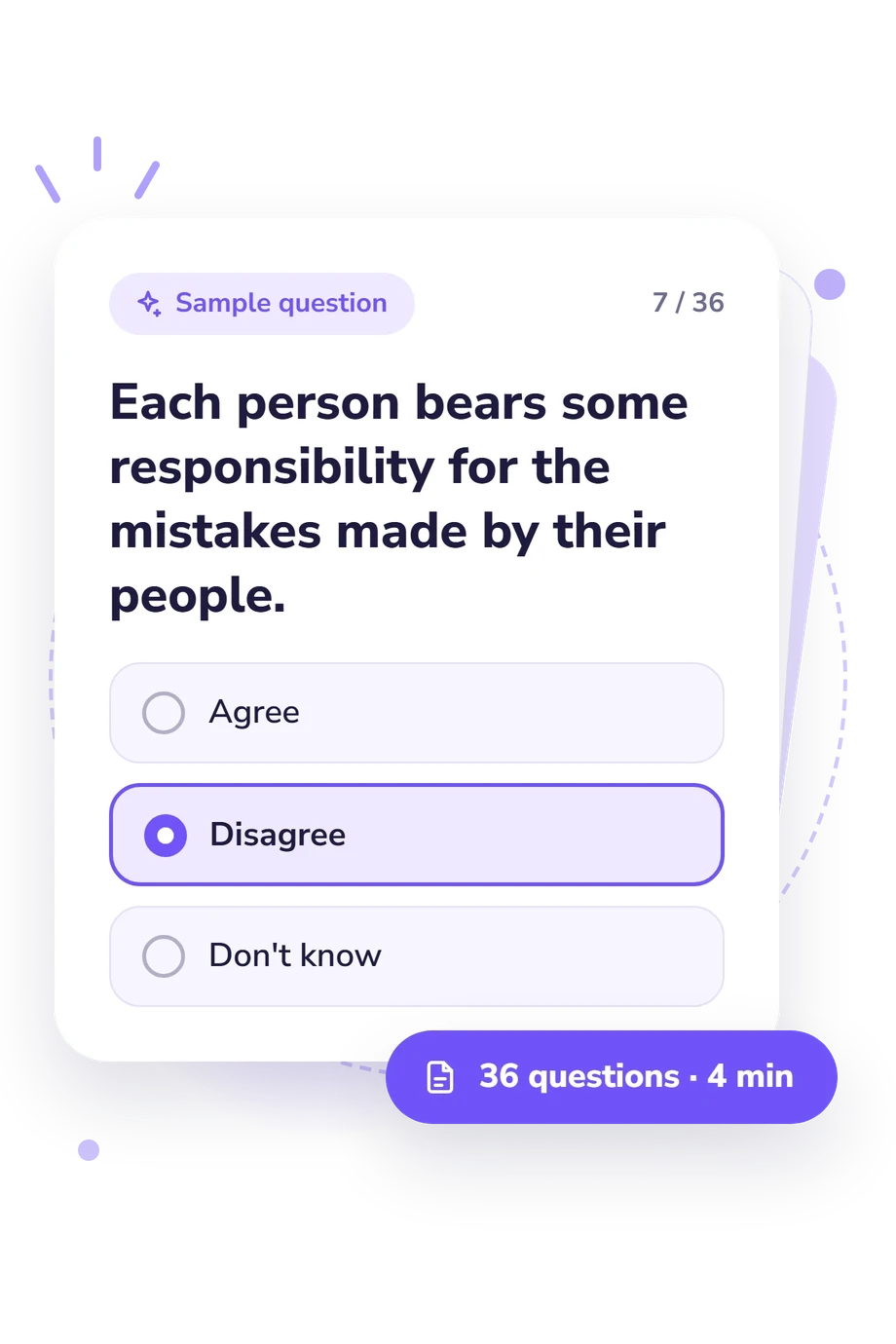
Each item is an opinion statement with three choices: Agree, Disagree, and a third option such as Not sure or Don’t know. Themes include customs, group responsibility, personal judgment, and intergroup understanding, so honest answers matter more than social approval.
The result displays two scale totals, with each total shown in its displayed level band. Higher values indicate a stronger expression of the relevant tendency. No published norms are established for this online version.
The questionnaire is conceptually consistent with Soldatova’s work on interethnic attitudes and Phinney’s account of ethnic identity, without establishing that it is an adaptation of either source. Balyaev and colleagues’ 2024 study provides a student-context example for interpreting ethnic attitudes.
Because the tool is an ethnic identity assessment, it remains sensitive to current circumstances, wording, and self-presentation. Treat the profile as response tendencies rather than a fixed label, because cultural identity may be layered and situational.
- Soldatova, G. U. Psychology of Interethnic Tension. Moscow: Smysl, 1998, 386 pp. ISBN 5-89357-029-4.
- Soldatova, G. U., and L. A. Shaigerova, eds. Psychodiagnostics of Personality Tolerance. Moscow: Smysl, 2008, 172 pp.
- Balyaev, S. I., Garanina, Zh. G., Nikishov, S. N., and Nikishova, I. S. Empirical Assessment of Ethnic Identity and Ethnic Attitudes of the Russian Students: Case Study of Humanities Degree Programmes Taught at National Research Mordovia State University. Integration of Education. 2024;28(2):232-248. 10.15507/1991-9468.115.028.202402.232-248
- Phinney, J. S. Ethnic Identity in Adolescents and Adults: Review of Research. Psychological Bulletin. 1990;108(3):499-514. 10.1037/0033-2909.108.3.499
Updated: