
Self-Assessment of Emotional States Test
How the Scales are Structured
Who Usually Takes This Test?
See How You Compare
Below is a preview of how scores are typically distributed across each scale.
Example Questions From the Test
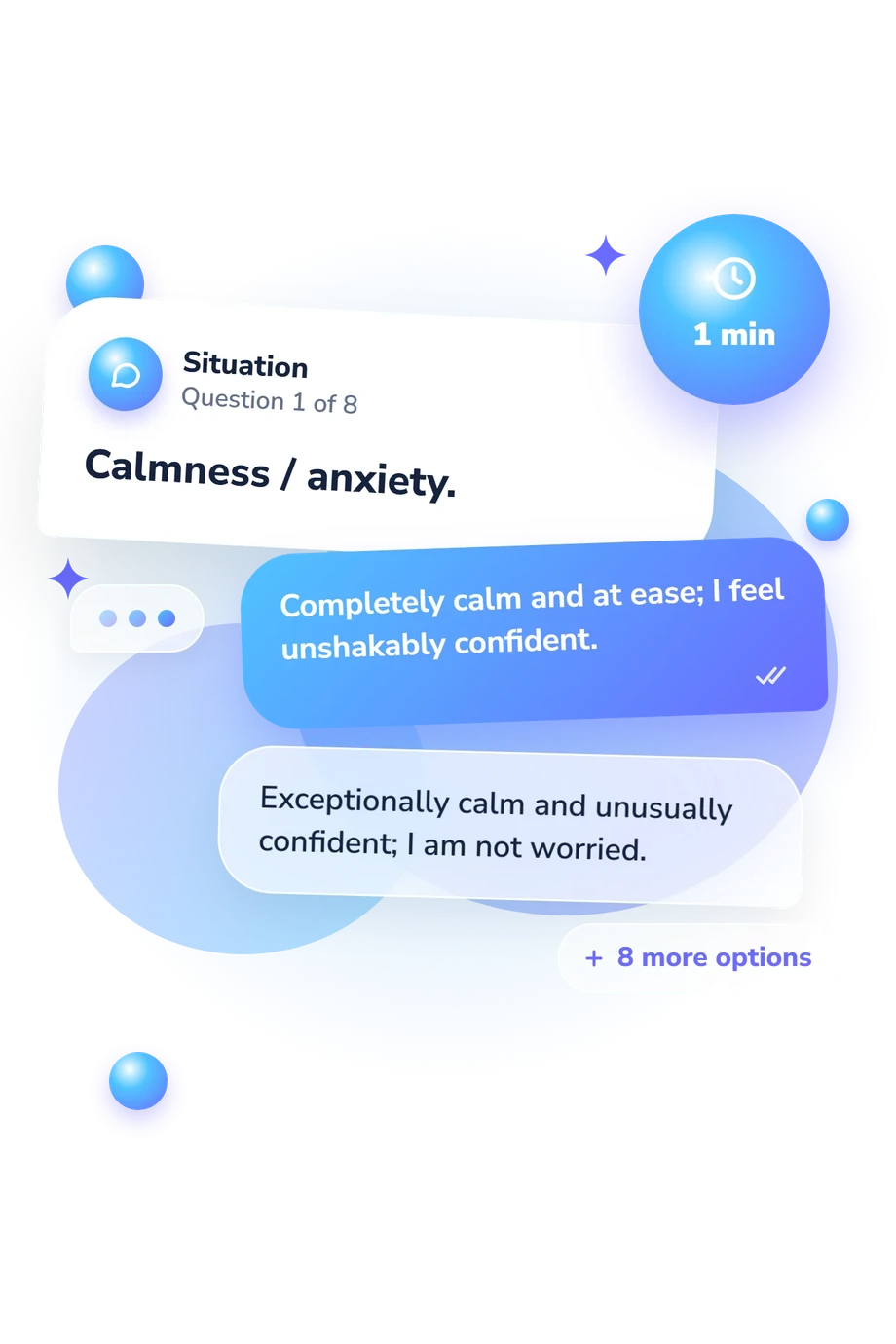
- Complete and total calm. I am unshakably confident.
- Exceptionally calm; unusually confident and not worried.
- A feeling of complete well-being. I am confident and feel at ease.
- Overall, I am confident and free from worry.
- Nothing in particular is bothering me. I feel more or less at ease.
- Somewhat concerned; I feel tense and a little anxious.
- I feel some concern, fear, worry, or uncertainty. I am nervous, tense, and irritable.
- Marked uncertainty. I am deeply distressed by uncertainty. I am afraid.
- Extreme anxiety and worry. I am consumed by fear.
- Completely overwhelmed with fear. I have lost my senses. I am frightened by problems with no solution.
- A surge of energy that feels unstoppable. Vitality is overflowing.
- Overflowing vitality, tremendous energy, and a strong drive to be active.
- A lot of energy and a strong need to be active.
- I feel very refreshed, with a substantial amount of energy in reserve.
- I feel fairly refreshed and moderately energetic.
- Slightly tired. Lazy. Not enough energy.
- Fairly tired. Apathetic (sleepy). Not much energy in reserve.
- Very tired. Sluggish. Limited energy reserves.
- Extremely tired. Almost worn out and practically unable to act. Almost no energy left.
- Completely exhausted. Unable to make even the slightest effort.
- A strong uplift; exuberant cheerfulness.
- I feel very excited and very elevated. Elation.
- I feel excited and in a good mood.
- I feel very well; cheerful.
- I feel fairly well; OK.
- I feel slightly down; so-so.
- My mood is low and somewhat gloomy.
- I feel oppressed and very depressed. My mood is definitely low.
- I feel very oppressed. I feel simply awful.
- Extreme depression and hopelessness. I feel depressed; everything seems black and gray.
Self-Assessment of Emotional States Test - Description and methodology of the test
People seeking a structured way to examine their feelings may find the Self-Assessment of Emotional States Test useful. It is intended for anyone who wants to use the resulting profile to identify which emotional tendency is most prominent and reflect on emotional balance. The profile supports focused reflection and helps the reader decide which area deserves closer attention.
What This Assessment Explores
Four prompts form an emotional self-assessment. Results identify a current state, not a fixed personality trait.
The result categories are:
- Confidence/Helplessness (1-10) shows confidence versus helplessness: Helplessness 1-4, Mixed / neutral 5-6, Confidence 7-10.
- Elevated Mood / Depressed Mood (1-10) indicates mood direction: Lowered mood 1-4, Neutral to slightly elevated 5-6, Elevated mood 7-10.
- Vigor/Fatigue (1-10) reflects vitality and activation: Low energy 1-4, Moderate energy 5-6, High energy 7-10.
- Calmness/Anxiety (1-10) describes calmness versus anxiety: Anxiety elevated 1-4, Moderate / mixed 5-6, Calmness predominant 7-10.
- Total Score (4-40) summarizes the overall response balance; higher totals may indicate a predominance of positive emotions, while lower totals may indicate a predominance of negative emotions: Low 4-14, Moderate 15-25, High 26-40.
Methodology and Scientific Basis
Each item offers ten ordered statements moving from one emotional pole to the other, so the respondent selects the description that best matches the present experience. Scoring reports four dimension scores and a combined total; the displayed bands describe how values are labelled, not how many points any individual statement adds.
The Wessman-Ricks self-assessment procedure (1966) uses bipolar, ordered descriptions to distinguish emotional states such as anxiety, energy, mood, and confidence. Karelin (2007) describes a related procedure for rating emotional states, while Dolgova (2017) examines similar states during an examination period. The four-item online form is conceptually consistent with this work, but its scoring has no reported population standardization.
For interpretation, this self-reflection questionnaire is best read as a snapshot of the state reported at answering. A high or low band shows its direction and relative intensity, while the total summarizes the profile and may conceal contrasts between dimensions. Responses remain sensitive to honesty, self-awareness, and immediate context; the stated bands are not population norms or clinical cutoffs.
- Karelin, Andrey. (2007). Big Encyclopedia of Psychological Tests: Personality, Motivation, Temperament, Intelligence, Leadership, Testing Children, Relationships, Career Guidance, Character. Moscow: Eksmo, pp. 38-39. ISBN 978-5-699-13698-8.
- Wessman, Alden E., and David F. Ricks. (1966). Mood and Personality. New York: Holt, Rinehart and Winston, 317 pp. ISBN 0030541158.
- Dolgova, Valentina Ivanovna. (2017). The Research of Self-Assessment of Emotional States of the Students with Different Levels of Emotional Intelligence During Examination Period. Evidence-Based Education Studies, no. 3, pp. 54-59. 10.18323/2221-5662-2017-3-54-59.
Updated: