
Tendency to Re-Experience Emotional Experiences Test
How the Scales are Structured
Who Usually Takes This Test?
See How You Compare
Below is a preview of how scores are typically distributed across each scale.
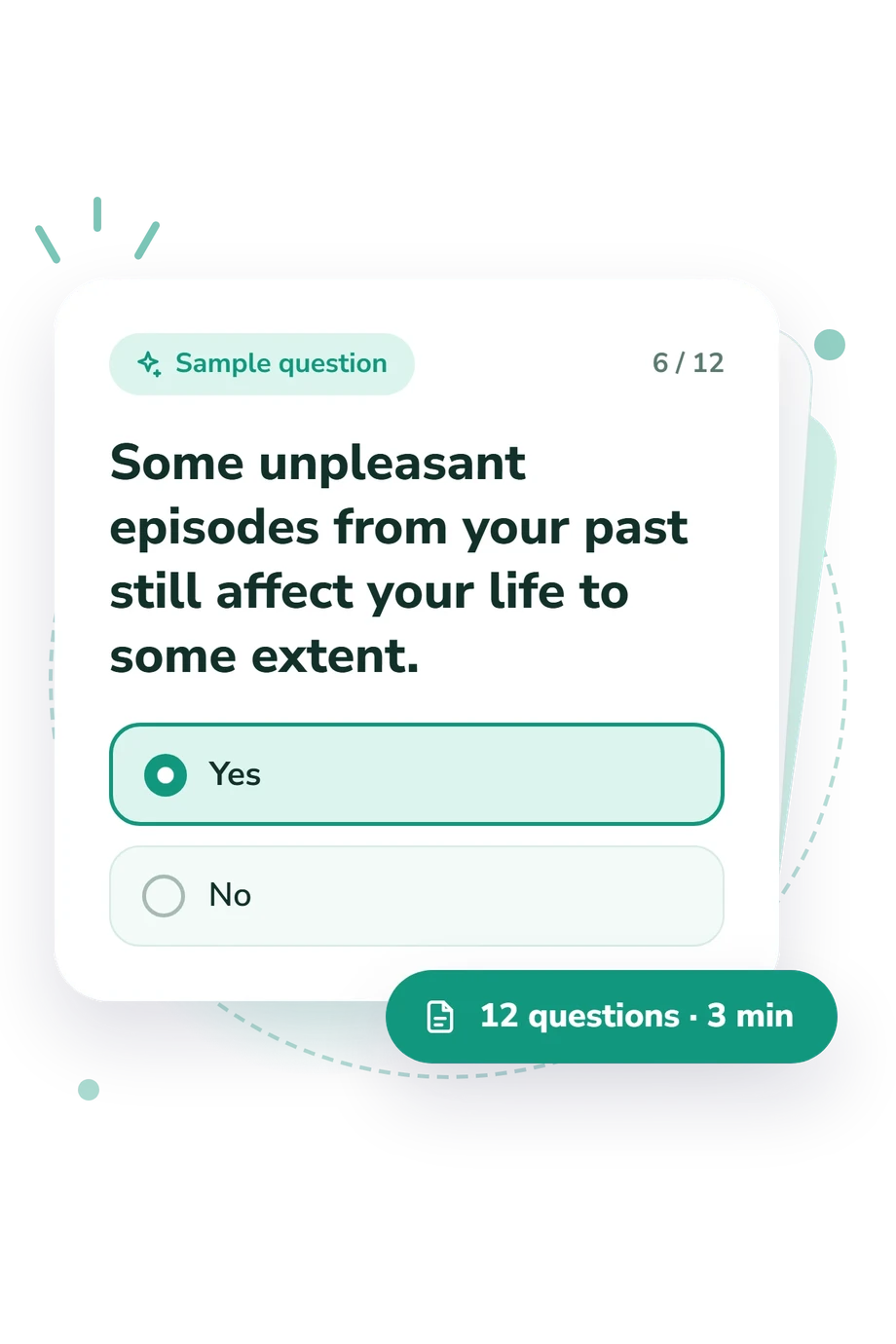
Example Questions From the Test
- Yes
- No
- Yes
- No
- Yes
- No
Tendency to Re-Experience Emotional Experiences Test - Description and methodology of the test
Readers who notice lingering emotional effects and want a structured way to examine them can use this assessment as a starting point. The Tendency to Re-Experience Emotional Experiences Test is intended for people deciding whether their experiences warrant closer reflection, rather than asking them to interpret every reaction alone. This emotional re-experiencing test focuses on involuntary returns to distressing experiences, helping the result answer a practical self-reflection question.
What the Questionnaire Measures
Negative experiences can return through memories, feelings, reminders, and reactions. Readers who notice earlier distress coloring present situations can consider whether re-experiencing distressing memories is part of that pattern.
The displayed scale is Tendency to Re-Experience Unprocessed Emotional Experiences (0-12). It measures involuntary return to distressing memories; higher scores indicate more frequent recurrence that may affect well-being and functioning. Bands are Low 0-4, Moderate 5-9, and High 10-12. This is one broad tendency, not separate relationship, mood, or planning scores.
These situations may reveal or trigger the same tendency:
- Media, bodily cues, or random events are reminders that may revive unpleasant feelings or memories.
- Emotional residue describes how past episodes may still influence mood, irritation, and daily reactions.
- Relational and future caution are contexts where disappointments may bring the same distress back, affecting trust, disclosure, goals, or expectations.
Methodology and Evidence Base
All 12 items use Yes/No responses about reminders, painful memories, interpersonal experiences, irritability, caution, and the continuing effect of earlier episodes. The format records self-perceived patterns rather than observed behavior or a clinical interview.
Answers are combined into the displayed score and read through the stated bands. Because no item-by-item weighting rule is given, points assigned to individual responses should not be inferred from the range.
The content is conceptually consistent with the Ruminative Responses Scale, which examines repetitive negative thinking, but this questionnaire is not presented as an adaptation of that instrument. Nolen-Hoeksema, Wisco, and Lyubomirsky offer a broader rumination framework; Foa and Kozak describe emotional reactivation and corrective processing; and Gross connects recurring distress with emotion-regulation theory.
These works provide conceptual context only; they do not validate this online questionnaire or establish norms for its displayed scale. Current mood, memory accuracy, self-awareness, and willingness to disclose can affect answers, so the result is best read as a structured self-reflection profile.
- Treynor, W., Gonzalez, R., & Nolen-Hoeksema, S. (2003). Rumination reconsidered: A psychometric analysis. Cognitive Therapy and Research, 27(3), 247-259. 10.1023/A:1023910315561
- Nolen-Hoeksema, S., Wisco, B. E., & Lyubomirsky, S. (2008). Rethinking rumination. Perspectives on Psychological Science, 3(5), 400-424. 10.1111/j.1745-6924.2008.00088.x
- Foa, E. B., & Kozak, M. J. (1986). Emotional processing of fear: Exposure to corrective information. Psychological Bulletin, 99(1), 20-35. 10.1037/0033-2909.99.1.20
- Gross, J. J. (2007). Emotion regulation: Conceptual and empirical foundations. In J. J. Gross (Ed.), Handbook of Emotion Regulation (pp. 3-24). Guilford Press.
Updated: